Introduction: Minimum Standard of Living
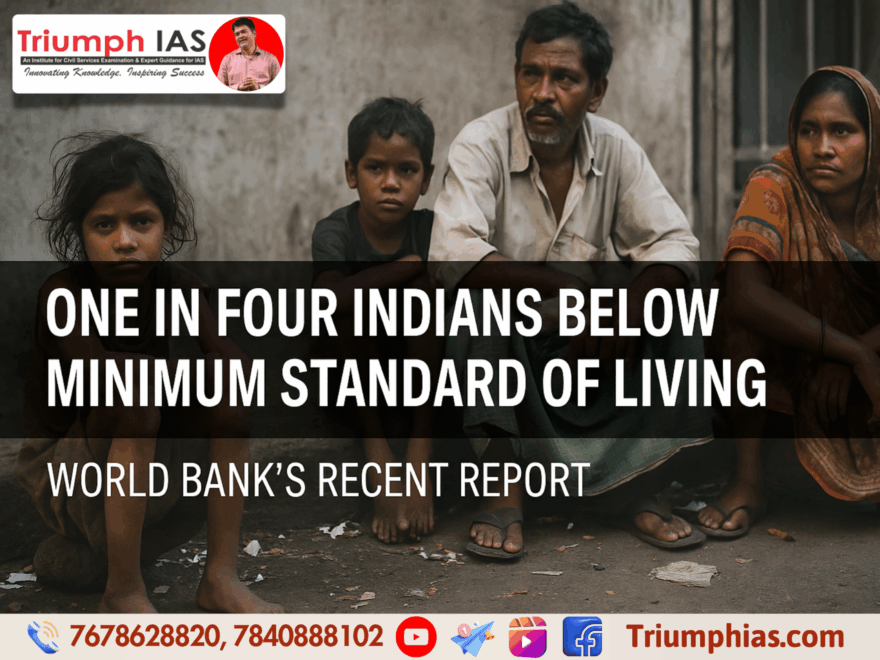
Despite significant progress in reducing extreme poverty, the latest World Bank report (2024) reveals a sobering reality: nearly one in four Indians—over 35 crore people—still live below the minimum standard of living. While India has seen a sharp decline in those surviving on less than $3 a day, many continue to fall short of meeting basic human needs. This shift in measurement—from extreme poverty to a more development-appropriate benchmark of $4.20 per day—reframes the poverty debate. In this blog, we critically analyze the World Bank’s findings through a sociological lens, examining the implications for social inequality, class stratification, urban-rural divides, and multidimensional poverty in India.
Key Findings of the World Bank Report
- Only 5% of Indians live in extreme poverty (less than $3/day PPP).
- However, 25% of Indians—over 35 crore people—live below $4.20/day, the new lower-middle-income poverty line.
- The shift from $3 to $4.20 reflects India’s rising development status and higher cost of basic living.
- Multidimensional Poverty Index (MPI) has improved: from 29% in 2013 to 11.3% in 2022.
- Gini Index (a measure of inequality) remains worrying: Top 1% own over 40% of India’s wealth, while bottom 50% own just 6.4%.
From Extreme Poverty to Minimum Standards: Why $4.20 Matters
The World Bank’s redefinition is not merely a statistical update but a recalibration of social expectations. A minimum standard of living today must include:
- Nutritious food
- Safe housing
- Access to healthcare
- Quality education
- Digital and electricity access
- Social dignity
The $4.20/day benchmark recognizes that economic growth alone is insufficient unless accompanied by inclusive welfare.
Dimensions of Poverty in India
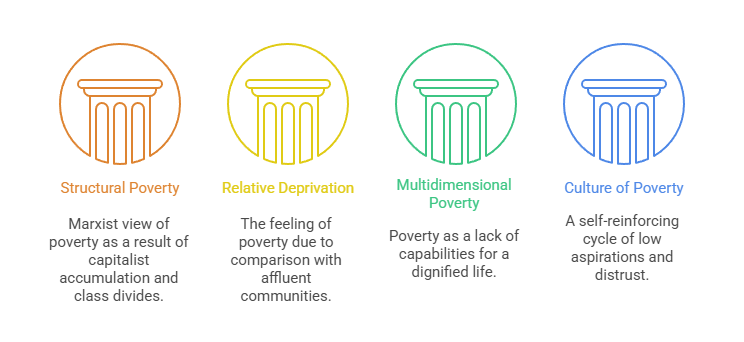
- Poverty as a Structural Condition – Marxist theory sees poverty as a consequence of capitalist accumulation. In India, economic liberalization (post-1991) accelerated growth but also widened class divides, leaving the bottom quartile vulnerable to labor exploitation, job insecurity, and lack of bargaining power.
- Relative Deprivation – Even when absolute poverty reduces, relative deprivation persists. Urban poor often live adjacent to affluent communities, intensifying feelings of exclusion and alienation. One can earn more than before and still feel poor if social comparison shows persistent inequality.
- Multidimensional Poverty and Capability Approach – Amartya Sen argued that poverty is more than income deprivation—it’s about the capability to lead a dignified life. Indicators such as malnutrition, school dropout, gendered access to toilets, or lack of mobility are crucial to understanding poverty holistically.
- The Culture of Poverty- Oscar Lewis would argue that chronic poverty can generate a cultural system characterized by low aspirations, fatalism, and distrust in formal institutions. This “culture” becomes self-reinforcing unless systemic interventions break the cycle.
Sociological Analysis:
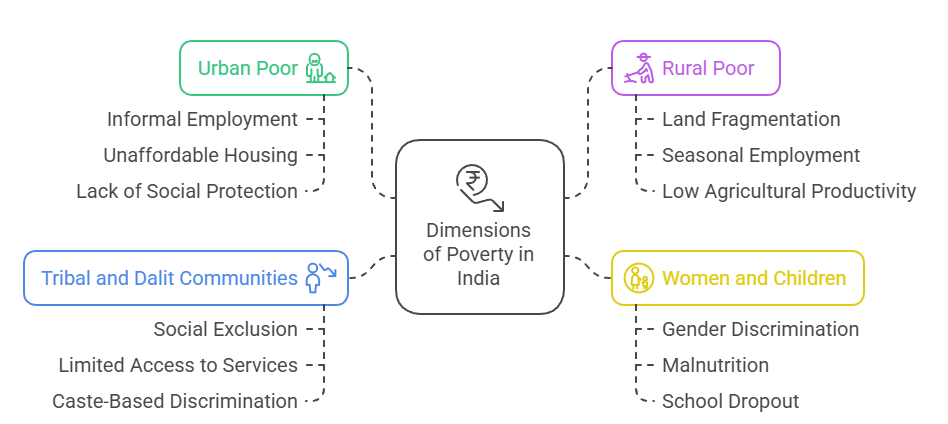
- Urban Poor: Urban poverty in India is marked by informal employment, unaffordable housing, and lack of social protection. Daily-wage laborers, street vendors, and gig workers often live in overcrowded slums with inadequate access to water, sanitation, or healthcare. Despite residing in cities of opportunity, they are excluded from secure jobs and formal social safety nets. High cost of living and job precarity keep them perpetually on the edge of poverty.
- Rural Poor: Rural India continues to grapple with poverty due to land fragmentation, seasonal employment, low agricultural productivity, and inadequate access to public services. The lack of diversified livelihoods forces people to migrate, often into precarious work. Despite schemes like MGNREGA, the rural poor remain dependent on informal arrangements and are vulnerable to climate shocks, market fluctuations, and debt traps.
- Women and Children: Poverty is feminized in India, with women often earning less, working in informal sectors, and shouldering unpaid care responsibilities. Gender discrimination in wages, education, and nutrition deepens their economic vulnerability. Children in poor families face high rates of malnutrition, school dropout, and child labor. This leads to intergenerational poverty and entrenched inequality.
- Tribal and Dalit Communities: Scheduled Tribes and Dalits face systemic social exclusion that intersects with economic deprivation. They often live in geographically isolated or resource-poor areas with limited access to education, healthcare, and employment. Caste-based discrimination in schools and workplaces continues to marginalize Dalit youth. Structural inequality, not just economic disadvantage, shapes their persistent vulnerability.
Critique of India’s Poverty Measurement Practices
- India still uses the outdated Tendulkar poverty line (Rs. 33/day in urban areas) for official estimates.
- Shift to Modified Mixed Recall Period (MMRP) improved consumption data, but also made poverty figures look deceptively low.
- Lack of timely, transparent, and disaggregated data undermines policy responses.
- Heavy reliance on global indices like MPI or WB thresholds shows institutional reluctance to redefine national poverty lines.
Inequality: The Other Face of Poverty
Even if poverty reduces, rising inequality undermines development:
- Top 1% own 40%+ of national wealth (Oxfam India, 2024).
- Bottom 50% own only 6.4%, reflecting wealth concentration and power asymmetry.
- Gini coefficient has improved slightly (from 28.8 to 25.5), but income distribution remains skewed.
This calls into question the inclusiveness of growth and exposes the failure of trickle-down economics.
Policy Implications:
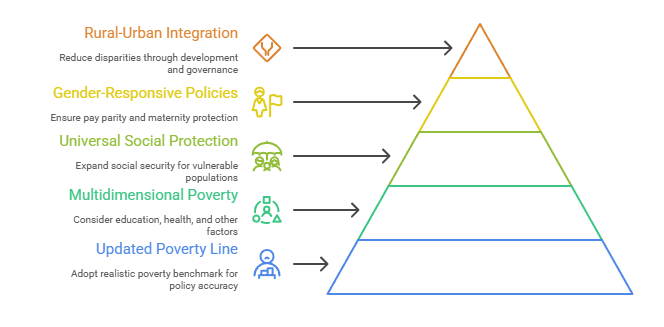
- Update India’s National Poverty Line: India must move beyond outdated poverty thresholds like the Rs. 33/day urban line and adopt a more realistic benchmark in line with its development status. The $4.20/day lower-middle-income threshold used by the World Bank provides a more accurate reflection of what it takes to live with dignity today. Updating this metric is crucial for designing better-targeted social welfare policies.
- Focus on Multidimensional Poverty: Poverty should not be seen only through the lens of income. A multidimensional approach—considering education, health, sanitation, electricity, housing, and nutrition—offers a holistic understanding. Strengthening the use of MPI (Multidimensional Poverty Index) can help the government identify real deprivation and prioritize interventions in lagging districts.
- Universal Social Protection: India needs to expand the reach and efficiency of social protection systems. Many workers in the unorganized sector still lack access to pensions, maternity benefits, health insurance, or job security. Building a universal social security net with minimal exclusion errors is key to insulating vulnerable populations from economic shocks.
- Gender-Responsive Policies: Policy frameworks must be gender-sensitive. This includes not just increasing women’s participation in the workforce, but also ensuring pay parity, maternity protection, and access to credit and property rights. Programs must recognize and reduce women’s unpaid labor burden through childcare support and time-saving public infrastructure.
- Rural-Urban Integration: Addressing poverty requires reducing rural-urban disparities. Rural development must focus on agriculture, skill development, and non-farm employment. Urban poverty needs to be addressed through rental housing, affordable healthcare, and regularization of informal labor. Strengthening local governance—both panchayats and urban local bodies—will ensure better service delivery and accountability.
Relevant Government Schemes and Their Role
| Scheme |
Objective |
| MGNREGA |
Provides rural employment and income security |
| PMAY |
Affordable housing for all |
| PM-POSHAN (Midday Meal) |
Nutritional support for school children |
| Ayushman Bharat |
Health coverage for vulnerable populations |
| NSAP |
Social pensions for widows, elderly, and disabled |
Conclusion
India’s poverty narrative has evolved. It’s no longer about just lifting people above a survival threshold; it’s about ensuring a life of dignity, security, and opportunity. The World Bank’s shift to the $4.20 benchmark is not a criticism, but a call for rethinking development priorities. From sociology’s lens, addressing poverty must go beyond GDP growth—it requires structural change, inclusive policy, and cultural transformation. Until every Indian has the opportunity to live a dignified life—not just survive—India’s development story remains unfinished.
Previous Year Questions
Paper I –
- Critically evaluate the relevance of the concept of relative deprivation in studying poverty and inequality. (2023)
- Examine the relationship between globalization and growing inequality in developing nations. (2021)
- How does the process of social mobility affect social stratification in a capitalist society? (2020)
- Discuss Amartya Sen’s capability approach to understanding poverty and development. (2019)
- Evaluate the relationship between poverty and social exclusion. (2018)
- What are the structural causes of poverty in developing countries? Explain using relevant sociological theories. (2017)
- Explain the Marxian notion of alienation. How is it relevant in understanding poverty and inequality today? (2016)
- Discuss the functionalist view of social stratification and its limitations in explaining contemporary poverty. (2015)
- Explain the significance of Max Weber’s multidimensional view of social stratification in the context of developing societies. (2015)
- What are the basic tenets of the conflict perspective in sociology? How does it explain persistent inequality? (2014)
Paper II –
- Evaluate the effectiveness of the Multidimensional Poverty Index (MPI) in capturing real poverty in India. (2023)
- Critically examine the role of poverty alleviation programmes in India. (2021)
- What are the implications of the informalization of labor for poverty and inequality in urban India? (2020)
- Discuss the multidimensional nature of poverty in India. How can it be tackled through targeted interventions? (2019)
- How does the Indian state address the issue of poverty through social welfare measures? Critically evaluate. (2018)
- Discuss the challenges of defining poverty in India in the context of changing consumption patterns and rising inequality. (2017)
- What are the causes of persistent poverty among Scheduled Castes and Tribes in India? Suggest policy measures. (2016)
- Examine how the rural-urban divide contributes to social inequality in India. (2015)
- Discuss the impact of globalization on poverty and employment in India. (2014)
|