

Honour Killing: A Sociological Analysis with the Radhika Yadav Case
(Relevant for Sociology Paper I: Stratification and Mobility; Systems of Kinship and Sociology Paper II: Systems of Kinship in India; Challenges of Social Transformation)
Introduction“Honour killing”—the murder of a family member, usually by male relatives, perceived to have brought dishonour on the family—is a tragic manifestation of patriarchal power, caste control, and gender norms. Across South Asia, honour-based violence is alarmingly persistent, informed by customs, caste hierarchies, and deep-rooted beliefs around purity and family image. This blog delves into the concept, relevant sociological frameworks, and contemporary context, centered around the shocking case of Radhika Yadav, a 25-year-old tennis player in Gurugram, whose own father is accused of fatally shooting her recently. What Is Honour Killing?As per Human Rights Watch, honour killings are “acts of violence, usually murder, committed by male family members against female family members who are perceived to have brought dishonour upon the family”. Key Sociological Characteristics:
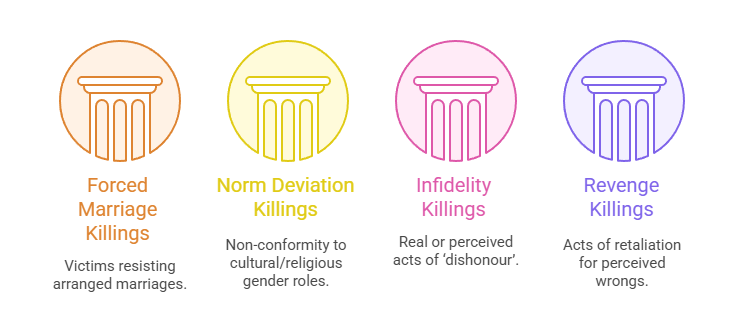
Types of honour killings:
Patriarchy, Caste and Honour Killing
EXAMPLE:
The Radhika Yadav Case: A Contemporary Honour KillingRadhika Yadav, a 25-year-old tennis player from Gurugram, was allegedly shot dead by her father, Deepak Yadav, on July 10, 2025. A rising athlete and coach, Radhika had built a public profile through her tennis career and social media presence. Reports suggest that her father disapproved of her lifestyle, particularly her Instagram activity and growing independence, which he viewed as a threat to family honour. The autopsy revealed four bullets to her chest, contradicting the FIR’s claim of three shots from behind, raising suspicions about premeditation. The motive appears rooted in a toxic mix of patriarchal insecurity, digital surveillance, and familial control. While not driven by caste or inter-caste marriage, this case still fits the broader sociological framework of honour killing, where patriarchal values are violently enforced under the guise of protecting family reputation. Sociological Analysis
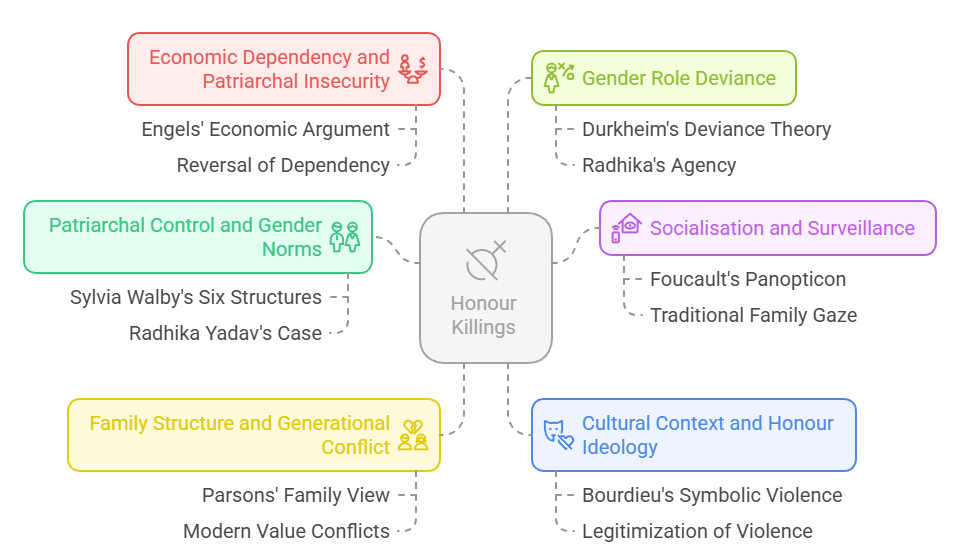
1. Patriarchal Control and Gender Norms In her seminal work “Theorizing Patriarchy”, Sylvia Walby outlined six structures of patriarchy, one of which is patriarchal relations in the household, where men exert control over women’s mobility, autonomy, and sexuality. In Radhika Yadav’s case, her father exercised patriarchal authority by objecting to her independence and public presence on social media. 2. Socialisation and Surveillance Foucault’s idea of the “Panopticon” (from Discipline and Punish) can be applied here. Social media becomes a digital panopticon where women are constantly watched and judged. In traditional families, this gaze is replicated through patriarchs who “monitor” and control female behavior under the pretext of honour. 3. Family Structure and Generational Conflict Parsons viewed the family as a unit of primary socialisation and personality stabilisation. However, in modern settings, intergenerational value conflict arises when youth, especially women, assert individualism and autonomy—traits not aligned with the father’s traditional values. This leads to dysfunction within the family. 4. Cultural Context and Honour Ideology Bourdieu’s concept of “Symbolic Violence” is pertinent here. Honour killings, though violent, are often legitimized as “necessary” by the perpetrators and society to preserve the symbolic capital of family honour. This violence is subtle in justification but brutal in reality. 5. Economic Dependency and Patriarchal Insecurity In “The Origin of the Family, Private Property and the State”, Engels argued that patriarchy emerged from men’s control over property and economic power. In Radhika’s case, a reversal of economic dependence—where the daughter supported the father—threatened the traditional patriarchal order. 6. Gender Role Deviance According to Durkheim, deviance is a normal and necessary part of social life. Radhika’s assertion of agency (via career, social media, financial independence) can be seen as deviance from traditional gender norms, which disrupted the collective conscience of the patriarchal family unit. Comparing with Traditional Honour KillingsUnlike caste-based killings over marriage choices, the Radhika case is rooted in social media, digital autonomy, and paternal insecurity. While the trigger differs, the underlying mechanisms of patriarchal surveillance and extreme control remain the same. Preventive & Legal Measures
ConclusionThe Radhika Yadav case is a horrifying reminder that honour-based violence transcends caste and sexual norms—it adapts to control modern female autonomy. Sociologically, it underscores the interconnectedness of patriarchy, socialisation, deviance, and cultural norms. It provides a rich case study to examine honour killing within family structures, gender inequality, caste dimensions, legal frameworks, and current societal debates around digital autonomy. It invites critical reflection on societal change, policy reforms, and the shifting terrain of patriarchal violence. PYQsPaper I
Paper II
|


To Read more topics, visit: www.triumphias.com/blogs
One comment