Introduction
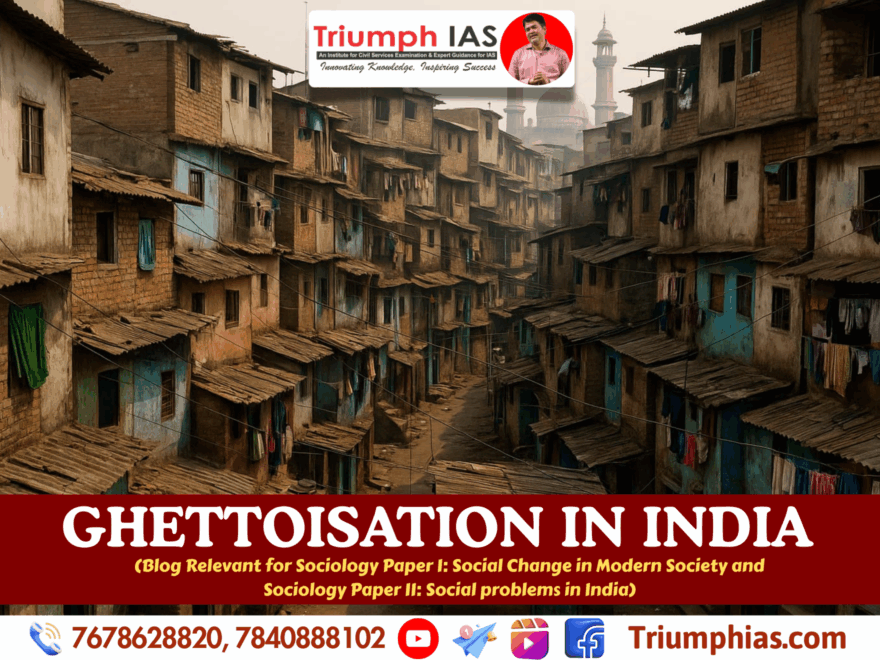
Ghettoisation is the process of social, economic, and spatial segregation, where certain communities—especially religious minorities, Dalits, tribal groups, or economically backward classes—are compelled to live in specific, often marginalized, areas of a city or region. This process is usually not voluntary but a response to discrimination, exclusion, fear, and socio-political marginalization.
In India, ghettoisation has become increasingly prominent due to urban development patterns, communal violence, caste discrimination, and institutional bias in housing, education, and employment.
What is Ghettoisation?
The term “ghetto” originated in 16th-century Venice, referring to designated areas where Jews were forced to live. Over time, it has evolved to mean any area of spatial confinement where a particular group resides due to social pressure or structural exclusion.
Ghettoisation is a multidimensional process
- Spatial (geographic confinement)
- Economic (limited livelihood options)
- Cultural (homogenized community life)
- Political (under-representation and neglect)
Sociological Analysis
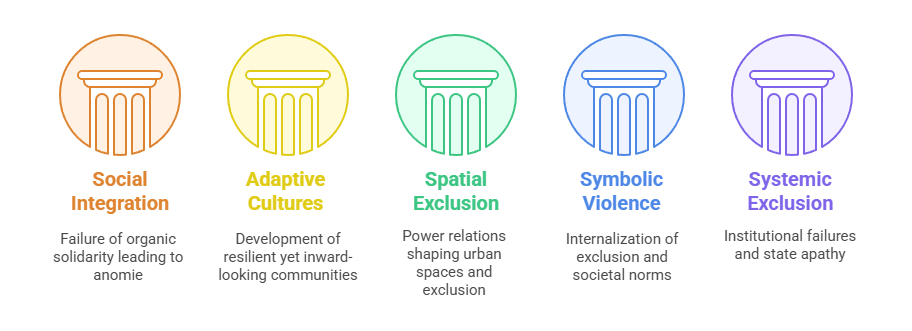
- Social Solidarity and Anomie: Emile Durkheim emphasized the importance of social integration. Ghettoisation indicates a failure of organic solidarity, leading to anomie, where marginalized groups are cut off from mainstream social networks and support systems.
- Urban Villagers: According to Herbert Gans, marginalized communities develop adaptive cultures within ghettos. These are resilient yet inward-looking, which often limits broader social mobility.
- Space, Power, and Exclusion: Manuel Castells argued that urban spaces are shaped by power relations. Ghettoisation reflects spatial exclusion as a manifestation of class conflict and control over urban planning.
- Habitus and Symbolic Violence: In ghettoised settings, residents internalize a “habitus” that shapes their worldviews, aspirations, and behaviors. Ghettoisation becomes a form of symbolic violence, reinforcing the idea that they do not belong to mainstream society.
- Beyond the Physical Space: Ghettoisation is not just about living in a particular space, but about systemic exclusion. It reflects:
- Institutional failures (biased education, policing, health systems)
- State apathy (selective development and welfare)
- Dominant cultural hegemony (where minorities are blamed for their own condition)
As Zygmunt Bauman notes, ghettos are “dumping grounds of modernity,” where undesirable populations are made invisible yet kept under control.
Characteristics of Ghettoised Areas
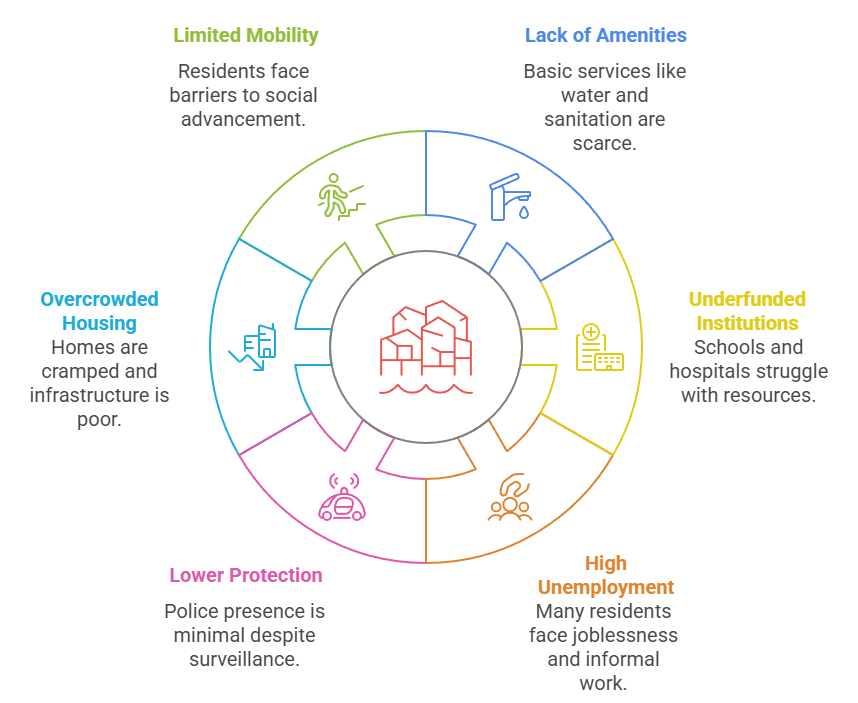
- Lack of civic amenities (water, sanitation, roads)
- Underfunded schools and hospitals
- High unemployment and informal work
- Lower police protection but higher surveillance
- Overcrowded housing and poor infrastructure
- High dropout rates and limited social mobility
Causes of Ghettoisation in Indian Context
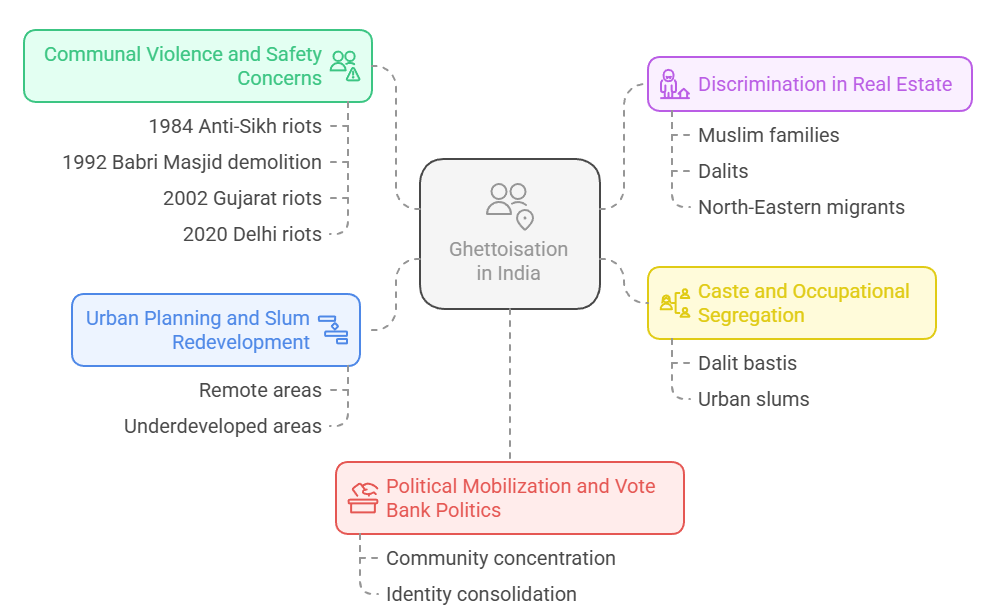
- Communal Violence and Safety Concerns: After riots or religious conflicts, many families belonging to minority communities choose to relocate for safety. This has been evident after:
- 1984 Anti-Sikh riots (Delhi)
- 1992 Babri Masjid demolition
- 2002 Gujarat riots (leading to the creation of Juhapura, Ahmedabad)
- 2020 Delhi riots
- Discrimination in Real Estate: Many Muslim families, Dalits, and North-Eastern migrants face rejections when applying for housing in “mainstream” societies, forcing them to cluster in homogenous localities.
- Caste and Occupational Segregation: In villages and cities alike, Dalits often reside in separate bastis, reflecting centuries-old untouchability and ritual exclusion. This segregation continues in urban slums.
- Urban Planning and Slum Redevelopment: Resettlement schemes for slum clearance often relocate the poor to remote and underdeveloped areas, creating economic ghettos disconnected from public services.
- Political Mobilization and Vote Bank Politics: Politicians sometimes encourage the concentration of communities in particular areas for electoral convenience, leading to identity consolidation and geographic polarization.
Case Studies
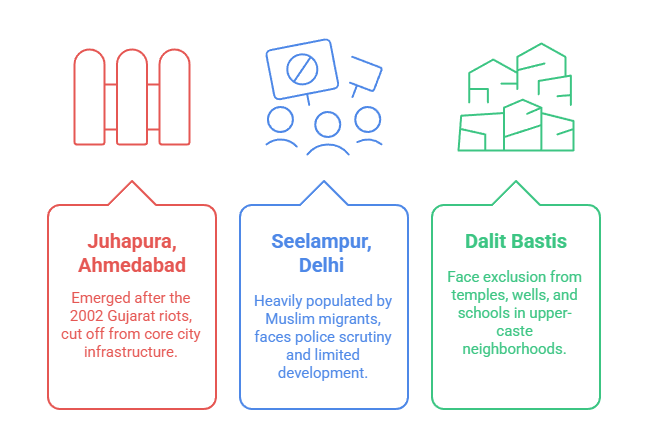
- Juhapura, Ahmedabad: Known as the “largest Muslim ghetto” in India, it emerged after the 2002 Gujarat riots. While once neglected, it now has pockets of affluence but remains cut off from core city infrastructure.
- Seelampur, Delhi: Heavily populated by Muslim migrants, Seelampur is often in the news during anti-CAA protests. It faces regular police scrutiny and limited government development.
- Dalit Bastis in UP and Bihar: Despite constitutional safeguards, many Dalit settlements continue to face exclusion from temples, wells, and schools in upper-caste neighborhoods.
Consequences of Ghettoisation
- Educational Marginalization: Low-quality schools, absence of libraries, and little interaction with wider society contribute to a vicious cycle of educational backwardness.
- Health Disparities: Ghetto areas are often not covered adequately by municipal health infrastructure, leading to higher disease burden and maternal and infant mortality.
- Limited Employment Opportunities: Due to distance from industrial hubs and stigma, youth often enter low-paying informal work, reinforcing economic dependence and frustration.
- Cultural Isolation and Stereotyping: Communities are seen through the lens of crime, religious orthodoxy, or backwardness, as seen in media portrayal of Muslims or Dalits in ghettos.
Way Forward
- Inclusive Urban Planning: Implement zoning laws that promote mixed housing, subsidized accommodation for minorities, and anti-discrimination audits in real estate.
- Anti-Discrimination Legislation: Enforce stricter laws against housing bias, akin to the Fair Housing Act in the USA, to prevent prejudice in renting or selling properties.
- Community-Based Development: Involve local communities in urban governance through Mohalla Sabhas, Resident Welfare Associations, and NGOs to address grievances.
- Representation in Local Governance: Promote political participation from marginalized areas through urban reservation policies and grassroots leadership training.
- Educational and Cultural Integration: Encourage inter-community schools, inclusive festivals, and youth programs to bridge the gap between ghettos and the mainstream.
Conclusion:
Ghettoisation is not just a spatial issue—it reflects deep-rooted inequalities, systemic apathy, and social fractures. To address it, we must move from token inclusivity to transformative justice, where every Indian—regardless of caste, religion, or class—has equal access to the city, its resources, and its promise.
In the words of Dr. B.R. Ambedkar, “Justice is not just about removing disabilities, but about creating abilities.”
PYQs –
Paper 1
- “How does space reproduce social inequality in urban settings?”(2020)
- “Urban communities show both integration and fragmentation. Comment.”(2017)
- “How does social stratification affect urban mobility and access to resources?”(2014)
Paper 2
- “Discuss the causes and consequences of ghettoisation of Muslims in urban India.”(2020)
- “Critically analyze the role of state policy in creating slums and resettlement colonies in metropolitan cities.”(2019)
- “Explain how caste and religion intersect with urban poverty and residential segregation.”(2018)
- “Muslim ghettos in India reflect deeper issues of marginalization and security. Comment.”(2016)
- “Analyze the process of social exclusion in the context of urban housing and employment.”(2015)
|


One comment