Introduction
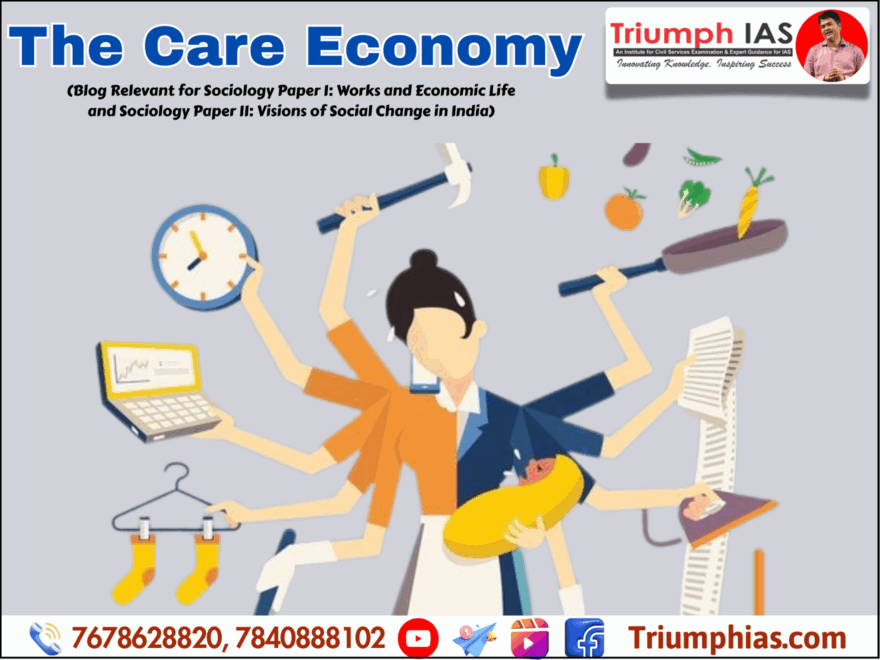
The care economy encompasses all forms of care work—paid and unpaid—performed in households, communities, and institutions. It includes childcare, eldercare, healthcare, education, and domestic services.
Despite being foundational to human development and economic productivity, care work remains undervalued, disproportionately performed by women, and often excluded from formal economic calculations like GDP.
Why is the Care Economy Important for India?
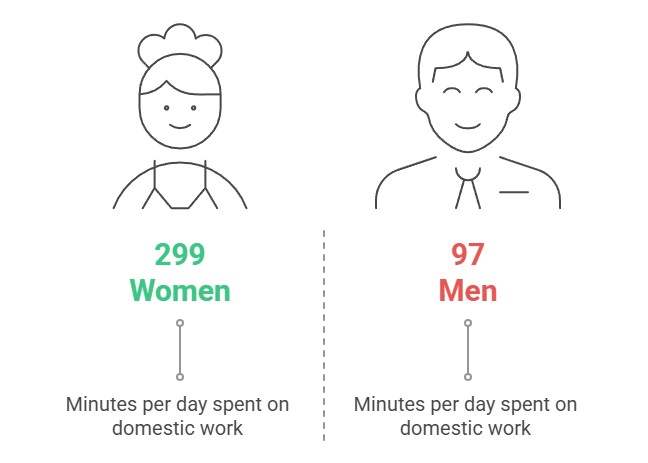
- According to NSSO’s Time Use Survey (2019), Indian women spend 299 minutes/day on unpaid domestic work compared to 97 minutes for men.
- Over 85% of care work in India is informal, unpaid, and predominantly handled by women.
- Gender inequality in caregiving restricts women’s participation in the labor force—India has one of the lowest female labor force participation rates (FLFPR) in the world (~25%).
Sociological Analysis
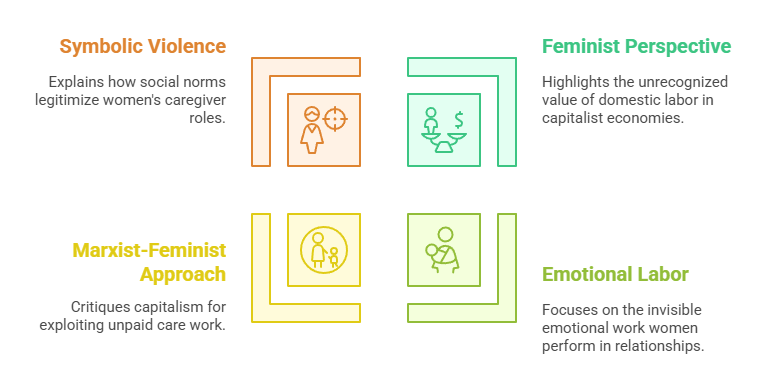
- Feminist Perspective: Ann Oakley, a leading feminist sociologist, emphasizes that domestic labor is real labor that deserves recognition. She argues that women’s unpaid work is a hidden subsidy to the capitalist economy.
- Arlie Hochschild’s “Emotional Labour”: In her seminal work, Hochschild describes how women not only perform physical care but also emotional labor—soothing, nurturing, and maintaining relationships. This labor is invisible but crucial.
- Marxist-Feminist Approach: The Marxist-Feminist perspective (e.g., Silvia Federici) critiques capitalism for relying on reproductive labor (care work) without compensating it. The exploitation of unpaid care sustains capitalist accumulation.
- Symbolic Violence: Bourdieu’s concept of symbolic violence helps explain how social norms naturalize women’s role as caregivers, making inequality appear legitimate and “normal.”
Recognitions & Reports
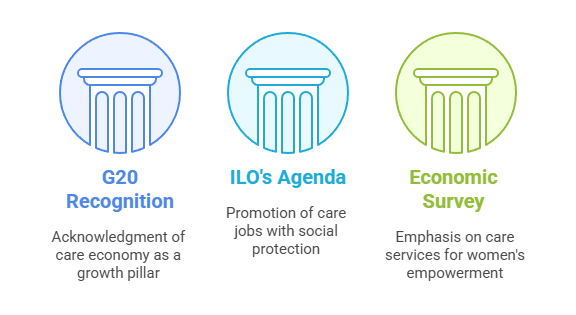
- G20 2023 India Presidency acknowledged the care economy as a pillar of inclusive growth.
- ILO’s Decent Work Agenda promotes investment in care jobs with social protection.
- The Economic Survey 2021-22 discussed “social infrastructure” like education and care services as critical for women’s empowerment.
Government Initiatives
- PM Matru Vandana Yojana (PMMVY)
- Anganwadi Services (ICDS)
- National Creche Scheme
- Kerala’s Kudumbashree as a decentralized care economy initiative.
However, none provide universal coverage or direct recognition of unpaid care work.
Way Forward
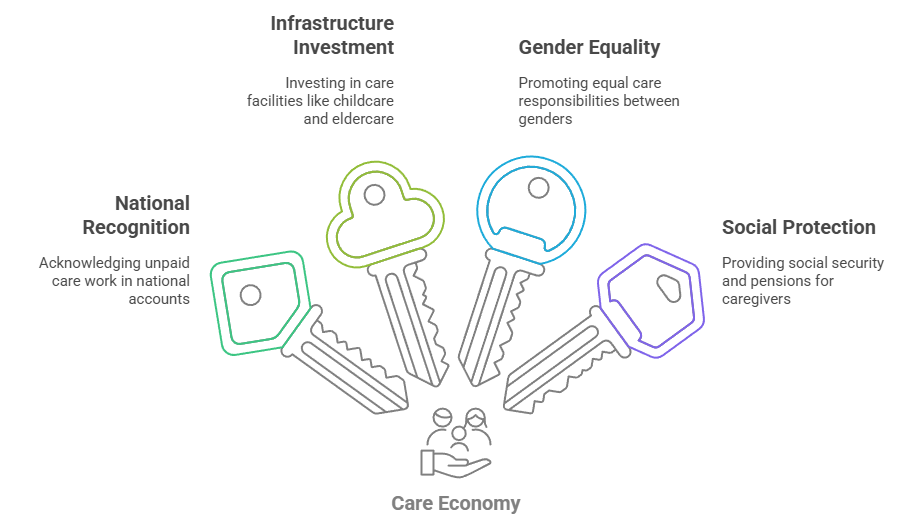
- Recognize unpaid care work in national accounts.
- Invest in care infrastructure—childcare centers, eldercare homes, maternity benefits.
- Promote redistribution of care responsibilities between men and women.
- Introduce social protection and pension schemes for unpaid caregivers.
Conclusion
The care economy is the invisible fuel that powers human capability and productivity. Recognizing and supporting it is not only a gender justice issue but also an economic and developmental necessity. A sociological lens reveals that restructuring care work can help create a more inclusive, equitable and humane society.
PYQs –
Paper I
- Examine the concept of emotional labour. How does it contribute to the understanding of gender roles in contemporary society? (2022)
- Discuss the gendered division of labour in the context of paid and unpaid work. (2016)
- Explain the concept of ‘reproductive labour’ and its significance in feminist sociology. (2015)
Paper II
- Explain the low work participation rate of women in India. (2023)
- Examine the impact of COVID-19 pandemic on women’s unpaid labour. (2021)
- Examine the role of Self-Help Groups (SHGs) in empowering women in rural India. (2019)
- Discuss the role of the State in recognizing and reducing women’s unpaid work. (2018)
|


One comment