Introduction
The issue of Adivasi protests against forced evictions from forest lands is once again in the spotlight, raising critical concerns about land rights, displacement, tribal marginalization, and development-induced displacement. With over 1.9 million forest-dwelling families facing eviction threats after Supreme Court orders related to Forest Rights Act (FRA) compliance, the urgency of resolving tribal land alienation cannot be overstated. This blog provides a sociological analysis of Adivasi resistance movements, exploring themes such as social stratification, ethnic identity, state-society relations, and development and displacement, making it highly relevant for Sociology.
Adivasi Struggles for Forest Rights
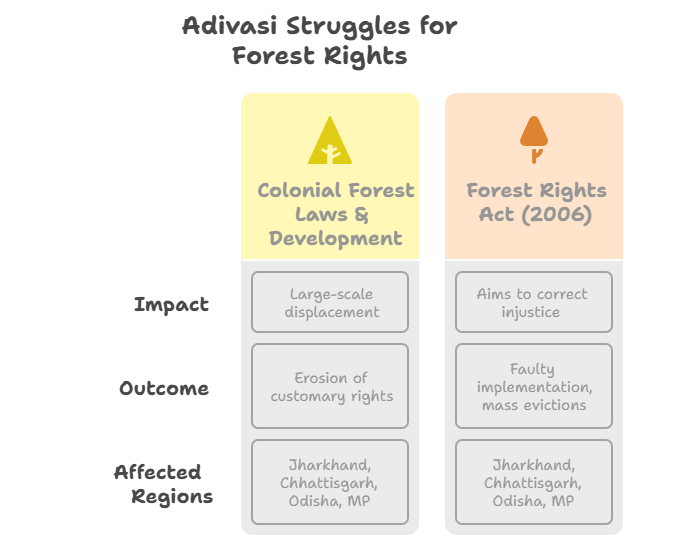
- Tribal communities or Scheduled Tribes (STs) in India have historically depended on forest ecosystems for livelihood, culture, and identity. However, colonial forest laws, followed by post-independence developmental projects like dams, mines, and wildlife sanctuaries, have led to large-scale displacement without rehabilitation, eroding customary rights.
- The Forest Rights Act (2006) aimed to correct this “historic injustice” by recognizing individual and community forest rights. But bureaucratic apathy, faulty implementation, and court rulings have led to mass evictions, prompting fresh waves of tribal protests in states like Jharkhand, Chhattisgarh, Odisha, and Madhya Pradesh.
Sociological Analysis

- Structural Marginalization of Adivasis: From the lens of A.R. Desai’s Marxist sociology, tribal displacement is a result of the capitalist mode of production penetrating tribal zones. The forest becomes a resource for exploitation, and Adivasis are seen as obstacles to economic growth.
- Ethnicity, Identity, and Resistance: Adivasi movements reflect ethnic mobilization against cultural erasure and political invisibility. According to Anthony Giddens, modernity often destroys traditional lifeworlds, creating resistance identities.
- State-Society Conflict and Developmentalism: The Indian state often follows a top-down development model that prioritizes GDP over human rights. The structural functionalist perspective sees the state as a stabilizer, but in tribal regions, it behaves as a coercive agent. The tribal protests represent a dysfunctional response to exclusion.
- Social Movements and Collective Action: The anti-eviction protests can be understood through resource mobilization theory and new social movement theory. Tribal leaders, NGOs, and activist networks mobilize legal resources, traditional knowledge, and international norms to fight displacement.
Case Studies
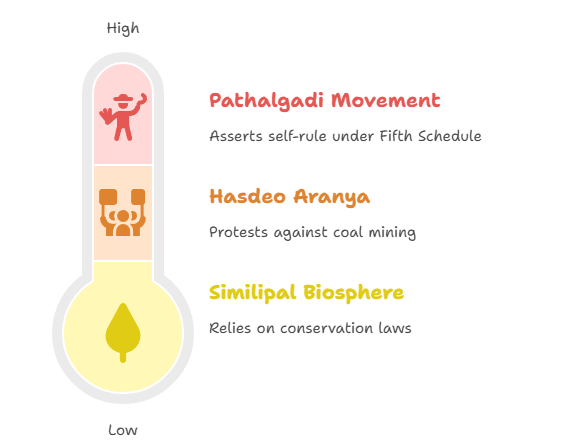
- Hasdeo Aranya (Chhattisgarh): Adivasi protest against coal mining in an ecologically sensitive forest zone.
- Similipal Biosphere (Odisha): Evictions under conservation laws led to resistance over denial of FRA claims.
- Pathalgadi Movement (Jharkhand): Assertion of tribal self-rule under the Fifth Schedule provisions.
Conclusion
The Adivasi protests against forest evictions are not just about land — they reflect a deep crisis in India’s development paradigm. From a sociological lens, these struggles highlight the contradictions between constitutional promises and on-ground realities. Understanding these protests offers insights into tribal rights, state policies, and resistance movements, helping connect theory with real-world issues.
PYQs
Paper 1 –
- How does Marx’s theory of class conflict help us understand resistance to development projects in tribal areas?(2020 / 10 marks)
- Examine the role of ideology in social movements. Use examples of environmental or tribal movements in your answer.(2018 / 20 marks)
- Explain the concept of social exclusion. How is it relevant in understanding the status of tribal populations in India?(2017 / 10 marks)
- What is ‘development-induced displacement’? Explain its impact on marginalized sections.(2016 / 10 marks)
- Discuss the relationship between development and environmental degradation from a sociological perspective.(2015 / 20 marks)
- What are the major types of social movements? How can tribal movements be classified within this framework?(2014 / 10 marks)
- Discuss the sociological relevance of environmental movements.(2013 / 10 marks)
Paper 2 –
- What is the significance of the Fifth and Sixth Schedules of the Constitution in safeguarding tribal interests?(2023 / 20 marks)
- Discuss the implications of the Forest Rights Act (2006) in addressing the marginalization of tribal populations.(2022 / 10 marks)
- Describe the factors responsible for the discontent among tribal communities in central India.(2021 / 10 marks)
- Highlight the challenges faced by tribal communities due to development-induced displacement. Suggest remedial measures.(2020 / 20 marks)
- What are the major tribal movements in India? Analyze their causes with a focus on forest and land rights.(2019 / 20 marks)
- Critically examine the role of the state in tribal development.(2018 / 10 marks)
- Describe the impact of mining and industrialization on tribal communities in eastern India.(2017 / 10 marks)
- Analyze the consequences of environmental policies on indigenous communities in India.(2015 / 10 marks)
- Evaluate the role of NGOs and civil society in protecting the rights of displaced tribal populations.(2014 / 20 marks)
|



One comment