Recent Supreme Court Judgment
In a landmark judgment, the Supreme Court of India has ruled that a man cannot be accused of making a “false promise of marriage” when both parties have willingly engaged in a long-term live-in relationship. The Court observed:
- “The court may, based on the length and conduct of the parties, presume implied consent of the parties to be in such a relationship.”
This ruling offers legal relief to individuals in consensual non-marital relationships, marking a progressive step in recognizing alternative forms of companionship beyond traditional marriage.
Key Highlights of the Ruling
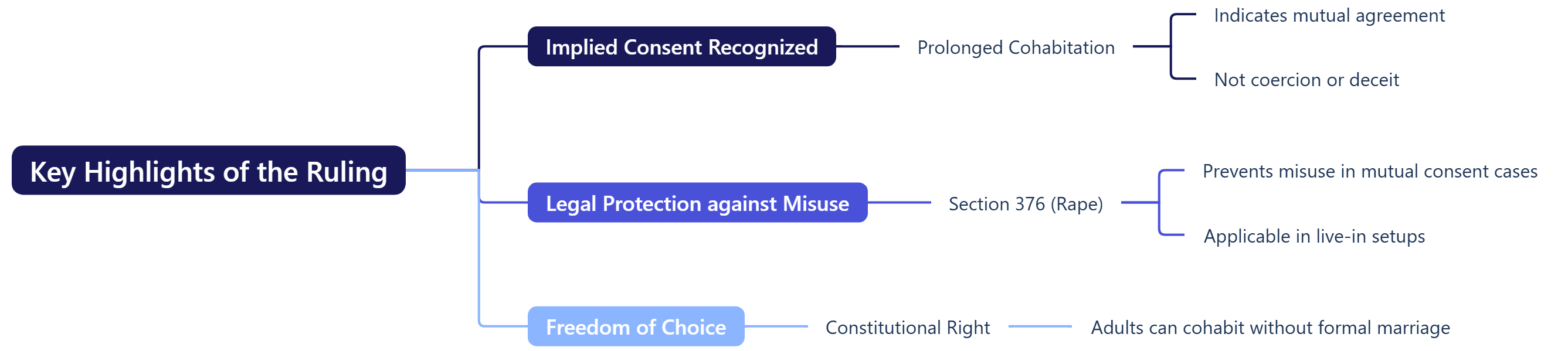
- Implied Consent Recognized: Prolonged cohabitation can indicate mutual agreement, not coercion or deceit.
- Legal Protection against Misuse: Prevents misuse of Section 376 (rape) in cases where there was mutual consent in a live-in setup.
- Freedom of Choice: Reinforces the constitutional right of adults to cohabit without formal marriage.
Sociological Analysis
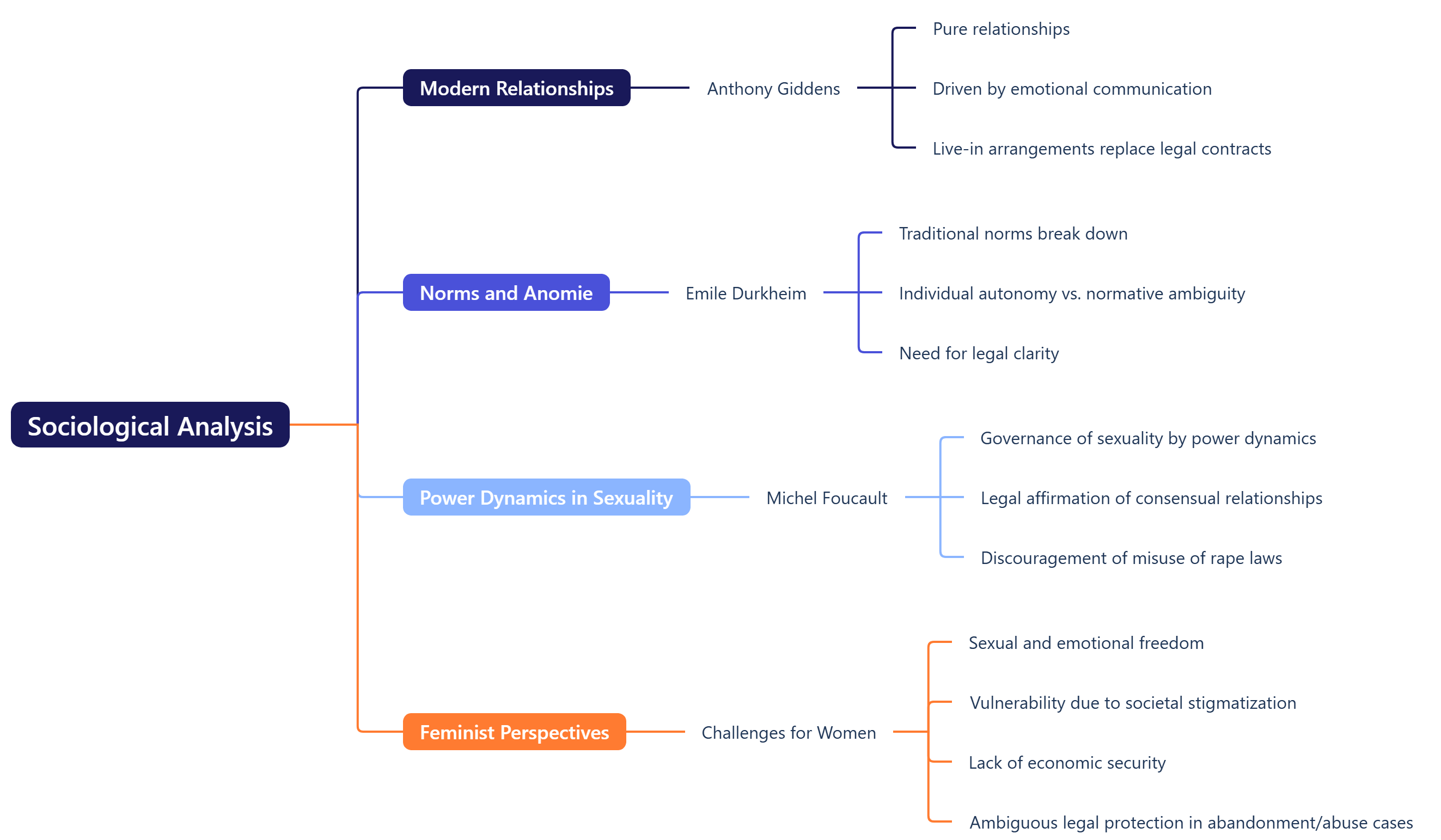
- Anthony Giddens argues that modern relationships are based on pure relationships, driven by emotional communication rather than institutional pressures. This aligns with live-in arrangements where emotional intimacy replaces legal contract.
- Emile Durkheim suggests Norms and Anomie persists as society modernizes, traditional norms break down. Live-in relationships may indicate a shift towards individual autonomy but also bring normative ambiguity—requiring legal clarity, as this ruling attempt to provide.
- Michel Foucault highlights how power dynamics govern sexuality. This judgment potentially empowers women and men by legally affirming consensual relationships while discouraging the misuse of rape laws in consensual contexts.
- Feminist sociologists may argue that while live-in relationships offer sexual and emotional freedom, women often remain more vulnerable due to societal stigmatization, lack of economic security, and ambiguous legal protection, especially in cases of abandonment or abuse.
Implications for Indian Society
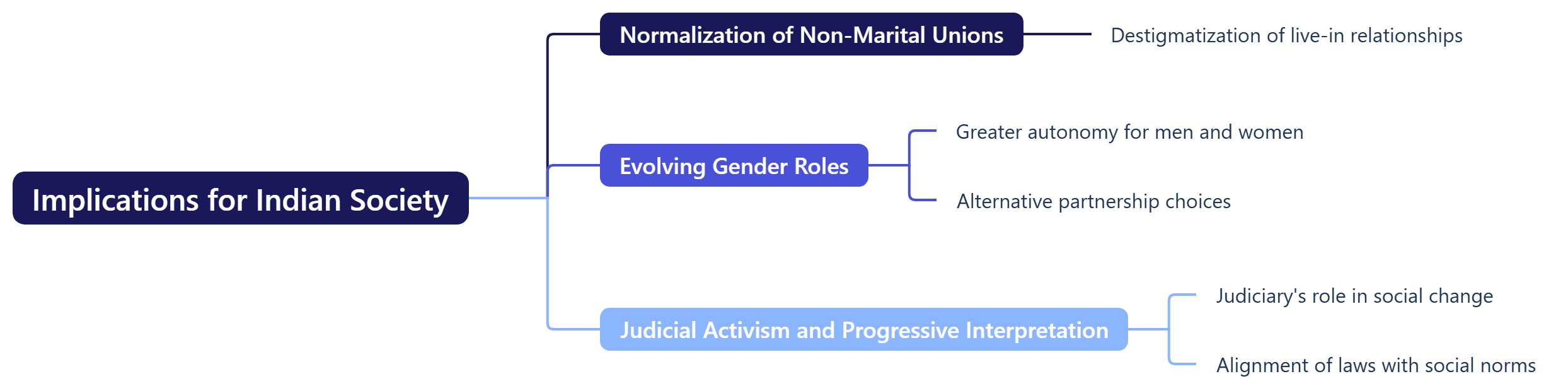
- Normalization of Non-Marital Unions: Helps destigmatize live-in relationships in conservative Indian society.
- Evolving Gender Roles: Reflects greater autonomy for both men and women in choosing partners and relationship forms.
- Judicial Activism and Progressive Interpretation: Reflects how the judiciary interprets social change and aligns laws with evolving social norms.
Conclusion
The Supreme Court’s verdict is a progressive legal recognition of changing intimate relationships in modern India. While it upholds the right to sexual and relational autonomy, it also demands a balanced approach to prevent misuse of protective laws. For aspirants, this is a crucial case study on law, family, gender, and evolving societal norms, highly relevant for Sociology Optional.
PYQs
Paper I:
- Explain how patriarchy manifests itself in family and marriage institutions. 2015
- What are the sociological implications of increasing instances of cohabitation and live-in relationships? 2016
- Describe the role of the state in regulating marriage and family in modern society. 2017
- How do changing kinship relations affect the institution of marriage? 2018
- Examine the concept of ‘reflexive modernity’ with respect to family and kinship systems. 2019
- Examine the changing patterns of marriage and family in modern societies. 2020
- Discuss the implications of ‘emotional labour’ in modern intimate relationships. 2021
- Critically examine the theoretical approaches to the study of family in sociology. 2023
Paper II:
- How far is the institution of marriage in India transforming under the impact of westernization and legal reforms? 2016
- What is the impact of modernization on marriage and family in India? 2017
- Live-in relationships challenge the traditional values of Indian society. Comment. 2018
- Discuss the legal and social implications of alternative forms of family such as single-parent households and live-in relationships in India. 2019
- Examine the changing trends in marriage and live-in relationships in India. 2020
- Discuss the role of judiciary in redefining family and marriage in contemporary India. 2021
- Critically analyze the intersection of law, gender, and morality in shaping sexual and relationship choices in Indian society. 2022
|