Introduction: A Tale of Two Cities
India’s Smart Cities Mission was launched in 2015 to drive economic growth and improve the quality of life through modern infrastructure, digital technology, and sustainable urbanization. However, amidst the gleaming facades of metro rails, surveillance systems, and Wi-Fi zones, lay sprawling slums and informal settlements that challenge the very idea of “smartness.” This paradox presents a rich sociological dilemma — how can we reconcile the promise of urban modernity with the persistence of poverty, inequality, and spatial exclusion?
The Urban Dilemma: What is a Smart City?
Smart Cities are envisioned as technology-driven, efficient urban spaces with focus on mobility, e-governance, sustainable housing, and digitization. However, in cities like Delhi, Mumbai, Bengaluru, and Pune, 40-60% of the population lives in slums, without access to basic amenities.
Paradox: On one hand, these cities have surveillance systems and metro connectivity. On the other, informal housing, lack of sanitation, and eviction threats haunt millions.
Sociological Perspectives on Slums and Urbanization
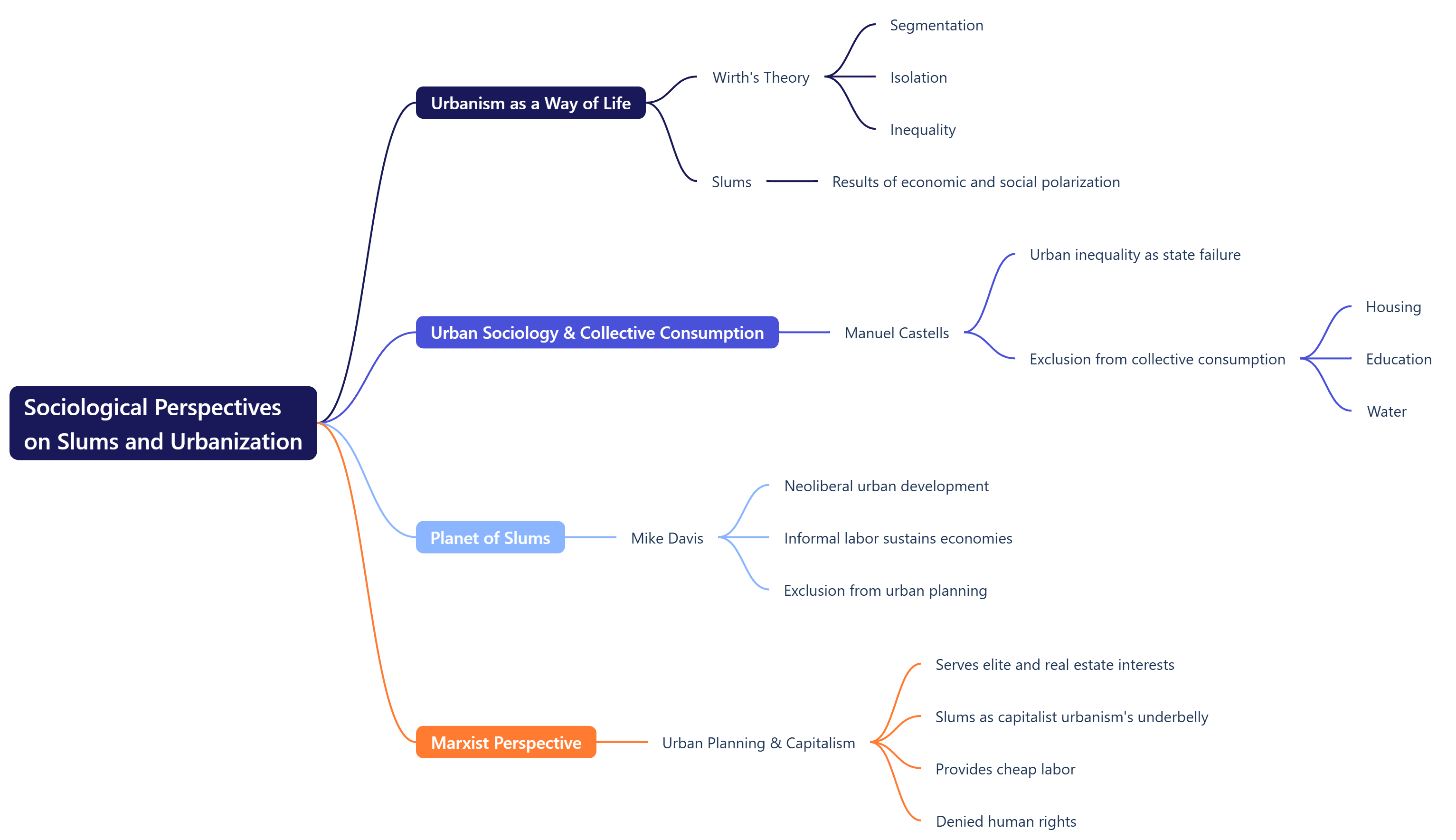
- Urbanism as a Way of Life: Wirth emphasized that urban life breeds segmentation, isolation, and inequality. Slums are not aberrations but results of economic and social polarization in cities.
- Urban Sociology & Collective Consumption: According to Manuel Castells, urban inequality is a failure of state provision of public goods. Slums emerge because the urban poor are excluded from ‘collective consumption’ like housing, education, water, etc.
- Planet of Slums: Mike Davis points out that slums are the result of neoliberal urban development, where informal labor sustains city economies, but urban planning excludes their housing needs.
- Marxist Perspective: Urban planning under capitalism serves the interests of the elite and real estate. Slums represent the underbelly of capitalist urbanism, providing cheap labor but denied human rights.
Why Do Slums Exist in Smart Cities?
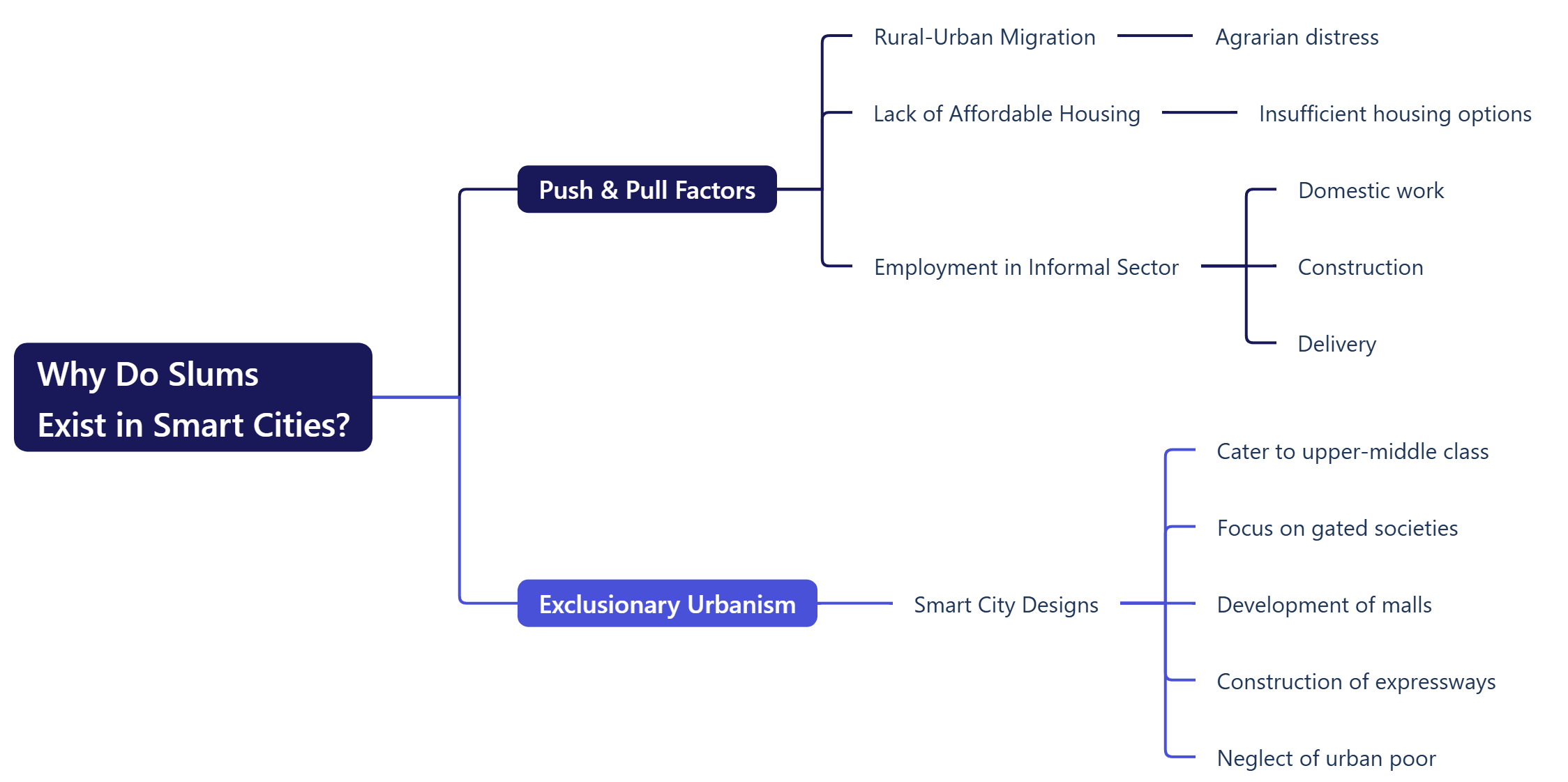
Push & Pull Factors
- Rural-urban migration due to agrarian distress
- Lack of affordable housing in cities
- Employment in informal sector (domestic work, construction, delivery)
Exclusionary Urbanism
- Smart city designs often cater to the upper-middle class: gated societies, malls, expressways, while ignoring the urban poor.
Case Study: Dharavi in Mumbai
One of the world’s largest slums, Dharavi is paradoxically a hub of economic activity, producing $1 billion in goods yearly — leather, textiles, pottery. Yet, redevelopment plans often displace rather than rehabilitate. Dharavi exemplifies functional duality — informal settlements that are economically productive but socially stigmatized.
Gender & Slums: Double Disadvantage
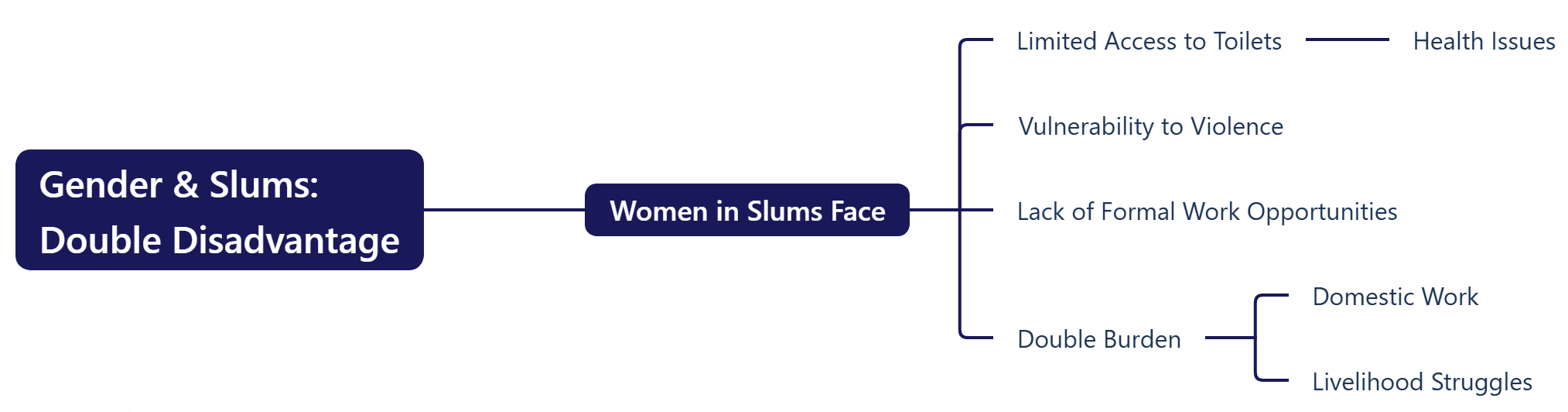
Women in slums face:
- Limited access to toilets → health issues
- Vulnerability to violence
- Lack of formal work opportunities
- Double burden of domestic work and livelihood struggles
Urban Policies: Inclusive or Eviction-Driven?
Problems with Smart Cities Mission:
- Focus on infrastructure over inclusion
- Use of surveillance instead of public participation
- Forced evictions and demolitions of slums
Sociological Alternatives:
- Participatory planning (Jockin Arputham model of slum redevelopment)
- In-situ slum upgrading instead of relocation
- Right to the city approach (Henri Lefebvre)
Global Comparison: Slums in Other Smart Cities
- Rio de Janeiro: Favela upgrading programs (community-based)
- Cape Town: Apartheid legacy and spatial segregation
- Jakarta: Eviction without rehabilitation during smart city transformation
- Global South cities share a common pattern: high-tech planning meets deep-rooted poverty.
Conclusion:
A truly smart city is not just digitized but inclusive, equitable, and just. Slums in smart cities are not failures, but reflections of inequitable development models. Sociologists urge human-centered urban planning, where slum dwellers are not passive recipients, but active stakeholders.
PYQs
Paper I:
- “Urbanization without industrialization has led to the proliferation of slums in India.” Discuss. – 2014
- Examine Louis Wirth’s theory of Urbanism and its relevance in understanding slums in Indian cities. – 2015
- Discuss the nature of social organization in urban slums and its implications for social mobility. – 2016
- Analyze the growth of informal sector in urban areas and its link to migration and slum formation. – 2017
- Explain the concept of “Urbanism as a way of life” and critically examine its impact on kinship and neighborhood in slum communities. – 2018
- What is the role of urban ecology models (like Burgess’ concentric zone theory) in explaining the spatial segregation in Indian cities? – 2019
- Examine the impact of globalization and neoliberal urban planning on the socio-economic conditions of slum dwellers. – 2020
- Explain the concept of ‘Right to the City’ and its relevance in contemporary urban movements involving slum dwellers. – 2022
- “Urban development policies often intensify social exclusion.” Illustrate with examples from Indian cities. – 2023
Paper II:
- “Slums are both a problem and a solution to urban poverty.” Discuss with examples from Indian cities. – 2014
- Analyze the impact of urban housing policies like JNNURM and PMAY on slum rehabilitation. – 2015
- Discuss the contribution of slum dwellers to the informal economy in Indian metropolitan cities. – 2016
- Examine the socio-economic and political issues involved in slum clearance drives and their impact on displaced communities. – 2017
- “Smart Cities Mission promotes exclusion in the name of modernity.” Critically evaluate. – 2018
- Discuss the intersection of caste, class, and gender in shaping the experience of urban slum dwellers. – 2019
- Critically analyze the socio-political consequences of gentrification and displacement in Indian smart cities. – 2020
- Analyze how slums are portrayed in policy narratives vis-à-vis their lived realities. – 2022
- “The paradox of urban development is that it often deepens inequality while aiming to reduce it.” Discuss in context of slum policies in India. – 2023
|



One comment