
50 Years of ICDS: A Sociological Reflection on India’s Experiment in Early Childhood Justice
(Relevant for Sociology Paper 1 & 2: Stratification and Mobility and Population Dynamics and Challenges of Social Transformation)
|
In 1975, when the Government of India launched the Integrated Child Development Services (ICDS) as a pilot in rural Karnataka, few could have predicted that it would become the world’s largest community-based early childhood development programme. ICDS: More Than a Nutrition Programme—A Social InstitutionLaunched on 2 October 1975—a symbolic date that echoed Gandhi’s emphasis on community and welfare—ICDS sought to improve the health, nutrition, and early learning outcomes of children aged 0–6 years, along with pregnant and lactating mothers. ICDS today falls under Mission Saksham Anganwadi & Poshan 2.0, and its goals remain deeply sociological:
Sociologists view ICDS not simply as service delivery, but as the institutionalisation of early childhood care, a domain previously relegated to families—often women—and rarely recognised by the state. Understanding ICDS Through Sociological Lenses
T.H. Marshall argued that citizenship includes civil, political, and social rights, especially welfare rights. For millions of India’s poorest children, ICDS is their first and often only point of contact with the welfare state.
Sen’s capability approach emphasises expanding freedoms by investing in health, nutrition, and education early in life.
The sociological impact is intergenerational: a well-nourished child is more likely to stay in school, break out of poverty, and participate meaningfully in society.
ICDS is also a feminist institution in two ways:
Nancy Fraser’s framework of redistribution + recognition applies perfectly: ICDS redistributes resources while recognising caregiving and women’s reproductive labour.
Anganwadi Centres are more than nutrition hubs—they are community spaces.
They function as hybrid spaces where state policies meet community realities.
ICDS disproportionately benefits:
Kimberlé Crenshaw’s concept of intersectionality helps explain why ICDS matters: it targets vulnerabilities created at the intersections of caste, class, gender, and region. Mission Saksham Anganwadi & Poshan 2.0: A New Phase in the Sociology of WelfareIn FY 2021–22, India launched Saksham Anganwadi & POSHAN 2.0, integrating ICDS with major schemes like:
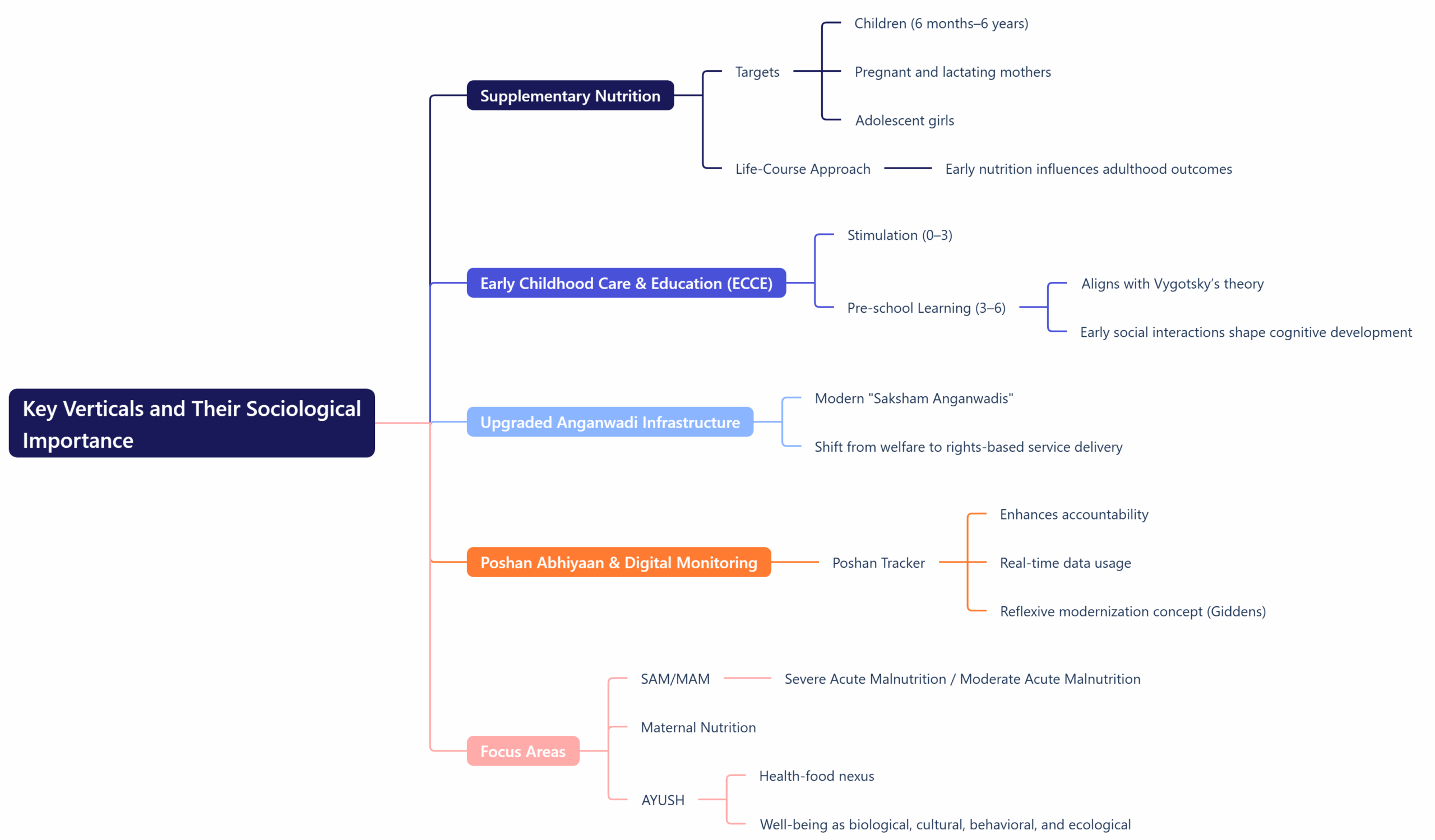
This integration reflects the sociological trend toward convergence-based welfare, which recognises that poverty, malnutrition, and gender inequality are interconnected structural problems—not isolated issues. Key Verticals and Their Sociological Importance
Targets:
This reflects a life-course approach: nutrition in early life influences outcomes in adulthood.
Providing stimulation (0–3) and pre-school learning (3–6) aligns with Vygotsky’s idea that early social interactions shape cognitive development.
Modern “Saksham Anganwadis” signal a shift from welfare to rights-based, dignified service delivery.
The Poshan Tracker enhances accountability through real-time data—an example of what Anthony Giddens calls reflexive modernisation, where institutions use data to continuously improve.
This expands the health-food nexus, recognising that well-being is not just biological but cultural, behavioural, and ecological. Why ICDS Still Matters: The Sociological Significance
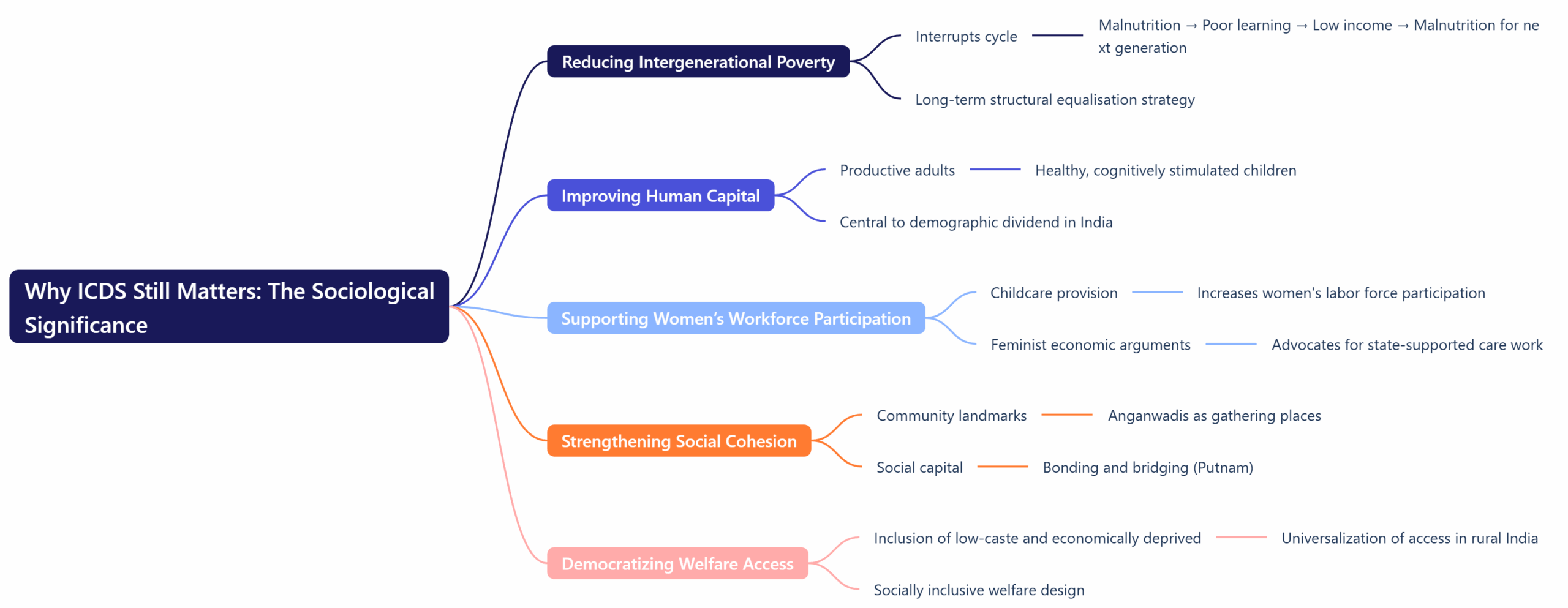
ICDS interrupts the cycle where malnutrition → poor learning → low income → malnutrition for next generation.
A healthy, cognitively stimulated child becomes a more productive adult—central to India’s demographic dividend.
By offering childcare, ICDS indirectly increases women’s labour force participation—echoing feminist economic arguments for state-supported care work.
Anganwadis are community landmarks. They bring together women, local leaders, health workers, teachers, and administrators, creating bonding and bridging social capital (Putnam).
In rural India, low-caste and economically deprived families often face exclusion. Anganwadis, by design, universalise access, making welfare socially inclusive. Challenges Ahead: Looking at the Next 50 Years with Sociological ClarityDespite its success, ICDS faces structural constraints:
A sociological view suggests that improving ICDS requires addressing power relations, not just budgets:
Conclusion: ICDS at 50—A Living Example of Welfare as Social TransformationICDS is not merely a nutrition scheme; it is a social revolution that redefined the Indian state’s role in childhood, gender justice, and community development. As Mission Saksham Anganwadi & Poshan 2.0 scales up ICDS for the next generation, the challenge is not only technological or financial—it is deeply sociological:
Half a century later, ICDS stands as one of India’s greatest experiments in early childhood justice, proving that investing in the smallest citizens reshapes the future of the entire society. |

To Read more topics, visit: www.triumphias.com/blogs
Read more Blogs:
Unite Against Violence: A Sociological Reading of Gendered Power, Technology, and Resistance