
Social Citizenship
(Relevant for Sociology Paper I: Politics and Society and Sociology Paper II: Politics and Society)
IntroductionSocial citizenship is a crucial component of modern democratic societies, ensuring that every individual enjoys not only legal and political rights but also social rights such as access to education, healthcare, housing, and social security. Coined and conceptualized by British sociologist T.H. Marshall, the term represents a transformative evolution in how states relate to their citizens, especially in welfare democracies. In the Indian context, social citizenship is deeply intertwined with the constitutional promise of justice, equality, and dignity, and is of immense relevance in UPSC sociology and public policy debates—especially in light of current issues like rising inequality, social exclusion, and the demand for universal basic services. Defining Social CitizenshipIt refers to a form of citizenship in which the state ensures that all individuals have access to basic social rights—irrespective of their socio-economic status. These rights are essential for people to function as full members of society. T.H. Marshall (1950) famously outlined three elements of citizenship:
While civil and political rights are crucial, Marshall argued that social rights make citizenship truly inclusive and participatory. Evolution of Social Citizenship: A Historical Overview
Social Citizenship in India:India provides a unique model of social citizenship embedded within its Constitutional architecture:
Thus, social citizenship in India is anchored in both rights-based and welfare-based approaches. Sociological Analysis
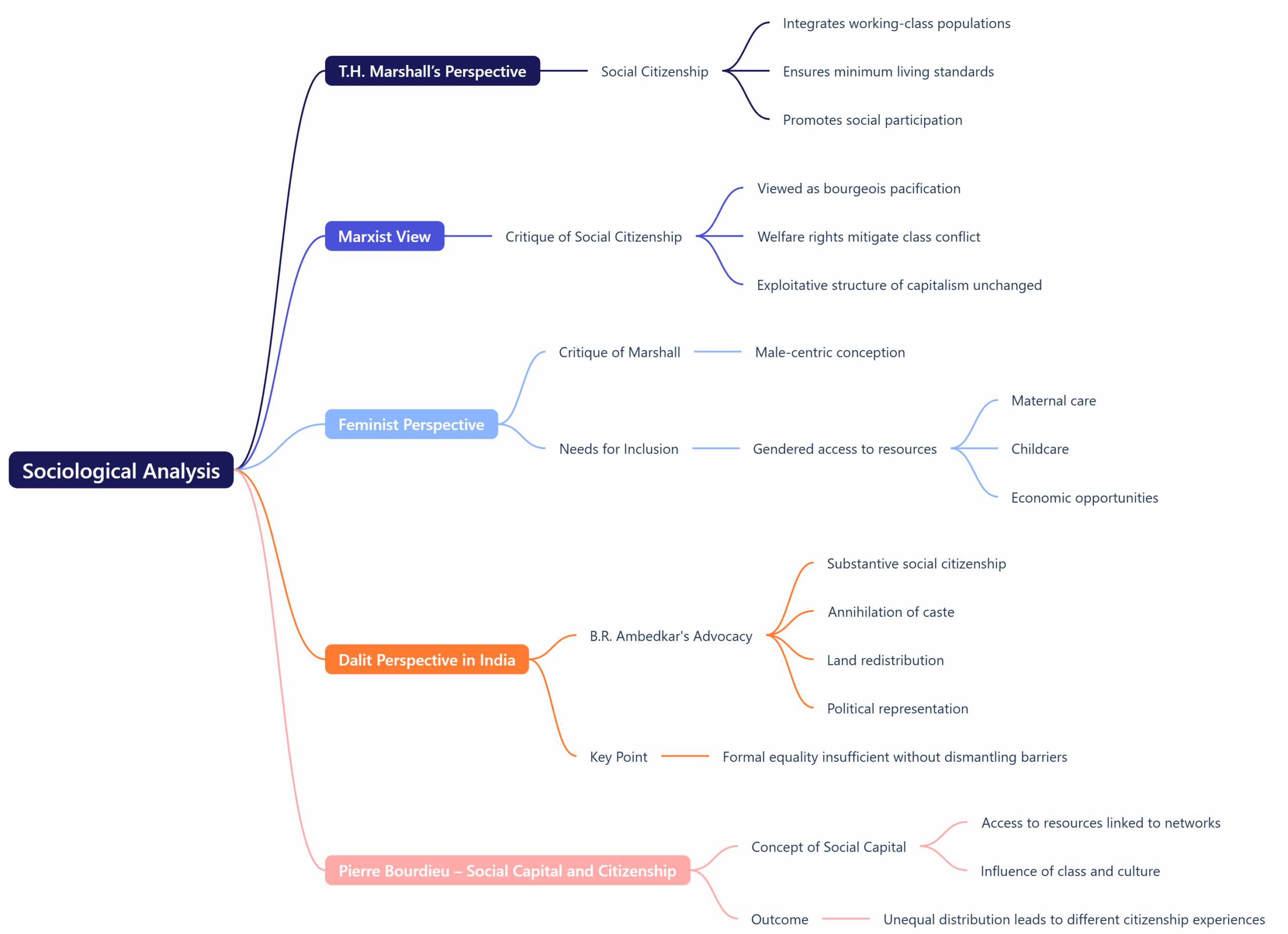
Marshall’s theory emphasizes that social citizenship helps integrate working-class populations into the nation by ensuring minimum standards of living and social participation.
Marxist sociologists critique social citizenship as bourgeois pacification, arguing that welfare rights are often used to mitigate class conflict without altering the exploitative structure of capitalism.
Feminist scholars argue that Marshall’s conception was male-centric. Social citizenship must include gendered access to resources like maternal care, childcare, and economic opportunities.
Dalit thinkers like B.R. Ambedkar advocated for a substantive social citizenship that includes annihilation of caste, land redistribution, and political representation—emphasizing that formal equality is insufficient without dismantling structural barriers.
Bourdieu’s concept of social capital highlights that even with formal rights, access to resources depends on one’s embeddedness in networks, class, and culture. Thus, unequal distribution of social capital leads to differential experience of citizenship. Challenges to Social Citizenship in India
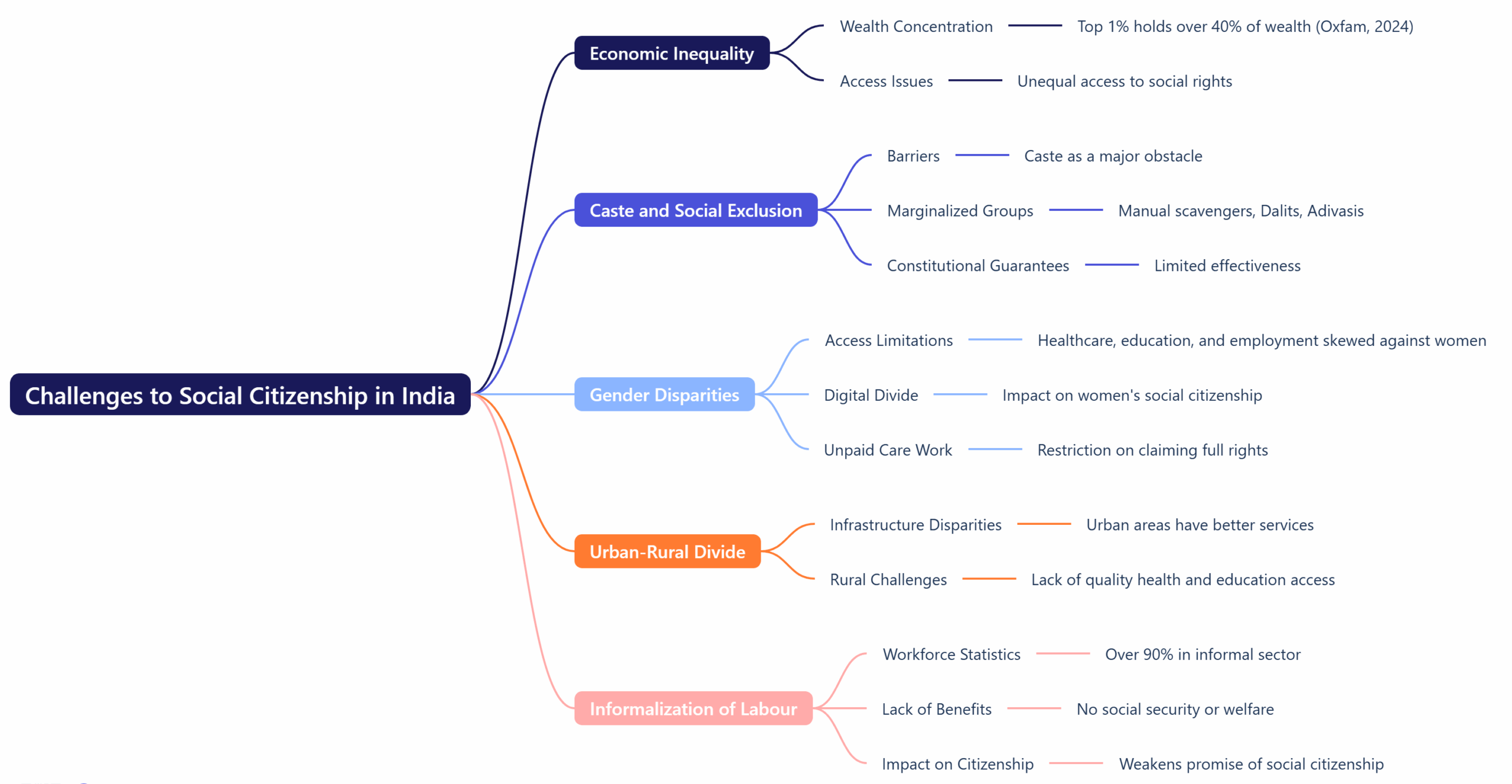
Despite multiple schemes, Oxfam (2024) reports that the top 1% holds more than 40% of national wealth. This economic disparity translates into unequal access to social rights.
Caste continues to be a major barrier to effective social citizenship. Manual scavengers, Dalits, and Adivasis remain marginalized despite constitutional guarantees.
Access to healthcare, education, and employment is still skewed against women. The digital divide and unpaid care work limit their ability to claim full social citizenship.
Urban areas have better infrastructure and service delivery, while rural populations often lack quality access to health and education.
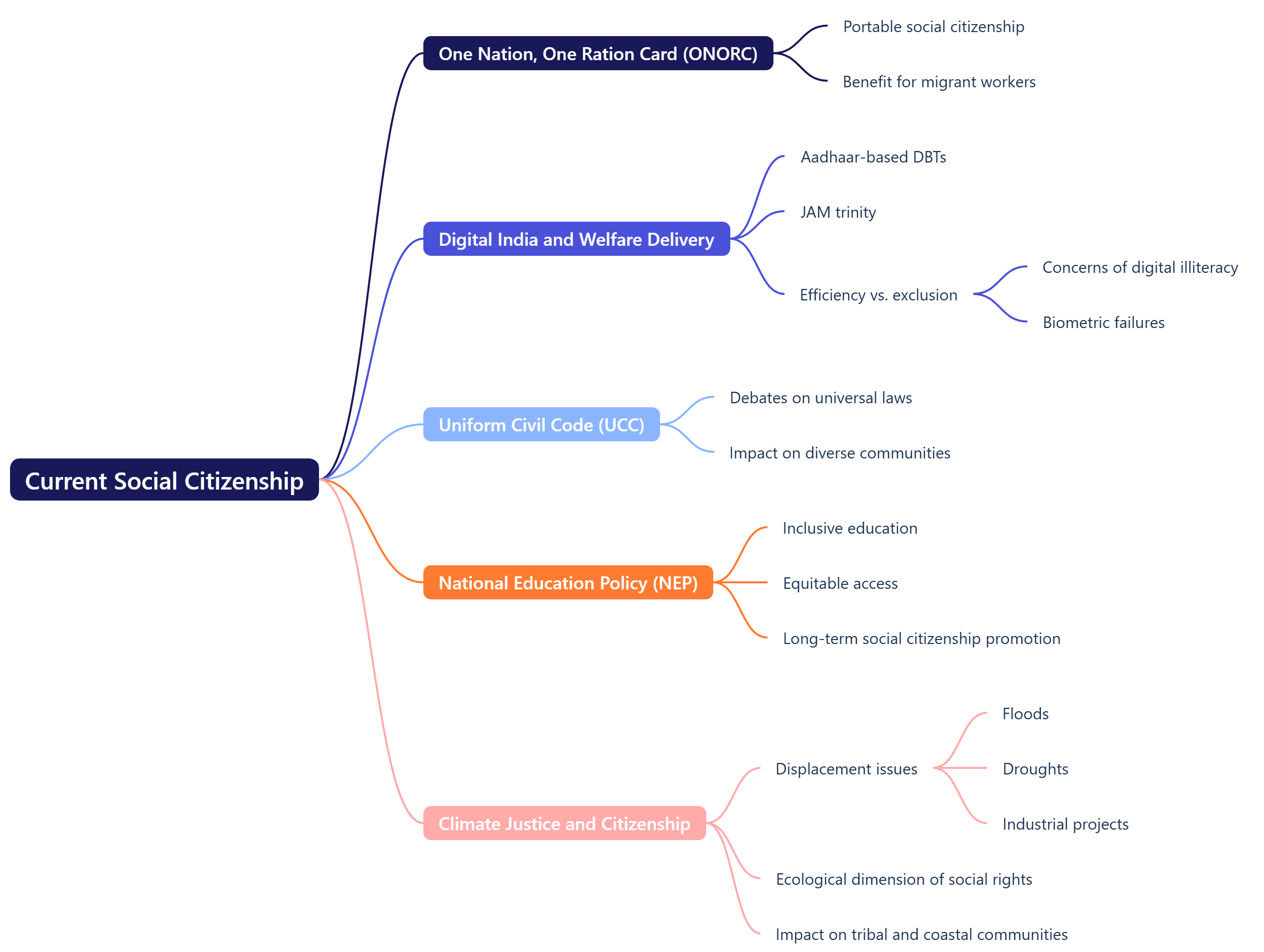
Over 90% of India’s workforce is in the informal sector, devoid of social security and welfare benefits, weakening the promise of social citizenship. Current Social Citizenship
Way Forward: Strengthening Social Citizenship in India
ConclusionIt is not merely about welfare transfers—it is about enabling dignified, participatory, and equitable living for all. In the Indian context, it is intrinsically linked to addressing caste, class, gender, and regional disparities. As India marches toward becoming a digital and economic superpower, its real strength will lie in democratizing access to social rights, ensuring that citizenship goes beyond documents to lived realities. For UPSC aspirants, understanding the sociological underpinnings of social citizenship is vital to analyze policies, social movements, and governance challenges through a rights-based lens. This is where sociology bridges the normative ideals of the Constitution with empirical challenges of society. Previous Year QuestionsPaper 1
Paper 2
|
To Read more topics, visit: www.triumphias.com/blogs
One comment