Strengthening Indian Agriculture
Strengthening the resilience of Indian agriculture is no longer optional—it’s vital. The sector sustains over 56% of India’s population and contributes around 16% to GDP (FY24), yet faces mounting challenges from climate change, groundwater depletion, and ecological fragility. Experts warn that, unless we act, major cereals could see yield drops between 6–25% by 2050. Cultivating resilience requires integrated solutions—from policy reforms and technology adoption to climate-smart practices and farmer empowerment.
Governmental Push: From Budget to Field
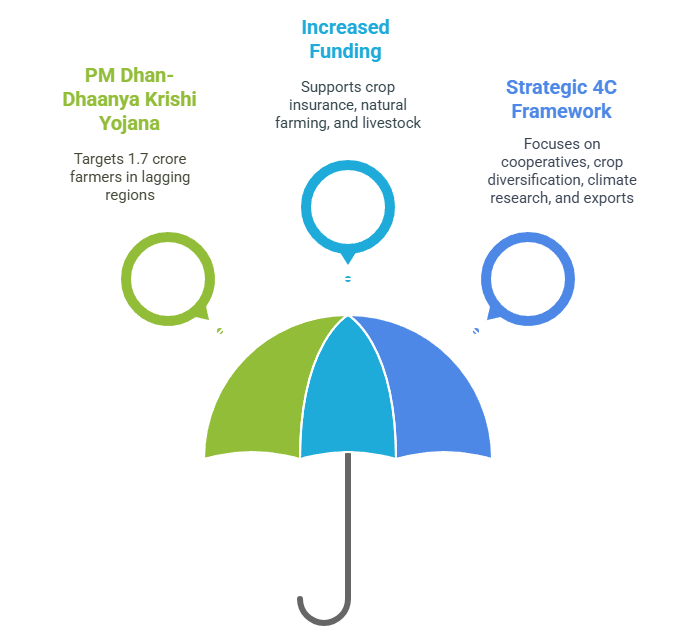
The 2025–26 Union Budget deepened its support for agriculture through initiatives like:
- PM Dhan-Dhaanya Krishi Yojana targeting 1.7 crore farmers in lagging regions, promoting diversified cropping and better storage mechanisms.
- Increased funding for crop insurance (PMFBY), natural farming, and livestock/pharma via schemes such as NPDD and Rashtriya Gokul Mission
- A strategic 4C framework—Co-operatives, Crop diversification, Climate research, and Customer-oriented exports .
These efforts align with rising investments in micro‑irrigation technology—covering over 95 lakh hectares—with ~₹22,000 cr released in FY25 under PMKSY’s “Per Drop More Crop”. Yet, the share of rainfed land remains high, calling for localized solutions and community participation.
Diversification: Sowing Future Security
India’s agricultural landscape is evolving:
- Horticulture output exceeds 362 million tonnes, signaling strong demand
- Fisheries, achieving a 13.7% CAGR, are another growth driver, backed by export gains under schemes like PM Matsya Sampada
- Innovations such as Punjab’s rice-to-maize incentive (₹17,500/ha on 12,000 ha) aim to conserve water and increase farmer incomes
- In the Himalayan Bageshwar region, trout farming now spans 10 villages, supports 165 farmers, and secured a ₹200 cr NABARD investment
These interventions reduce migration, diversify income, and enhance community resilience.
Innovation & Technology: Catalysts of Change
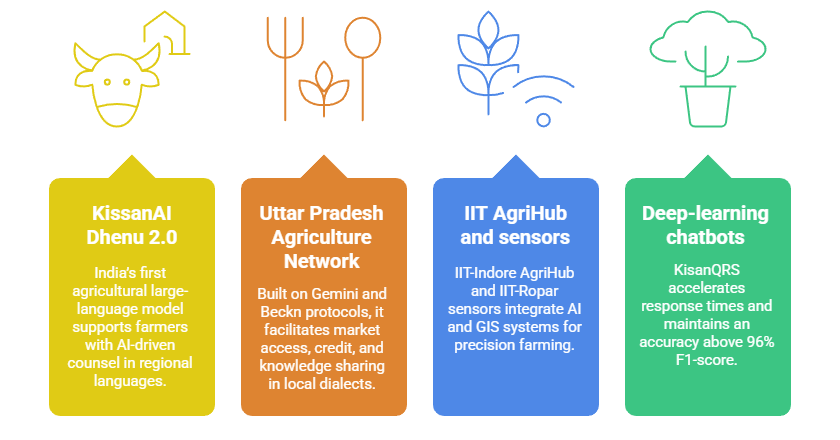
Agri-innovation today spans from AI-powered advisory systems to climate-resilient genetics:
- KissanAI launched Dhenu 2.0, India’s first agricultural large-language model—available in regional languages, supporting farmers with AI-driven counsel
- Uttar Pradesh’s Open Network for Agriculture, built on Gemini and Beckn protocols, facilitates market access, credit, and knowledge sharing in local dialects
- The IIT-Indore AgriHub and IIT-Ropar sensors integrate AI and GIS systems for precision farming and real-time weather guidance
- Deep-learning chatbots like KisanQRS accelerate response times and maintain an accuracy above 96% F1-score
Research institutions are also stepping up: ICRISAT released a heat-tolerant pigeon pea (ICPV 25444) saving imports and generating economic benefits; and Berhampur University is exploring climate-resilient kewda cultivation in Odisha
Global agencies encourage decarbonization—promoting millets and pulses in place of rice to curb emissions, as agriculture contributes up to 40% of India’s GHG .
Institutional Reform & Grassroots Engagement
Effective resilience demands structural changes:
- The Viksit Krishi Sankalp Abhiyan (VKSA) is on a mission in regions like Mizoram and Uttar Pradesh to modernize farming practices. Over 19,000 farmers in Mizoram alone (8,000 women among them) have been trained; UP aims to engage 50 lakh farmers, backed by modern seed, irrigation, and natural farming awareness
- The Union Agriculture Minister has emphasized farmer-led policymaking, shifting from bureaucratic frameworks to ground-level inputs
- Institutions such as ICAR’s NICRA and the National Agroforestry Policy promote multi-sector innovations alongside regenerative farming.
Civil society participation, notably by FAIFA, is pushing climate-resistant measures and farmer-friendly subsidies
Key Challenges Ahead
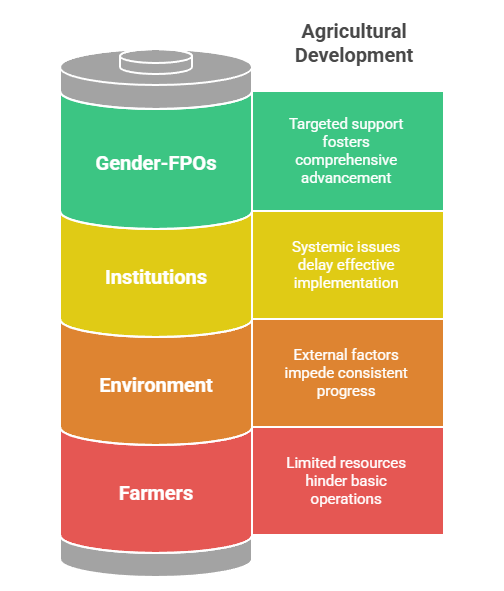
Implementing such a future-ready strategy has hurdles:
- About 30% of farmers lack access to digital tools, irrigation, or credit despite policy pushes .
- Persistent climate threats could outpace innovation .
- Institutional rigidity, inadequate outcome-based monitoring, and uneven state capacity slow reform implementation.
- There’s an urgent need to improve inclusion through Gender-Inclusive Farmer Producer Organizations (FPOs), support smallholders, revive traditional seeds (like native cotton strains), and embed local knowledge .
Road Ahead: A Strategic Vision
To build resilience, three imperatives stand out:
- Accelerate Agri-Tech Adoption: Bridge access gaps, scale proven systems, and offer user-friendly support.
- Deepen Institutional Reforms: Embed farmer voices in policy, decentralize irrigation and crop planning decisions, and improve accountability.
- Ensure Inclusive Growth: Focus on smallholders, women, young farmers, and marginal ecosystems through financing and community engagement.
|