
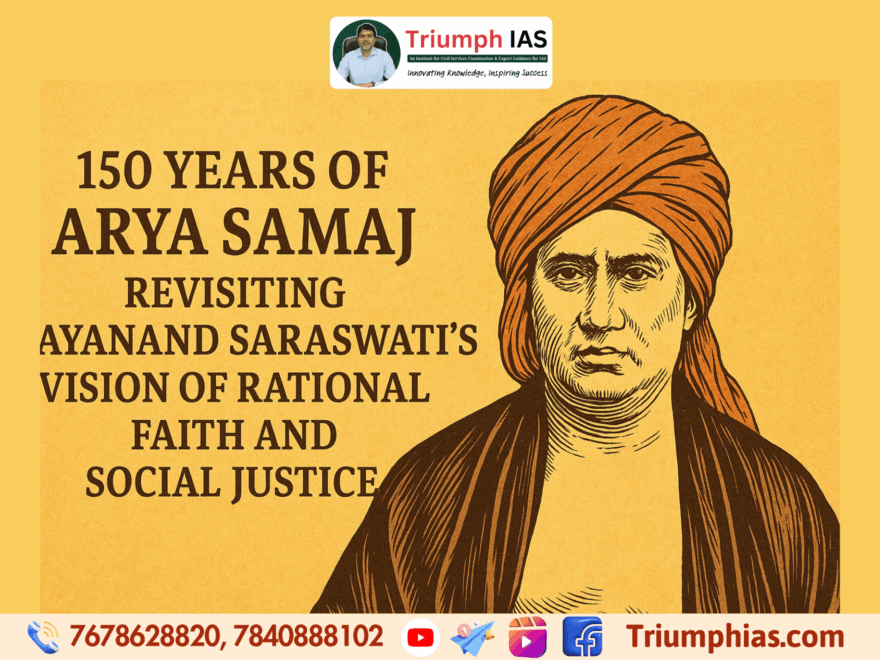
150 Years of Arya Samaj: Revisiting Dayanand Saraswati’s Vision of Rational Faith and Social Justice
(Relevant for Sociology Paper 2: Impact of colonial rule on Indian society)
150 Years of Arya Samaj: Revisiting Dayanand Saraswati’s Vision of Rational Faith and Social JusticeIn November 2025, India celebrates 150 years of the Arya Samaj — one of the most influential reform movements in modern Indian history. The International Arya Mahasammelan 2025 in New Delhi, organized as part of the Jyāna Jyoti Festival, not only commemorates this milestone but also marks the 200th birth anniversary of Maharshi Dayanand Saraswati — the visionary who lit the flame of reform in colonial India. While the event celebrates “150 Golden Years of Service,” its true value lies in what it represents: a moment to reflect on how faith, reform, and modernity can coexist, and how religion, when reinterpreted, can become a force for social change rather than social control. The Birth of Arya Samaj: A Revolution Rooted in the VedasFounded in 1875 in Bombay, the Arya Samaj emerged at a time when India was struggling under colonial domination, social stagnation, and the pressures of Western modernity. Maharshi Dayanand Saraswati, originally Mool Shankar Tiwari from Gujarat, challenged both colonial ideology and orthodox Hinduism, envisioning a society guided by reason, equality, and moral discipline. The Arya Samaj’s motto — “Krinvanto Vishwam Aryam” (“Make the world noble”) — reflected a universal, reformist vision. It rejected idol worship, superstition, animal sacrifice, and hereditary caste hierarchy, advocating instead a rational return to the Vedas, which Dayanand considered the purest source of truth and ethics. His clarion call — “Back to the Vedas” — was not a cry for regression but for reform through rediscovery, an attempt to re-anchor Indian identity in reason, morality, and social justice. Reform as Rationalization: A Weberian PerspectiveFrom a sociological lens, Dayanand’s project fits well within Max Weber’s theory of rationalization. Weber argued that modern societies evolve through a shift from traditional authority to rational-legal authority — a process he described as the “disenchantment of the world.” The Arya Samaj embodied this transformation within Hinduism itself. By stripping religion of ritual excess and priestly mediation, Dayanand rationalized faith, transforming it into a moral-ethical system accessible to the common person. The Vedas, in his view, were not mystical texts to be worshipped but manuals of ethical conduct and social order. This reorientation aligned spirituality with reason — a process akin to what Weber saw in the Protestant Reformation, where reformers sought to purify religion of superstition while emphasizing individual moral responsibility. Arya Samaj, thus, became the Protestant Reformation of Hinduism, reinterpreting scripture to support modern education, meritocracy, and social mobility — qualities that underpinned India’s emerging middle class. Social Reform: The Moral Community and Durkheim’s IdealÉmile Durkheim, in his study of religion, viewed it as the foundation of social cohesion — a moral community that binds individuals through shared beliefs and rituals. The Arya Samaj redefined this collective conscience for modern India. By promoting women’s education, widow remarriage, inter-caste marriages, and the abolition of untouchability and child marriage, it sought to rebuild Hindu society on principles of justice and equality. In doing so, it turned moral reform into a social movement — a modern expression of samaj dharma. The establishment of DAV schools and colleges (from 1886 onwards) embodied this synthesis of ancient and modern — institutions where Vedic ethics coexisted with English education and science. In today’s terms, these were early laboratories of social modernization, nurturing figures like Lala Lajpat Rai, who would later bridge reform with nationalism. Durkheim might say that Dayanand’s moral project provided India a collective identity amid colonial fragmentation — a sense of unity rooted not in ritual orthodoxy but in moral rationality. The Arya Samaj and Caste: A Marxian and Dumontian ReadingFor Karl Marx, religion often served as the ideological glue that sustained exploitation. Dayanand’s reinterpretation of the Vedas was a direct challenge to that hierarchy. He envisioned a classless and casteless Hindu order, where varna was determined by guna (virtue) and karma (deeds), not by birth. This was revolutionary — not in the Marxist sense of material overthrow, but in a moral reconfiguration of social hierarchy. However, as anthropologist Louis Dumont observed in “Homo Hierarchicus”, Indian society’s enduring feature was its hierarchical logic. The Arya Samaj’s attempt to rationalize varna into a merit-based framework faced resistance, as caste retained deep social and symbolic power. Yet, the movement’s Shuddhi campaign — aimed at reconverting those who left Hinduism — showed how Dayanand tried to redefine community boundaries on the basis of faith and ethics, not lineage. In essence, Arya Samaj attempted a social reconstruction of Hinduism, seeking not to destroy hierarchy overnight, but to replace it with a moral meritocracy — a vision that remains unfinished but foundational to India’s later social justice movements. Women, Education, and the Reform of Everyday LifeDayanand was among the first Indian thinkers to explicitly link religion with gender equality. He denounced the practices of Sati, child marriage, and polygamy, while advocating for female literacy and public participation. His gurukulas and Girls’ Gurukul Pathshalas were among the earliest efforts to provide structured education for women, centuries before the state made it policy. This reflected a deeper sociological transformation: the emergence of the modern woman as a social actor, not merely a domestic figure. Dayanand’s concept of strī-shakti (female power) was both spiritual and social — reclaiming the Vedic recognition of women as equal bearers of wisdom. Religion and Nationalism: The Political LegacyMaharshi Dayanand’s call for “Swaraj” in 1876 — decades before Tilak or Gandhi — demonstrated how religious reform could evolve into political consciousness. His emphasis on Swadeshi (self-reliance) and education for national regeneration shaped the ideological foundation of early Indian nationalism. Leaders such as Lala Lajpat Rai, Swami Shraddhanand, and Pandit Lekh Ram carried forward this synthesis of Vedic revival and national self-respect. Arya Samaj institutions became training grounds for patriotic education and civic responsibility. In this sense, the movement blurred the boundaries between religious awakening and political mobilization. Sociologically, this aligns with Benedict Anderson’s idea of the “imagined community” — the nation as a moral and cultural construct. Through schools, publications, and rituals, Arya Samaj helped Indians imagine themselves as part of a reformed, self-reliant civilization — an identity rooted in ethical pride rather than colonial mimicry. Challenges and Controversies: The Limits of ReformNo reform is free of contradiction. The Arya Samaj’s Shuddhi movement, while intended to restore lost members to the Hindu fold, was often viewed as aggressive or exclusionary, leading to tensions with other religious communities. Its literalist interpretation of the Vedas also faced critique for marginalizing the plural, syncretic traditions of Indian religiosity. Moreover, the split within Arya Samaj in 1893 — between Gurukul traditionalists led by Lala Hansraj and modernists like Lala Lajpat Rai — reflected the broader Indian dilemma: how to modernize without Westernizing, and how to preserve tradition without becoming orthodox again. Yet, this internal debate was itself a sign of vitality — proof that Arya Samaj had become a living forum of social introspection. The Enduring Legacy: Rational Faith for a Rational NationAs India marks 150 years of Arya Samaj, its spirit remains strikingly relevant. In an age when religion often polarizes rather than purifies, Dayanand’s message — that truth must be sought through reason, not blind faith — offers a timeless guide. His vision of education as liberation, faith as ethics, and society as service anticipates the very ideals of Viksit Bharat 2047 — a nation built on knowledge, equality, and moral strength. To borrow from M.N. Srinivas, Dayanand represented the “Sanskritization of modernity” — a process through which India internalized modern values without abandoning its cultural grammar. He made reform indigenous — a product of introspection, not imitation. Conclusion: The Modern Sage and His Eternal MessageMaharshi Dayanand Saraswati was not merely a reformer of religion but a reformer of reason itself. His Arya Samaj transformed spiritual awakening into social action, turning temples of faith into schools of thought and communities of service. As the world marks 150 years of Arya Samaj, it is worth remembering that Dayanand’s greatest gift to India was not just a movement — it was a mindset: to question, to reason, and to act for justice. |
To Read more topics, visit: www.triumphias.com/blogs
Read more Blogs:
The Urban Paradox: India’s Cities, Power, and the Crisis of Local Governance
Pharmaceutical Safety and the State: A Sociological Lens on Schedule M Reforms