Environmental Movements and Development Conflicts

Environmental Movements and Development Conflicts

Relevant for Sociology Optional Paper 1, Paper 2, and GS Paper I (Indian Society)

Introduction

Development is often viewed as a symbol of progress, modernization, and economic growth. Large dams, mining projects, industrial corridors, highways, and urban expansion are frequently presented as necessary steps toward national development. However, these projects also generate conflicts over land, livelihood, ecology, and social justice. Environmental movements emerge from these conflicts, highlighting the tension between developmental goals and environmental sustainability.

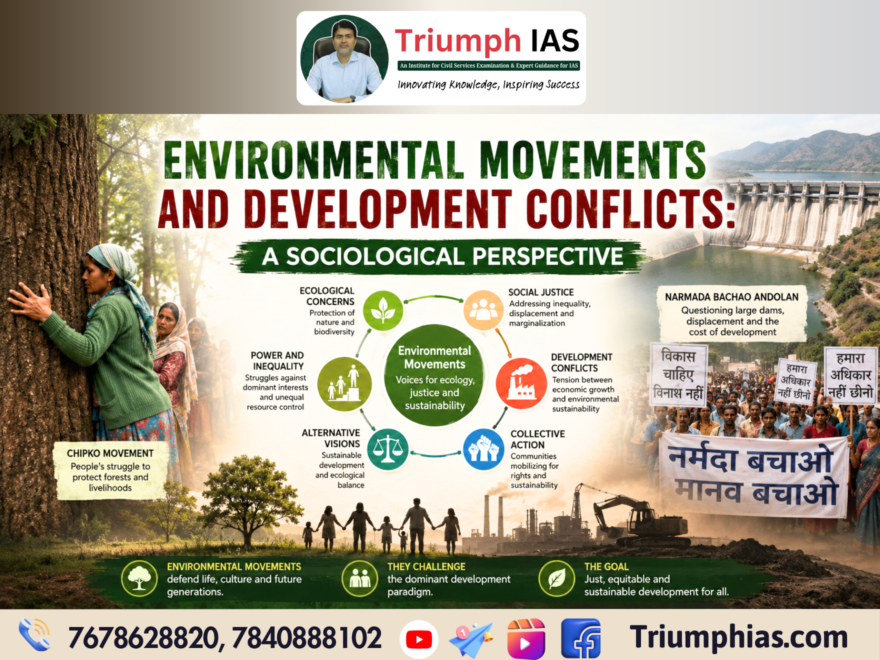
From a sociological perspective, environmental movements are collective efforts aimed at protecting natural resources, preserving ecosystems, and defending the rights of communities affected by developmental projects. Unlike traditional social movements focused primarily on political or economic issues, environmental movements connect ecological concerns with questions of power, inequality, displacement, and social justice.

One of the most significant environmental movements in India was the Chipko Movement of the 1970s in Uttarakhand. Villagers, particularly women, embraced trees to prevent commercial logging. The movement demonstrated that forests were not merely economic resources but essential for sustaining local livelihoods and ecological balance. Similarly, the Narmada Bachao Andolan challenged the displacement of thousands of people caused by large dam projects on the Narmada River. The movement questioned the prevailing model of development that prioritized economic benefits while neglecting social and environmental costs.

Sociologists have interpreted such movements through different theoretical perspectives. New Social Movement theory argues that contemporary movements are increasingly concerned with issues such as identity, quality of life, human rights, and environmental protection rather than purely economic interests. Environmental movements represent this shift by emphasizing sustainable development and ecological citizenship.

Conflict theorists view environmental disputes as struggles between powerful economic and political actors and marginalized communities. Large corporations and state agencies often possess greater control over resources and decision-making processes, while tribal groups, farmers, and rural populations bear the burden of displacement and environmental degradation. Development conflicts therefore reflect broader inequalities within society.

Environmental sociologists have also highlighted the concept of environmental justice. This perspective argues that environmental harms are distributed unequally across social groups. Vulnerable communities frequently experience greater exposure to pollution, deforestation, and displacement, while the benefits of development are often enjoyed by more privileged sections of society. Environmental movements seek to challenge these unequal outcomes and promote equitable access to natural resources.

The relationship between development and the environment has become increasingly important in the era of globalization and climate change. Rapid industrialization and urbanization have accelerated ecological pressures, including deforestation, water scarcity, biodiversity loss, and pollution. Consequently, environmental movements have expanded beyond local concerns to address global issues such as climate justice, sustainable development, and ecological sustainability.

In India, contemporary movements against mining in tribal regions, protests over industrial pollution, and campaigns for forest rights demonstrate the continuing relevance of environmental activism. These movements are not anti-development; rather, they advocate alternative models of development that balance economic growth with environmental protection and social welfare.

The concept of sustainable development provides a possible resolution to development conflicts. It emphasizes meeting present needs without compromising the ability of future generations to meet their own needs. Sustainable development seeks to integrate economic progress, social equity, and environmental conservation into a unified framework.

Conclusion

In conclusion, environmental movements represent a critical sociological response to the contradictions of modern development. They challenge dominant development paradigms, defend the rights of affected communities, and promote environmentally sustainable alternatives. As environmental challenges become more complex in the twenty-first century, understanding the sociology of environmental movements and development conflicts remains essential for creating a more just and sustainable society.

UPSC Civil Services (Mains) Question

Q. “Environmental movements in India are not merely ecological struggles but also movements for social justice and equitable development.” Critically examine. (20 Marks)

To Read more topicsvisit: www.triumphias.com/blogs

Read more Blogs:

Dalit and Backward Class Movements in Contemporary India

A good life is one inspired by love and guided by knowledge – Triumph IAS & Vikash Ranjan Sir

🔥 YOUR FINAL UPSC RANK CAN BE DECIDED BY JUST TWO PAPERS — ESSAY & OPTIONAL!

Most aspirants study hard.
But very few know how to convert knowledge into MARKS.

That’s where Triumph IAS creates the difference. 🚀

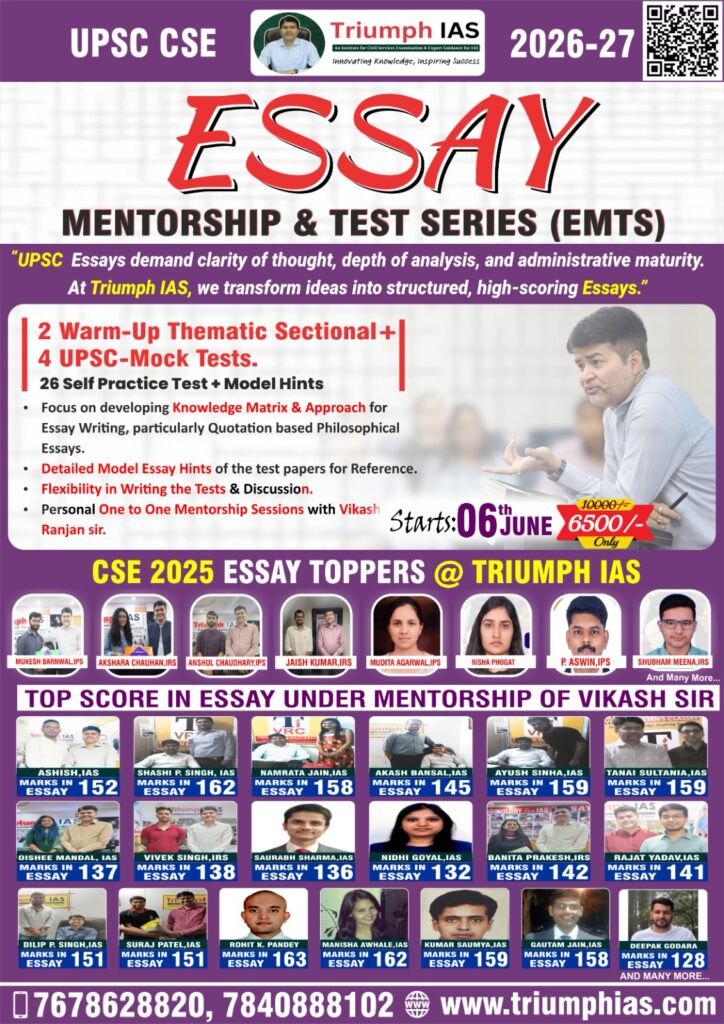
✍️ EMTS – Essay Mentorship & Test Series (CSE Mains 2026–27)

Under the mentorship of Vikash Ranjan Sir, master the art of writing structured, philosophical, multidimensional, and topper-level essays.

Scientific Essay Writing Approach
Knowledge Matrix Framework
5 Exclusive Essay Approach Classes
2 Thematic Tests + 4 UPSC Mock Tests
Detailed Model Essay Hints
Flexible Writing & Discussion Sessions
Personal 1-to-1 Mentorship

🏆 Trusted by UPSC Essay Toppers
━━━━━━━━━━━━━━━━━━

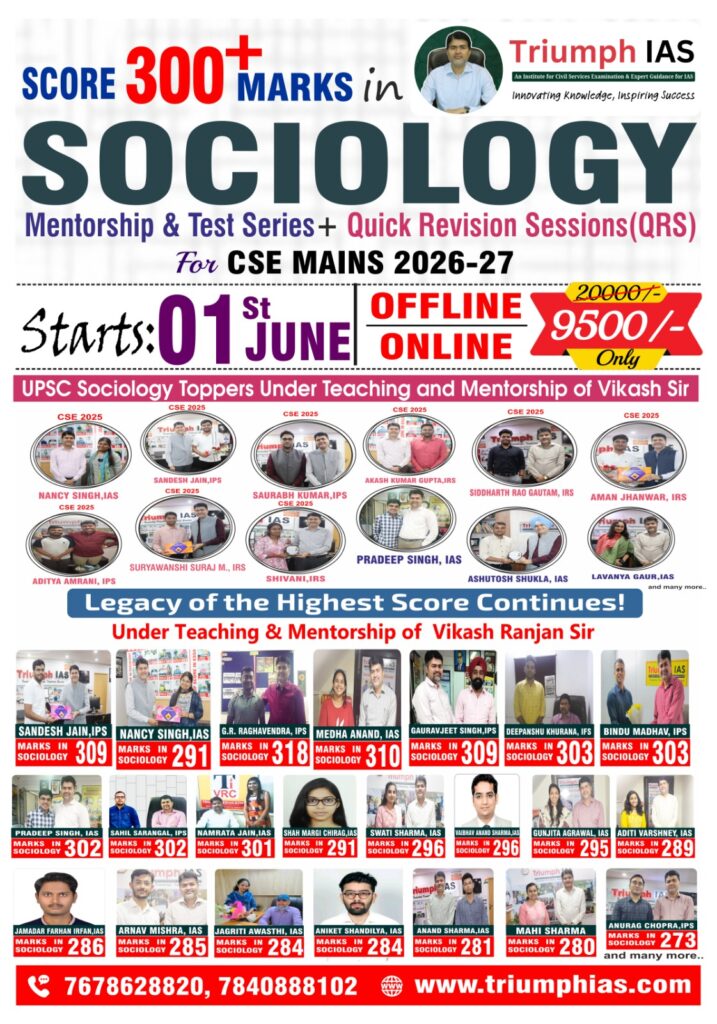
📚 SMTS – Sociology Mentorship & Test Series + Quick Revision Session (QRS)

🎯 SCORE 300+ MARKS IN SOCIOLOGY OPTIONAL

A structured, analytical, and result-oriented mentorship program designed to maximize your Sociology score under the guidance of Vikash Ranjan Sir.

Program Highlights:

26 Full-Length Tests with Detailed Evaluation
PYQ–NYQ Trend Analysis
Quick Revision Sessions on Unconventional Questions
Brainstorming & Concept Enrichment Sessions
1-to-1 Personal Mentorship Discussions
Topic-wise Answer Writing Practice
Current Social Issues Compilation
Home-based Practice Tests with Model Hints
Thinkers Integration & Value Addition Notes
Essay & GS Enrichment through Sociology

  • 🏆 Legacy of High Scores Continues:
  • 🌟 G.R. Raghavendra, IPS – 318
  • 🌟 Medha Anand, IAS – 310
  • 🌟 Sandesh Jain, IPS – 309
  • 🌟 Gauravjeet Singh, IPS – 309
  • 🌟 Deepanshu Khurana, IFS – 303
  • 🌟 Pradeep Singh, IAS – 302
  • 🌟 Swati Sharma, IAS – 296
  • 🌟 Gunjita Agarwal, IAS – 295

…and many more successful aspirants.

━━━━━━━━━━━━━━━━━

Batch Starts: 01 June

  • 📍 Available in OFFLINE & ONLINE Mode
  • 📞 Call/WhatsApp: 7678628820 | 7840888102
  • 🌐 triumphias.com
  • 📍 Triumph IAS
  • 23-B, 3rd Floor, Pusa Road
  • Near Karol Bagh Metro Pillar No. 114, New Delhi
EMTS – Essay Mentorship & Test Series (CSE Mains 2026–27)

One comment

Leave a Reply

Your email address will not be published. Required fields are marked *