
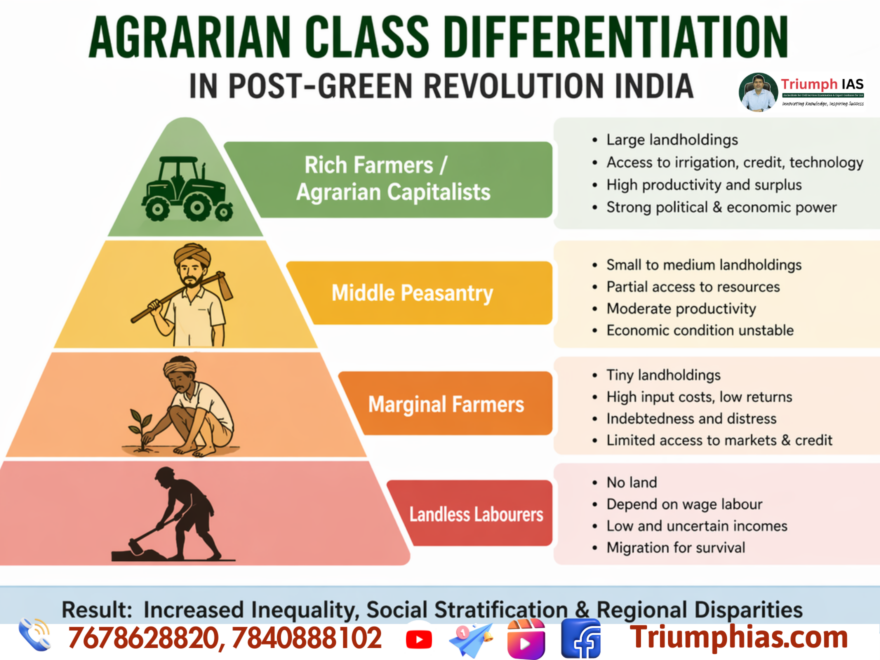
Relevant for Sociology Optional Paper 1, Paper 2, and GS Paper I (Indian Society)
IntroductionThe Green Revolution of the late 1960s and 1970s marked a decisive turning point in India’s agrarian structure. While it enhanced food security and transformed agricultural productivity, it also intensified class differentiation in rural society. Sociologically, this process can be understood through shifts in land ownership, access to technology, labour relations, and market integration. At its core, agrarian class differentiation refers to the emergence of distinct economic classes within the rural structure, primarily based on control over productive resources. The Green Revolution did not affect all regions and communities uniformly; instead, it produced uneven development, particularly in regions like Punjab, Haryana, and Western Uttar Pradesh. DimensionStructural Transformation and Class FormationPre-Green Revolution rural India was characterized by semi-feudal relations, where landlords dominated land and labour. However, the introduction of High-Yielding Variety (HYV) seeds, irrigation, fertilizers, and mechanization shifted the mode of production toward a more capital-intensive agrarian economy. Scholars like M. N. Srinivas highlighted the concept of “dominant caste,” where certain caste groups leveraged economic resources to consolidate power. In Green Revolution regions, these dominant castes—often middle peasant proprietors—emerged as agrarian capitalists, accumulating surplus through market-oriented agriculture. In contrast, A. R. Desai viewed this transformation through a Marxist lens, arguing that the Green Revolution accelerated capitalist relations in agriculture, leading to polarization between rich farmers and landless labourers. Patterns of Differentiation
Regional and Social InequalitiesThe Green Revolution deepened regional disparities, as benefits were concentrated in irrigated areas. Rainfed and tribal regions remained largely excluded, reinforcing uneven development. Additionally, class differentiation intersected with caste hierarchies. Lower castes and Dalits, traditionally dependent on agrarian labour, faced increased marginalization. Thus, economic stratification was not merely class-based but also caste-inflected, reinforcing social inequality. Changing Labour RelationsMechanization—tractors, harvesters—reduced dependence on human labour, altering traditional patron-client ties (jajmani system). Wage labour became more contractual and market-driven, weakening social obligations but also increasing insecurity for labourers. Migration became a survival strategy, with rural workers moving to cities or agriculturally advanced states, contributing to the phenomenon of circular migration. ConclusionAgrarian class differentiation in post-Green Revolution India reflects a transition from semi-feudal agrarian relations to capitalist agriculture, marked by inequality, regional imbalance, and social stratification. While the Green Revolution succeeded in ensuring food security, it also generated structural inequalities that continue to shape rural India. A nuanced understanding of these dynamics is essential for framing inclusive agricultural and rural development policies. |
UPSC Civil Services (Mains) Question
Q. “Critically examine the impact of the Green Revolution on agrarian class structure in India. Has it led to inclusive rural development?” (250 words)
To Read more topics, visit: www.triumphias.com/blogs
Read more Blogs:
Poets are the unacknowledged legislators of the world – Triumph IAS & Vikash Ranjan Sir
 SANDESH JAIN [B.Tech] SOCIOLOGY STRATEGY #UPSC CSE 2025
 𝐖𝐡𝐚𝐭 𝐦𝐚𝐤𝐞𝐬 𝐭𝐡𝐢𝐬 𝐚𝐜𝐡𝐢𝐞𝐯𝐞𝐦𝐞𝐧𝐭 𝐞𝐱𝐭𝐫𝐚𝐨𝐫𝐝𝐢𝐧𝐚𝐫𝐲 𝐢𝐬 𝐡𝐢𝐬 𝐒𝐨𝐜𝐢𝐨𝐥𝐨𝐠𝐲 𝐎𝐩𝐭𝐢𝐨𝐧𝐚𝐥 𝐬𝐜𝐨𝐫𝐞:
 𝐓𝐎𝐓𝐀𝐋 𝐒𝐎𝐂𝐈𝐎𝐋𝐎𝐆𝐘 𝐌𝐀𝐑𝐊𝐒: 𝟑𝟎𝟗
 𝐏𝐚𝐩𝐞𝐫 𝟏 – 173 Marks 𝐏𝐚𝐩𝐞𝐫 𝟐 – 136 Marks
 Single Source Preparation- Only #Vikash #Ranjan Sir’s Sociology Foundation Class Notes, Discussions, Application Strategies & Answer Writing Practice. No multiple books or Scattered Materials, No PDFs, No Free YouTube Time Wastes, No other Essentials.
 Offline Classroom Program
 Live Online Classes
 Tablet Course (Learn Anytime)
2 comments