
Relevant for Sociology Optional Paper 1, Paper 2, and GS Paper I (Indian Society)
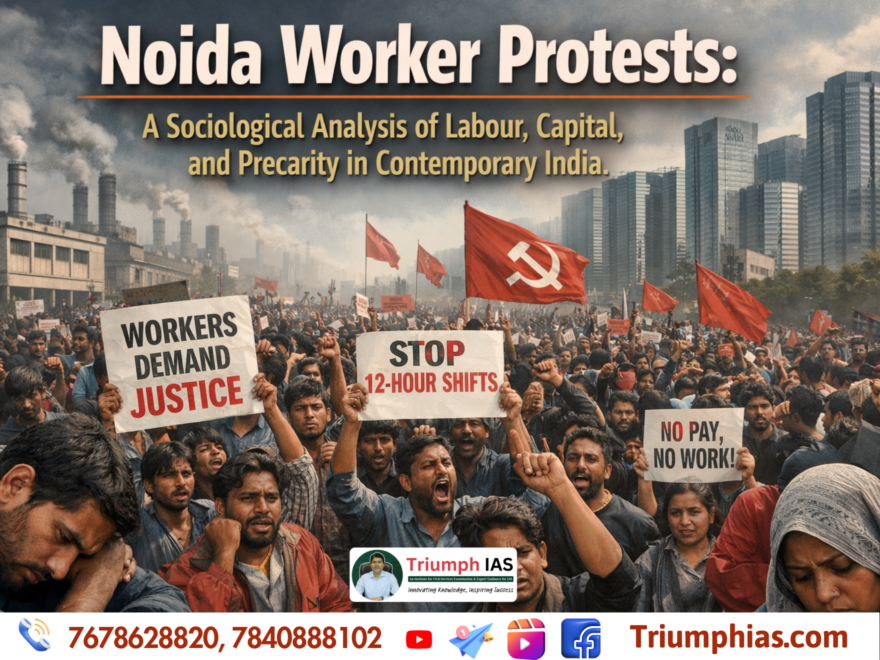
IntroductionThe recent worker protests in Noida are not an isolated eruption of discontent but a structural manifestation of contradictions within India’s contemporary industrial economy. While media narratives foreground issues such as 12-hour shifts, unpaid overtime, and low wages, a sociological lens reveals deeper processes—informalisation, commodification of labour, and crisis of social reproduction. These protests therefore must be interpreted not merely as economic grievances, but as collective responses to systemic inequalities embedded in neoliberal industrialisation. 1. Informalisation of Formal Labour: The Paradox of Industrial GrowthNoida, as a major industrial hub, represents the success of India’s manufacturing expansion. However, this growth has been accompanied by what sociologists term “informalisation of the formal sector.” Despite working in registered factories, workers experience:
This reflects a broader transformation where formal institutions coexist with informal labour practices, diluting regulatory protections. The rise of contract labour systems further fragments employer accountability, creating what can be conceptualised as a “dispersed control regime”. 2. Labour Exploitation and Surplus Extraction: A Marxian ReadingAt the core of the protests lies a classical issue—the extraction of surplus value. Workers report long hours without proportional compensation, indicating an intensification of exploitation. From a Marxist perspective:
This creates a widening gap between labour contribution and remuneration, reinforcing class inequalities. The protests signal a shift from passive endurance to active class assertion, suggesting an emerging class-for-itself consciousness. 3. Relative Deprivation and Wage InequalityAn important trigger of the unrest is not absolute poverty but relative deprivation. Workers compare their wages with:
This aligns with Runciman’s theory of relative deprivation, where dissatisfaction emerges not from deprivation per se, but from perceived inequality. Thus, the protests are driven by comparative injustice, not mere subsistence crisis. 4. Precarity and the Crisis of Social ReproductionLow wages and unstable employment have direct implications for workers’ ability to sustain daily life—food, housing, healthcare, and education. This leads to what feminist sociologists describe as a “crisis of social reproduction.” Workers are unable to:
This crisis extends beyond the workplace into the household, making labour unrest a reflection of broader social instability. 5. Contractualisation and Disembedded Labour RelationsThe dominance of contractors in labour recruitment has fundamentally altered industrial relations. Workers often do not interact directly with factory owners, resulting in:
This aligns with Karl Polanyi’s idea of “disembedded markets”, where economic relations are detached from social obligations. Labour becomes a pure commodity, stripped of social protection. 6. State, Policy, and the Question of Labour GovernanceThe state’s response—primarily wage revisions and law-and-order measures—reveals a reactive rather than structural approach. The broader trend indicates:
This reflects a shift toward what can be described as a “pro-market regulatory regime”, where labour rights are subordinated to investment priorities. 7. Collective Action and the Re-emergence of Labour PoliticsThe scale and intensity of the protests indicate a revival of labour collectivism in an era often characterised by fragmented workforces. Despite contractual divisions, workers mobilised around shared grievances. This suggests:
In sociological terms, this marks a transition from individualised precarity to collective mobilisation. Conclusion: Structural Contradictions and the Future of LabourThe Noida worker protests highlight a fundamental contradiction:
The issue is not merely about wages or working hours, but about the nature of development itself. When economic growth is decoupled from social justice, it generates conditions for unrest. A sustainable resolution requires:
Ultimately, the protests are a reminder that labour is not just a factor of production, but a social entity demanding dignity, security, and recognition. |
To Read more topics, visit: www.triumphias.com/blogs
Read more Blogs:
Forests are the best case studies for economic excellence – Triumph IAS & Vikash Ranjan Sir
 SANDESH JAIN [B.Tech] SOCIOLOGY STRATEGY #UPSC CSE 2025
 𝐖𝐡𝐚𝐭 𝐦𝐚𝐤𝐞𝐬 𝐭𝐡𝐢𝐬 𝐚𝐜𝐡𝐢𝐞𝐯𝐞𝐦𝐞𝐧𝐭 𝐞𝐱𝐭𝐫𝐚𝐨𝐫𝐝𝐢𝐧𝐚𝐫𝐲 𝐢𝐬 𝐡𝐢𝐬 𝐒𝐨𝐜𝐢𝐨𝐥𝐨𝐠𝐲 𝐎𝐩𝐭𝐢𝐨𝐧𝐚𝐥 𝐬𝐜𝐨𝐫𝐞:
 𝐓𝐎𝐓𝐀𝐋 𝐒𝐎𝐂𝐈𝐎𝐋𝐎𝐆𝐘 𝐌𝐀𝐑𝐊𝐒: 𝟑𝟎𝟗
 𝐏𝐚𝐩𝐞𝐫 𝟏 – 173 Marks 𝐏𝐚𝐩𝐞𝐫 𝟐 – 136 Marks
 Single Source Preparation- Only #Vikash #Ranjan Sir’s Sociology Foundation Class Notes, Discussions, Application Strategies & Answer Writing Practice. No multiple books or Scattered Materials, No PDFs, No Free YouTube Time Wastes, No other Essentials.
 Offline Classroom Program
 Live Online Classes
 Tablet Course (Learn Anytime)
2 comments