
Relevant for Sociology Optional Paper 1, Paper 2, and GS Paper I (Indian Society)
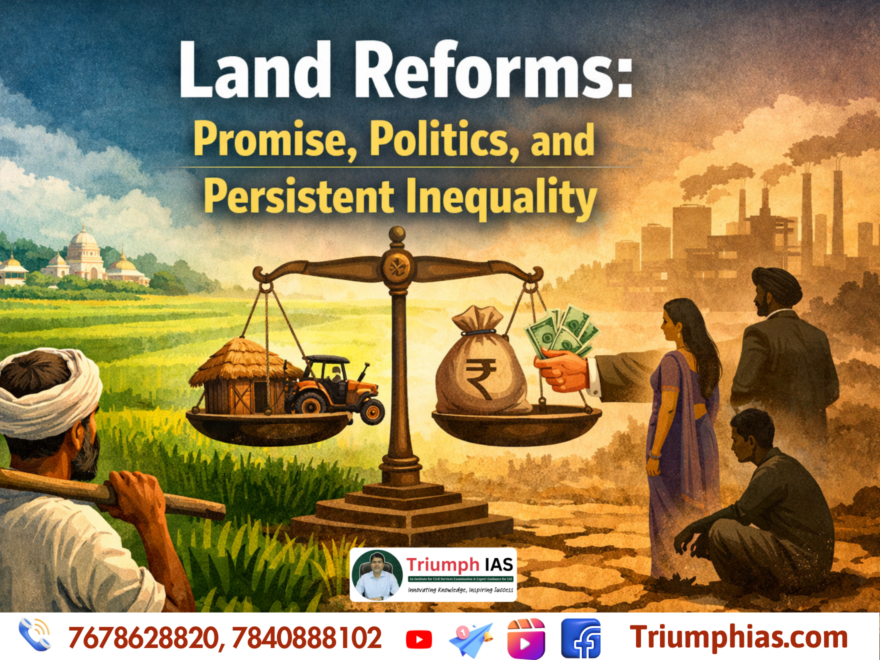
IntroductionLand reforms in India were envisioned as a transformative project to dismantle semi-feudal agrarian structures and promote social justice after independence. Rooted in ideals of equity and redistribution, these reforms sought to address historical injustices embedded in land ownership patterns shaped during colonial rule. However, despite early optimism, their outcomes reveal a complex interplay of structural constraints, political interests, and enduring inequalities. DimensionAt the core, land reforms included three major components: abolition of intermediaries (zamindari system), tenancy regulation, and land ceiling laws. The abolition of zamindari aimed to eliminate exploitative rent-seeking intermediaries, transferring ownership rights directly to cultivators. This was expected to democratize agrarian relations and weaken entrenched hierarchies. From a sociological lens, however, the implementation varied significantly across regions due to differences in power structures. Scholars like M. N. Srinivas highlighted how dominant castes adapted to reforms, often retaining control over land through legal loopholes or informal mechanisms. Instead of radical redistribution, reforms frequently resulted in the consolidation of land among locally powerful groups. Similarly, tenancy reforms aimed to provide security to tenant farmers and regulate rents. While states like West Bengal (Operation Barga) demonstrated relative success, in many regions tenancy was concealed to evade legal provisions. This reflects what Karl Marx would identify as structural resistance by landed elites to protect economic interests, revealing the class dimension of agrarian relations. Land ceiling laws were perhaps the most ambitious yet least effective component. Intended to redistribute surplus land to the landless, these laws were undermined by benami transfers, fragmentation, and administrative inefficiencies. Consequently, the expected egalitarian transformation remained limited. The persistence of inequality in rural India is thus not merely an economic issue but deeply sociological. Land ownership intersects with caste, class, and gender. Dalits and Adivasis continue to be disproportionately landless, reinforcing cycles of marginalization. Gender inequality is equally stark—despite legal provisions, women’s land ownership remains minimal due to patriarchal inheritance norms. Furthermore, land reforms did not adequately address the transition to capitalist agriculture. With the Green Revolution, new forms of inequality emerged based on access to technology, irrigation, and credit. This aligns with the Marxist critique that reforms without structural transformation tend to reproduce inequality in new forms. From a contemporary perspective, land reforms remain relevant in debates around farmer distress, agrarian crisis, and rural development. The rise of contract farming and corporate entry into agriculture raises new questions about land rights and dispossession. Thus, the unfinished agenda of land reforms continues to shape India’s rural sociology. ConclusionIn conclusion, land reforms in India illustrate the gap between policy intent and social reality. While they succeeded in weakening feudal structures to some extent, they fell short of achieving substantive equality. A renewed focus on land rights, inclusive policies, and institutional accountability is essential to address persistent disparities. |
UPSC Civil Services (Mains) Question
Q. “Land reforms in India have largely failed to achieve their redistributive goals due to entrenched social structures.” Critically examine. (250 words)
To Read more topics, visit: www.triumphias.com/blogs
Read more Blogs:
Not all who wander are lost – Triumph IAS & Vikash Ranjan Sir
 SANDESH JAIN [B.Tech] SOCIOLOGY STRATEGY #UPSC CSE 2025
 𝐖𝐡𝐚𝐭 𝐦𝐚𝐤𝐞𝐬 𝐭𝐡𝐢𝐬 𝐚𝐜𝐡𝐢𝐞𝐯𝐞𝐦𝐞𝐧𝐭 𝐞𝐱𝐭𝐫𝐚𝐨𝐫𝐝𝐢𝐧𝐚𝐫𝐲 𝐢𝐬 𝐡𝐢𝐬 𝐒𝐨𝐜𝐢𝐨𝐥𝐨𝐠𝐲 𝐎𝐩𝐭𝐢𝐨𝐧𝐚𝐥 𝐬𝐜𝐨𝐫𝐞:
 𝐓𝐎𝐓𝐀𝐋 𝐒𝐎𝐂𝐈𝐎𝐋𝐎𝐆𝐘 𝐌𝐀𝐑𝐊𝐒: 𝟑𝟎𝟗
 𝐏𝐚𝐩𝐞𝐫 𝟏 – 173 Marks 𝐏𝐚𝐩𝐞𝐫 𝟐 – 136 Marks
 Single Source Preparation- Only #Vikash #Ranjan Sir’s Sociology Foundation Class Notes, Discussions, Application Strategies & Answer Writing Practice. No multiple books or Scattered Materials, No PDFs, No Free YouTube Time Wastes, No other Essentials.
 Offline Classroom Program
 Live Online Classes
 Tablet Course (Learn Anytime)
One comment