Relevant for Sociology Optional Paper 1, Paper 2, and GS Paper I (Indian Society)
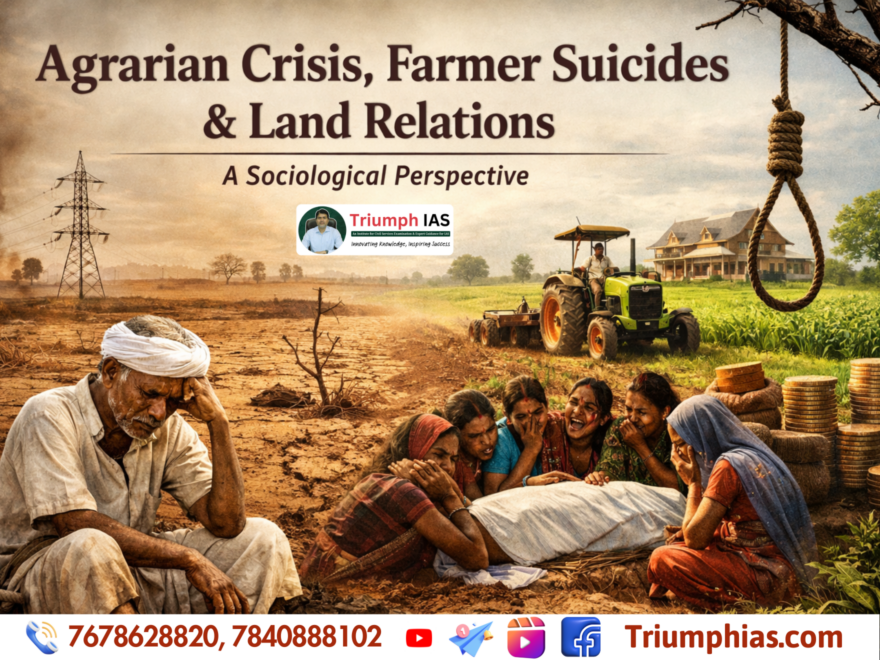
IntroductionIndia’s agrarian structure has long been central to its socio-economic fabric, yet it remains fraught with deep inequalities and systemic vulnerabilities. The ongoing agrarian crisis, reflected starkly in the phenomenon of farmer suicides, cannot be understood merely as an economic issue—it is fundamentally sociological, rooted in historical land relations, institutional failures, and changing rural dynamics. DimensionUnderstanding the Agrarian CrisisThe agrarian crisis refers to the persistent distress in the agricultural sector characterized by low productivity, declining profitability, rising indebtedness, and ecological degradation. While agriculture employs a significant proportion of India’s workforce, its contribution to GDP has steadily declined, creating a structural imbalance. From a sociological standpoint, this crisis is linked to the transformation of rural society under the forces of modernization, globalization, and state policies. The shift from subsistence farming to market-oriented agriculture has exposed farmers to volatile price mechanisms and global competition, often without adequate institutional support. Farmer Suicides: Beyond Economic DeterminismFarmer suicides represent the most tragic manifestation of agrarian distress. While indebtedness, crop failure, and lack of institutional credit are immediate triggers, sociologists argue that these deaths must be understood within a broader social context. Firstly, the erosion of traditional community support systems has intensified individual vulnerability. Earlier, kinship networks and caste-based solidarities provided informal safety nets; however, with increasing individualization and migration, these mechanisms have weakened. Secondly, the cultural dimension of agrarian life—where land ownership is tied to identity, status, and masculinity—amplifies psychological stress. Failure in farming is not merely economic loss but a loss of dignity and social standing, leading to what can be termed “status anxiety.” Thirdly, state policies often fail to address the lived realities of marginal and small farmers. Institutional credit systems remain inaccessible to many, forcing reliance on informal moneylenders who charge exorbitant interest rates, perpetuating cycles of debt. Land Relations and Structural InequalityAt the core of the agrarian crisis lies the question of land relations. India’s agrarian structure is historically shaped by unequal land distribution, semi-feudal relations, and incomplete land reforms. Despite post-independence efforts such as land ceiling acts and tenancy reforms, significant disparities persist. A large number of farmers are either landless laborers or marginal landholders, making them highly vulnerable to economic shocks. The persistence of informal tenancy further complicates the issue. Many cultivators do not possess legal rights over the land they farm, excluding them from institutional benefits such as subsidies, crop insurance, and credit facilities. This creates a class of “invisible farmers” who bear the risks without corresponding protections. Moreover, the commercialization of agriculture has altered class relations in rural areas. The rise of capitalist farming has led to differentiation within the peasantry—rich farmers benefit from mechanization and market access, while small farmers are pushed into distress and, often, out of agriculture altogether. Theoretical InsightsDifferent sociological perspectives provide valuable insights into the agrarian crisis:
Way Forward: A Sociological ApproachAddressing the agrarian crisis requires more than economic interventions—it demands a holistic, sociologically informed approach:
The agrarian crisis is not merely about declining agricultural output; it is about the erosion of rural livelihoods, identities, and social structures. Any meaningful solution must therefore engage with the deeper sociological roots of the problem. |
UPSC Civil Services (Mains) Question
Q. “Farmer suicides in India are not merely an economic issue but a reflection of deeper structural and sociological problems.” Discuss. (250 words)
To Read more topics, visit: www.triumphias.com/blogs
Read more Blogs:
Not all who wander are lost – Triumph IAS & Vikash Ranjan Sir
 SANDESH JAIN [B.Tech] SOCIOLOGY STRATEGY #UPSC CSE 2025
 𝐖𝐡𝐚𝐭 𝐦𝐚𝐤𝐞𝐬 𝐭𝐡𝐢𝐬 𝐚𝐜𝐡𝐢𝐞𝐯𝐞𝐦𝐞𝐧𝐭 𝐞𝐱𝐭𝐫𝐚𝐨𝐫𝐝𝐢𝐧𝐚𝐫𝐲 𝐢𝐬 𝐡𝐢𝐬 𝐒𝐨𝐜𝐢𝐨𝐥𝐨𝐠𝐲 𝐎𝐩𝐭𝐢𝐨𝐧𝐚𝐥 𝐬𝐜𝐨𝐫𝐞:
 𝐓𝐎𝐓𝐀𝐋 𝐒𝐎𝐂𝐈𝐎𝐋𝐎𝐆𝐘 𝐌𝐀𝐑𝐊𝐒: 𝟑𝟎𝟗
 𝐏𝐚𝐩𝐞𝐫 𝟏 – 173 Marks 𝐏𝐚𝐩𝐞𝐫 𝟐 – 136 Marks
 Single Source Preparation- Only #Vikash #Ranjan Sir’s Sociology Foundation Class Notes, Discussions, Application Strategies & Answer Writing Practice. No multiple books or Scattered Materials, No PDFs, No Free YouTube Time Wastes, No other Essentials.
 Offline Classroom Program
 Live Online Classes
 Tablet Course (Learn Anytime)