Introduction
Sociology, as a scientific study of society, has historically aspired to objectivity, neutrality, and value-freedom. However, in the contemporary era marked by ideological polarization, hyper-nationalism, and media trials, the very possibility of objectivity in sociology is under serious strain. Social realities today are not merely observed; they are constructed, framed, sensationalised, and contested in real time by media narratives and ideological positions. This raises a fundamental sociological question: Can sociology remain objective in an age where knowledge itself is politicised?
Dimension:
Classical Foundations of Objectivity in Sociology
The discipline of sociology emerged with a strong commitment to scientific objectivity.
-
Max Weber argued for value-neutrality (Wertfreiheit), insisting that while values may guide the choice of research topics, the analysis itself must remain free from personal and political bias.
-
Émile Durkheim treated social facts as “things”—external, coercive realities that could be studied empirically.
-
Even Karl Marx, though overtly normative, maintained a structural and materialist analysis rather than impressionistic opinion.
Thus, objectivity was not absence of perspective, but methodological discipline and reflexivity.
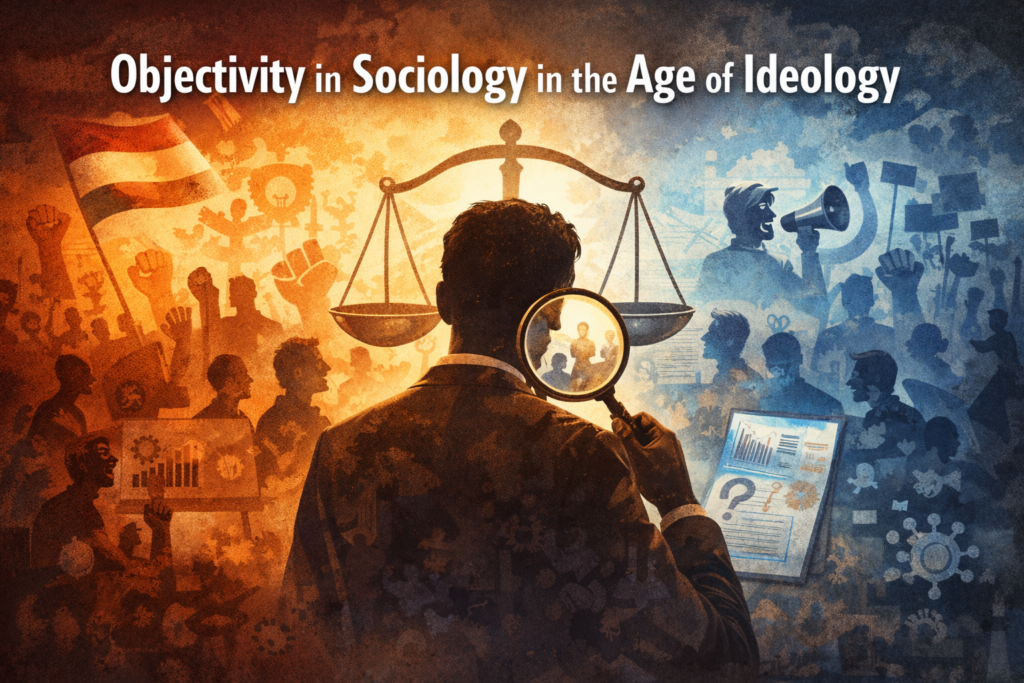
Ideology and the Production of Knowledge
In contemporary societies, ideology increasingly shapes what is considered “truth.” Nationalism, neoliberalism, identity politics, and cultural majoritarianism influence research funding, academic freedom, and public reception of sociological knowledge. Sociology, which often critiques power structures, is frequently labelled as “anti-national,” “biased,” or “activist.”
This reflects what Antonio Gramsci described as cultural hegemony, where dominant groups shape common sense and delegitimise alternative viewpoints. Objectivity is thus challenged not only internally but also externally through ideological pressure.
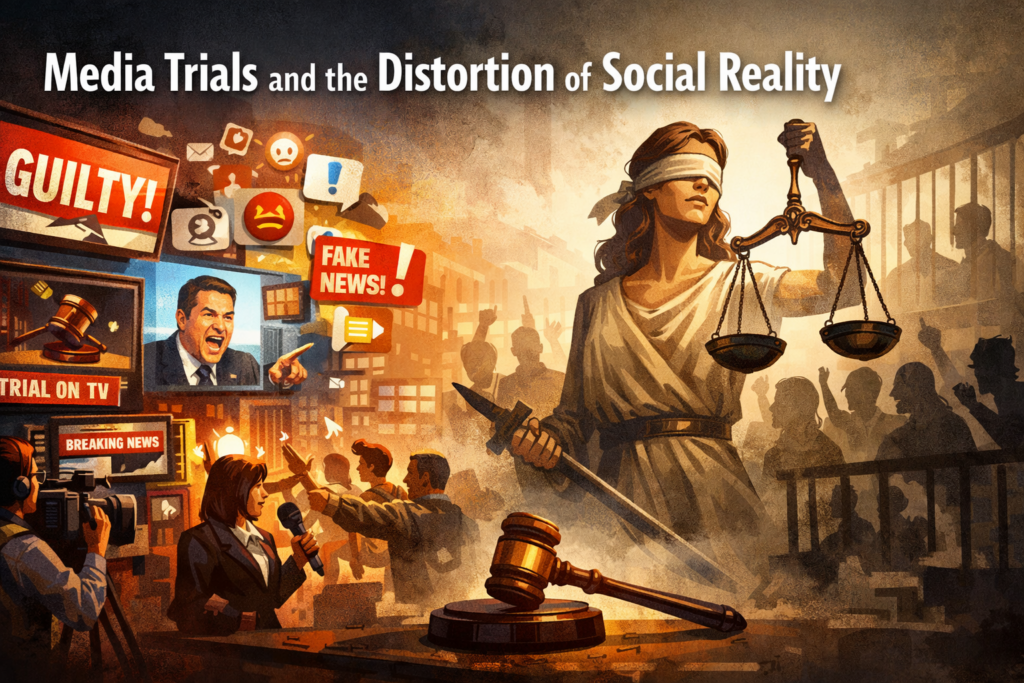
Media Trials and the Distortion of Social Reality
The rise of 24×7 news cycles and social media platforms has led to the phenomenon of media trials, where complex social issues are reduced to binaries of guilt/innocence, patriot/traitor, victim/perpetrator. Sociological nuance is sacrificed for TRPs, virality, and moral outrage.
Media framing often precedes judicial outcomes, influencing public opinion and policy debates. Sociology, which relies on contextualisation, structural causation, and long-term patterns, finds itself competing with instant judgments and emotional narratives. This environment discourages detached analysis and encourages conformity to dominant narratives.
Post-Truth Era and Methodological Challenges
The contemporary world is often described as a post-truth society, where beliefs override evidence. Algorithms curate information silos, reinforcing confirmation bias. In such a context, sociological research faces challenges such as:
As Jürgen Habermas warned, the erosion of rational-critical public discourse undermines democratic deliberation—and by extension, objective social science.
Reflexivity: A New Path to Objectivity
Modern sociology increasingly acknowledges that complete neutrality is impossible, but argues for reflexive objectivity. Sociologists must:
-
Declare their positionality
-
Use transparent methods
-
Rely on triangulation and peer review
-
Distinguish clearly between empirical analysis and normative judgment
Objectivity today lies not in denial of values, but in systematic control over bias.
Conclusion: Reclaiming Sociology’s Critical Role
In the age of ideology and media trials, objectivity in sociology is under siege—but not obsolete. Rather, it demands greater methodological rigor, ethical responsibility, and intellectual courage. Sociology must resist both ideological co-option and media sensationalism to remain a credible interpreter of social reality. For democratic societies, an objective sociology is not a luxury—it is a necessity.
|


2 comments