
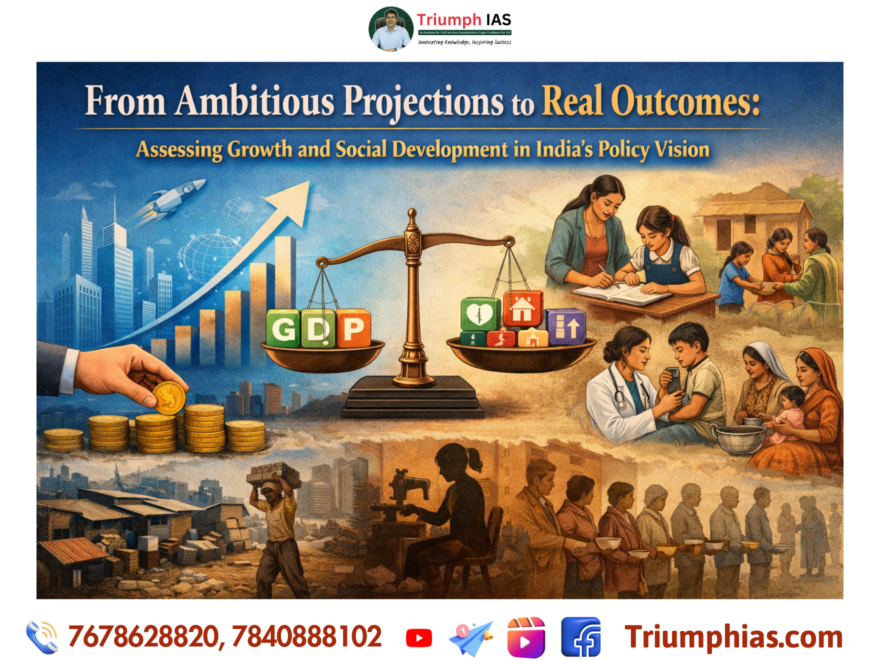
From Ambitious Projections to Real Outcomes: Assessing Growth and Social Development in India’s Policy Vision
(Relevant for Sociology, Society [GS] & Essay 𝐏𝐚𝐩𝐞𝐫)
Introduction“How much of this ambitious projection game shall translate into realised growth and developmental spending that leads to measurable, progressive social outcomes?” This question, posed by Deepanshu Mohan and Saksham Raj, strikes at the heart of India’s contemporary political economy. In recent years, policy discourse—particularly around budgets and macroeconomic planning—has been marked by bold projections of growth, investment, and global leadership. However, sociology urges us to move beyond headline figures and interrogate whether such projections meaningfully translate into developmental spending, social inclusion, and improved human capabilities. For UPSC aspirants, this debate is crucial, as it links economic growth with social justice, state capacity, and the lived realities of citizens.
The Politics of Projections and Growth NarrativesModern states increasingly rely on growth projections as instruments of political communication and market signalling. High GDP growth estimates reassure investors, enhance global credibility, and construct an image of economic dynamism. However, from a sociological perspective, projections are not neutral numbers; they are political narratives that shape public expectations and policy priorities. The risk lies in conflating projected growth with realised development. Growth, measured narrowly through GDP, may coexist with stagnant wages, informalisation of labour, and uneven regional development. Thus, the key sociological question is not whether growth is projected, but who benefits from it and through which social channels.
Developmental Spending and State ResponsibilityDevelopmental spending—on health, education, nutrition, housing, and social security—is the primary mechanism through which economic growth is converted into social outcomes. Sociological theories of the welfare state emphasize that markets alone cannot address structural inequalities rooted in class, caste, gender, and region. When fiscal policy prioritises capital expenditure and infrastructure without proportionate investment in human development, growth risks becoming job-poor and exclusionary. For instance, inadequate spending on public health and education disproportionately affects marginalized communities, reinforcing intergenerational inequality. Sociology thus foregrounds the idea that state expenditure is not merely economic allocation but social intervention. Measurable Outcomes vs. Aggregate IndicatorsA critical concern raised by analysts is the gap between aggregate indicators and lived realities. While macro-level data may show improvements in fiscal discipline or investment inflows, micro-level indicators—such as nutritional status, learning outcomes, women’s labour force participation, and employment security—often tell a more complex story. From a sociological standpoint, measurable social outcomes must be evaluated through disaggregated data. Development becomes meaningful only when it enhances capabilities across social groups rather than amplifying existing hierarchies. Without such evaluation, ambitious projections risk becoming symbolic exercises detached from social transformation.
Inequality, Informality, and Social StratificationIndia’s growth trajectory is deeply shaped by its social structure. A large informal workforce, persistent caste-based inequalities, and gendered divisions of labour limit the trickle-down potential of growth. Digitalisation and formalisation drives, while promising efficiency, may also marginalise those lacking skills, access, or social capital. Sociology highlights that growth without redistribution can intensify relative deprivation, leading to social discontent and weakened social cohesion. Therefore, developmental spending must consciously target structural disadvantages rather than assume automatic inclusion through growth.
Bridging the Gap: From Projections to Social ProgressFor ambitious projections to translate into progressive outcomes, three conditions are essential. First, policy coherence, where economic and social policies reinforce each other. Second, institutional capacity, ensuring effective implementation and accountability. Third, social orientation, where development is evaluated in terms of dignity, security, and opportunity rather than numerical growth alone. In this sense, sociology complements economics by reminding policymakers that societies do not develop automatically with growth; they develop when growth is socially embedded and ethically directed. ConclusionThe critique advanced by Deepanshu Mohan and Saksham Raj invites a deeper sociological interrogation of India’s development strategy. Ambitious projections may be necessary, but they are insufficient unless anchored in sustained developmental spending and measurable social outcomes. For UPSC aspirants, this debate underscores a foundational insight: economic growth is a means, not an end. The true test of policy lies in its capacity to transform social structures, reduce inequality, and expand human well-being. Only when projections are matched by inclusive implementation can growth evolve into genuine social progress. |

To Read more topics, visit: www.triumphias.com/blogs
Read more Blogs:
Global Diplomacy Takes Center Stage: The World Economic Forum at Davos
2 comments