
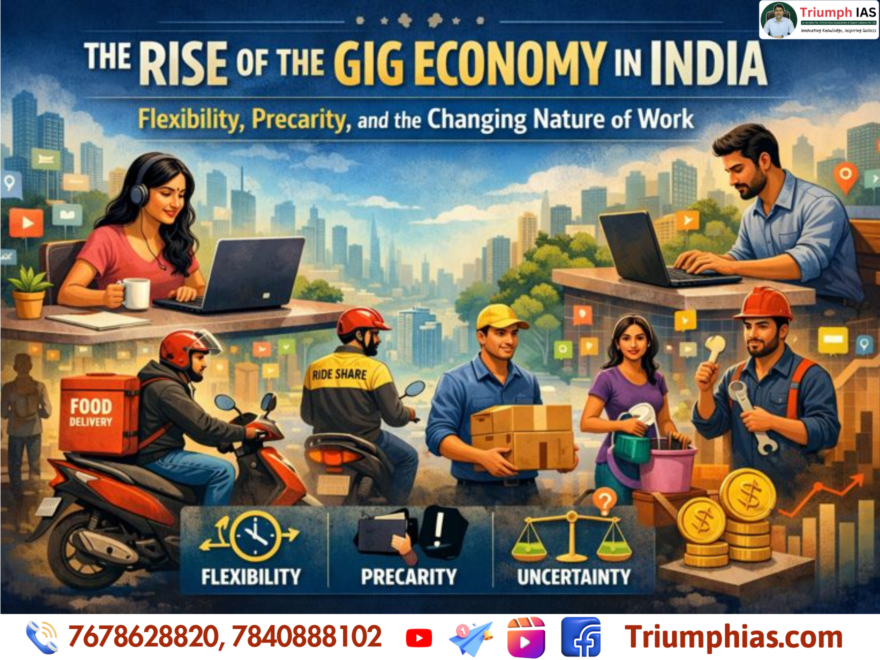
The Rise of the Gig Economy in India: Flexibility, Precarity, and the Changing Nature of Work
(Relevant for Sociology Paper 2)
|
India is witnessing a profound transformation in the nature of work. From food delivery partners and ride-hailing drivers to freelance designers, coders, content creators, and home-service providers, millions of workers are now part of what is commonly known as the gig economy. Enabled by digital platforms and driven by urban demand for convenience, gig work has rapidly become a defining feature of India’s contemporary labour market. While often celebrated for flexibility and entrepreneurship, the gig economy also raises serious concerns about job security, workers’ rights, social protection, and inequality. This dual character makes it a crucial subject in today’s current affairs—one that sits at the intersection of technology, economy, labour, and social justice. Understanding the Gig EconomyThe gig economy refers to a labour market characterized by short-term contracts, task-based work, or freelance arrangements, rather than permanent employment. Workers are paid per task or “gig” and are typically classified as independent contractors rather than employees. In India, gig work has expanded rapidly due to:
Examples include:
This model marks a shift from standard employment to platform-mediated labour. Why the Gig Economy Is Expanding in India1. Demographic Pressure and Employment GapsIndia’s young population enters a labour market that struggles to create enough formal jobs. Gig work fills this gap by absorbing surplus labour, especially in urban areas. 2. Platform CapitalismDigital platforms act as intermediaries connecting workers and consumers. Algorithms, ratings, and data analytics now regulate work instead of traditional supervisors. 3. Flexibility and Low Entry BarriersGig work requires minimal qualifications, making it accessible to migrants, students, and informal workers transitioning to digital platforms. 4. Post-Pandemic ShiftsThe COVID-19 pandemic accelerated platform dependence, normalizing home delivery and remote freelance work. Promises of the Gig EconomySupporters of the gig economy argue that it offers several advantages: FlexibilityWorkers can choose working hours, locations, and frequency of work—especially attractive to students and secondary earners. Income OpportunitiesFor many migrants and urban poor, gig work provides an immediate source of income without lengthy recruitment processes. Entrepreneurial NarrativePlatforms often frame gig workers as “partners” or “micro-entrepreneurs,” emphasizing independence and self-employment. Economic EfficiencyFrom a consumer perspective, gig platforms reduce transaction costs and improve service availability. These factors explain why gig work is often portrayed as a modern and progressive employment model. The Dark Side: Precarity and InsecurityDespite its promise, the gig economy is marked by deep structural vulnerabilities. 1. Lack of Job SecurityGig workers can be de-platformed without notice. There is no guarantee of minimum wages, stable income, or long-term employment. 2. Absence of Social SecurityMost gig workers lack:
This places them outside the traditional welfare framework. 3. Algorithmic ControlAlthough presented as “independent,” workers are tightly controlled by algorithms that:
This creates a paradox of controlled autonomy. 4. Income VolatilityEarnings fluctuate based on demand, incentives, and platform policies, pushing workers into economic uncertainty. Sociological Perspective: Is Gig Work Really ‘Free’?From a sociological lens, the gig economy represents a new form of informalisation of labour within a digital framework. Karl Marx: Labour and ExploitationGig platforms extract surplus value while shifting risks onto workers—fuel, maintenance, insurance—mirroring capitalist exploitation in a new form. Max Weber: RationalisationWork is increasingly governed by impersonal algorithms, efficiency metrics, and calculability, intensifying rational control. Guy Standing: The PrecariatGig workers fit into the concept of the “precariat”—a class marked by insecurity, unstable income, and lack of occupational identity. Thus, gig work challenges the idea that flexibility automatically translates into freedom. Gig Economy and InequalityClass DimensionMost platform owners and investors belong to the global elite, while workers remain replaceable and fragmented. Gender DimensionWomen face additional challenges:
While gig work offers flexibility, it often reinforces existing gender inequalities. Caste and MigrationUrban gig workers are disproportionately from marginalized castes and migrant backgrounds, reproducing social hierarchies in digital form. State Response and Policy Measures in IndiaRecognizing the scale of gig employment, the Indian state has begun addressing worker vulnerabilities. Code on Social Security, 2020For the first time, the law recognizes gig and platform workers and proposes:
However, implementation remains weak and largely dependent on platform contributions. Judicial InterventionsCourts have increasingly questioned:
Yet, clear legal standards are still evolving. Global Comparisons and LessonsSeveral countries have taken stronger steps:
India can draw lessons from these models while adapting to its own informal-heavy labour structure. Future of Work: What Lies Ahead?The gig economy is unlikely to disappear. Instead, the challenge lies in regulating without destroying flexibility. Key priorities include:
The future of work must balance innovation with dignity. Why This Topic Matters in Today’s Current Affairs
Conclusion: Convenience for Some, Insecurity for ManyThe gig economy captures the contradictions of contemporary capitalism. It offers convenience to consumers and flexibility to workers—but at the cost of security, stability, and rights. As India moves toward a digital future, the challenge is not whether gig work should exist, but how it should be governed. Ensuring fair wages, social protection, and dignity of labour will determine whether the gig economy becomes a tool of empowerment or a new form of exploitation. |
To Read more topics, visit: www.triumphias.com/blogs
Read more Blogs:
Economy and Inflation: Navigating Uncertainty in a Changing Global Order
A World at a Crossroads: India and Global Developments Shaping January 2026
One comment