
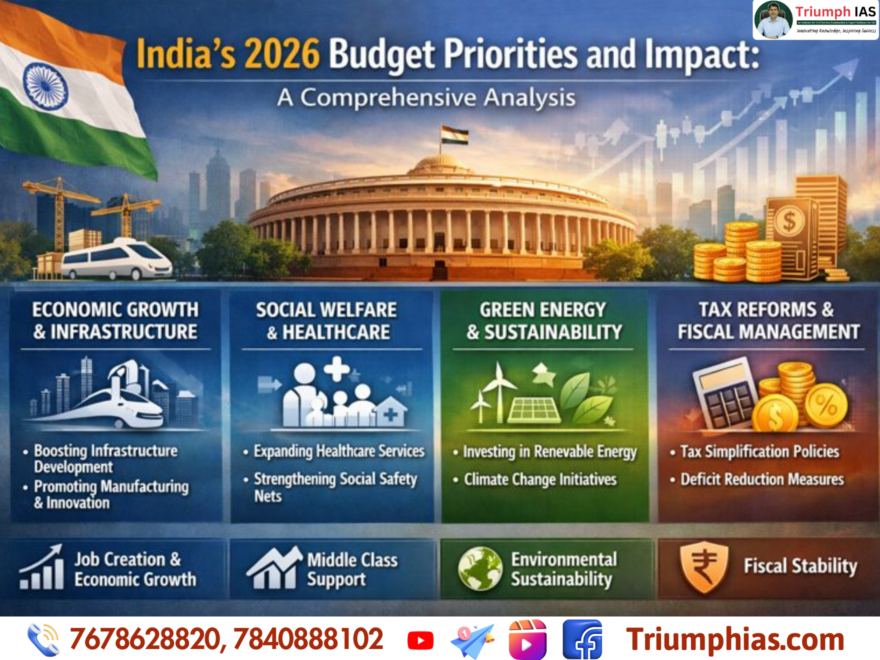
India’s 2026 Budget Priorities and Impact: A Comprehensive Analysis
(Relevant for Sociology Paper 2: Vision of Social changes in India, politics and Society and Rural Agrarian transformation in India)
IntroductionIndia’s Union Budget 2026–27, scheduled to be presented on 1 February 2026, comes at a critical juncture for the Indian economy. The country stands out as one of the fastest-growing major economies in the world, even as global growth slows due to geopolitical tensions, high interest rates, and supply-chain disruptions. Against this backdrop, Budget 2026 is expected to consolidate economic gains while addressing emerging structural challenges. The government’s long-term vision of “Viksit Bharat @2047”—transforming India into a developed nation—continues to guide fiscal policymaking. Budget 2026 is therefore not just an annual financial statement, but a strategic instrument aimed at balancing growth, fiscal prudence, social justice, and sustainability. This blog examines the key priorities of India’s 2026 Budget, the economic rationale behind them, and their sectoral and societal impact, using current economic data and policy trends. India’s Economic Context Ahead of Budget 2026Growth PerformanceIndia’s real GDP growth for FY 2025–26 is estimated at around 7–7.5%, driven by strong domestic demand, rising capital investment, and improving manufacturing output. This growth rate places India well above the global average, which remains below 3%. Key drivers of growth include:
However, challenges such as uneven consumption growth, employment generation, and global uncertainties persist. Fiscal Deficit and Public FinanceFiscal consolidation remains a central objective. The fiscal deficit is expected to decline towards 4.2–4.5% of GDP in FY27, continuing the glide path from pandemic-era highs. Key fiscal concerns include:
Budget 2026 is expected to strike a careful balance between fiscal responsibility and developmental spending. Major Priorities of India’s 2026 Budget1. Capital Expenditure as the Growth EngineCapital expenditure (Capex) has emerged as the backbone of India’s economic strategy. Budget 2026 is expected to further increase capex allocation, continuing the trend of double-digit growth in infrastructure spending. Focus areas include:
Economic Impact: 2. Manufacturing Push and Make in IndiaDespite progress, manufacturing still accounts for only about 16–17% of India’s GDP. Budget 2026 is expected to reinforce the government’s ambition to raise this share through targeted policy support. Key policy expectations:
Sectors such as electronics, electric vehicles, defence production, pharmaceuticals, and semiconductors are likely to receive focused attention. Impact: 3. Job Creation and Labour Market SupportIndia’s demographic dividend presents both an opportunity and a challenge. Each year, millions enter the workforce, making job creation a political and economic priority. Budget 2026 is expected to emphasize:
Societal Impact: 4. MSME Support and Ease of Doing BusinessMicro, Small, and Medium Enterprises (MSMEs) contribute nearly 30% of India’s GDP and employ over 110 million people. Budget 2026 is likely to enhance support for this sector. Key focus areas:
Impact: 5. Tax Reforms and Income SupportTax policy remains a crucial lever for stimulating demand and investment. Budget 2026 is expected to focus on tax certainty and simplification rather than major rate cuts. Possible measures include:
Impact: 6. Agriculture and Rural DevelopmentAlthough agriculture’s share in GDP has declined to around 15%, it remains vital for employment and food security. Budget 2026 is expected to focus on:
Social Impact: 7. Digital Economy, Technology, and InnovationIndia’s digital economy is projected to reach over 20% of GDP by 2030. Budget 2026 is likely to reinforce India’s digital public infrastructure model. Key priorities:
8. Green Growth and SustainabilityClimate action is increasingly integrated into economic policy. Budget 2026 is expected to support India’s commitment to net-zero emissions by 2070. Focus areas include:
India already has over 180 GW of renewable energy capacity, and continued fiscal support will be crucial to achieving future targets. Long-term Impact: Sector-Wise Impact AssessmentInfrastructure and Real Estate
Manufacturing and Industry
Services Sector
Social Sectors
Challenges and Risks AheadDespite strong fundamentals, Budget 2026 faces several constraints:
Policy effectiveness will depend not only on allocations but also on implementation quality, coordination with states, and institutional capacity. ConclusionIndia’s Union Budget 2026 is poised to reinforce a growth-oriented yet fiscally responsible development path. By prioritising capital expenditure, manufacturing, MSME support, employment creation, and sustainability, the Budget seeks to align short-term recovery with long-term national aspirations. If executed effectively, Budget 2026 can strengthen India’s economic resilience, promote inclusive growth, and lay a strong foundation for the journey toward a developed India by 2047. |
To Read more topics, visit: www.triumphias.com/blogs
Read more Blogs:
New Criminal Laws in India and the Sociology of Punishment: Power, Justice, and Social Control