
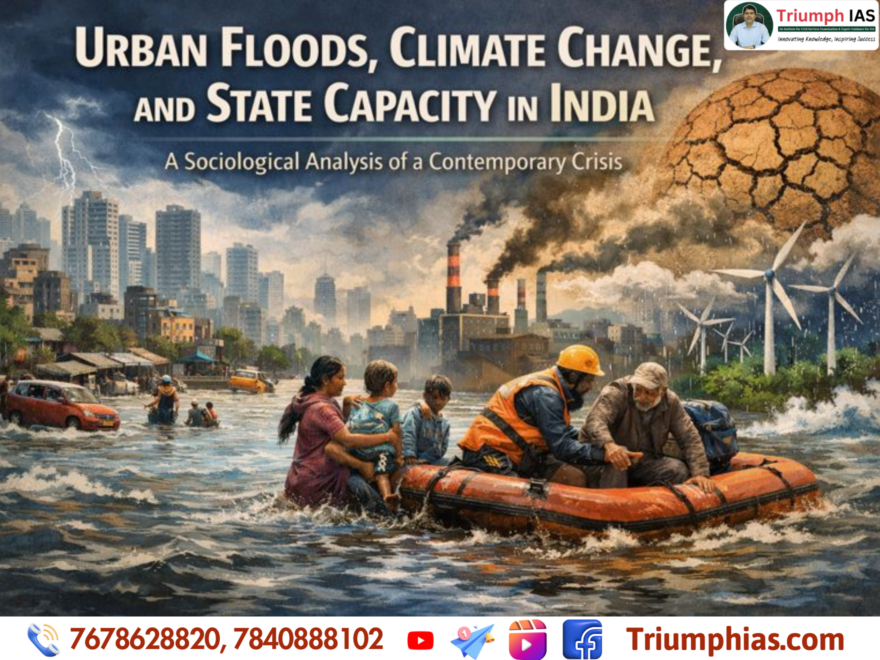
Urban Floods, Climate Change, and State Capacity in India: A Sociological Analysis of a Contemporary Crisis
(Relevant for Sociology Paper I and II)
IntroductionIn recent years—and increasingly in today’s news cycle—Indian cities such as Delhi, Chennai, Bengaluru, Mumbai, Guwahati, and Hyderabad have witnessed recurrent episodes of urban flooding. What were once described as “once-in-a-century” events are now becoming seasonal realities. Roads turn into rivers, homes are submerged, livelihoods are disrupted, and urban infrastructure collapses under pressure. Urban flooding is no longer a purely environmental or engineering problem. It is a sociological crisis that reveals deeper issues of governance, inequality, planning, and state capacity. As a current affairs topic, it directly connects climate change, urbanization, and public policy, making it highly relevant for Sociology Optional (Paper 1 and Paper 2). Climate Change and the New Urban RiskClimate change has intensified extreme weather events, including short-duration, high-intensity rainfall. However, sociology emphasizes that disasters are not “natural” alone; they are socially produced. Ulrich Beck’s concept of the risk society is particularly relevant. Modern societies generate new forms of risks through development itself. Rapid urbanization, concretization of land, destruction of wetlands, and inadequate drainage systems transform heavy rainfall into catastrophic flooding. Thus, urban floods represent manufactured risks—where environmental hazards intersect with social and political decisions. Urbanization Without PlanningIndia’s urban population has expanded rapidly, but urban planning has failed to keep pace. Cities have grown outward and upward with little regard for ecological limits. From a functionalist perspective, urban institutions—municipal bodies, planning authorities, disaster management agencies—are expected to maintain equilibrium. However, repeated flooding indicates institutional dysfunction. Encroachment on floodplains, lakebeds, and drainage channels reflects weak enforcement, political patronage, and market-driven urban development. State Capacity and Governance FailureState capacity refers to the ability of the government to design, implement, and enforce policies effectively. Urban floods expose the limitations of Indian state capacity at multiple levels. Max Weber’s idea of bureaucracy assumes rational planning and rule-based administration. In reality, overlapping authorities, fragmented responsibilities, and poor coordination characterize urban governance in India. Flood management often becomes reactive rather than preventive, highlighting the gap between policy intent and implementation. Political Economy of Urban DevelopmentFrom a conflict perspective, urban flooding disproportionately affects the poor. Slum dwellers, informal workers, and migrants often live in low-lying, flood-prone areas due to lack of affordable housing. Elite neighborhoods, by contrast, are better protected through infrastructure investments and quicker relief. This reflects what sociologists call unequal vulnerability. Urban flooding thus becomes a class issue, where environmental risks are distributed unevenly across social groups. Informality, Migration, and Precarious LivesIndian cities rely heavily on migrant labor working in informal sectors. These populations lack secure housing, insurance, or social protection. When floods occur, migrants lose livelihoods overnight and are often excluded from compensation due to lack of documentation. Feminist sociology further highlights how women bear disproportionate burdens during disasters, managing household survival under extreme stress. Urban floods, therefore, intensify existing social insecurities. Disaster Management and Social InequalityIndia has a formal disaster management framework, yet urban flooding exposes its rural and cyclone-centric bias. City-specific risks receive less attention in planning and funding. Sociologically, disaster response reflects power relations. Middle-class voices dominate media narratives, while the suffering of the urban poor remains underrepresented. This selective visibility influences policy priorities and relief distribution. Media, Blame, and Moral ResponsibilityMedia coverage of urban floods often focuses on immediate visuals and blame games—targeting municipal bodies or short-term administrative lapses. However, sociology urges a structural analysis that examines long-term urban policies, political economy, and environmental degradation. Without this, floods are framed as episodic failures rather than systemic crises. Environmental Justice and the Right to the CityThe concept of environmental justice emphasizes that all citizens have the right to a safe and healthy environment. Urban flooding violates this principle by systematically endangering marginalized populations. Henri Lefebvre’s idea of the Right to the City is relevant here. Urban spaces are increasingly shaped by real estate interests rather than citizens’ needs, pushing the poor into hazardous zones. Flood resilience, therefore, becomes a question of democratic urban governance. Federalism and Urban Local BodiesUrban governance in India operates within a complex federal structure. While cities face floods, financial and administrative powers remain limited. The 74th Constitutional Amendment aimed to empower urban local bodies, but sociologists note a gap between constitutional vision and actual devolution. Weak municipal autonomy undermines long-term climate adaptation. Contemporary Relevance in Today’s IndiaUrban flooding connects multiple current issues:
It highlights the urgent need to rethink India’s development model Conclusion: Floods as a Mirror of Urban SocietyUrban floods are not accidental disasters; they are mirrors reflecting the social, political, and economic choices made by Indian society. Climate change has intensified risks, but governance failures and inequality determine who suffers most. A sociological approach moves beyond technical fixes toward questions of justice, participation, and accountability. For Indian cities to become resilient, urban planning must be inclusive, ecological, and democratic. |
To Read more topics, visit: www.triumphias.com/blogs
Read more Blogs:
World Inequality Report 2026: A Sociological Reading of Global and Indian Inequalities