
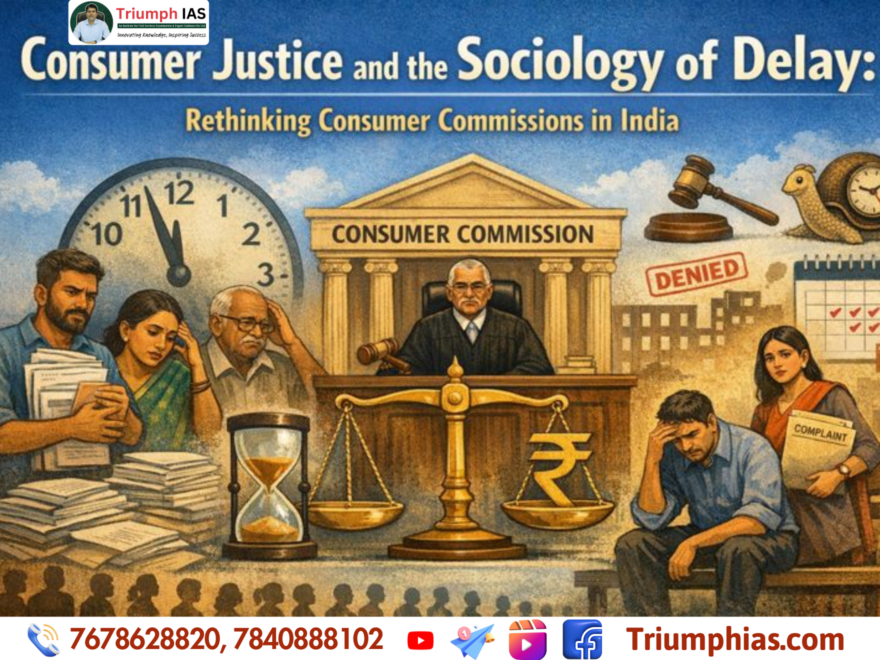
Consumer Justice and the Sociology of Delay: Rethinking Consumer Commissions in India
(Relevant for Sociology Paper 1: Stratification and Mobility and Politics and Society)
|
Every year on 24 December, India observes National Consumer Day, celebrating the recognition of consumers as rights-bearing citizens rather than passive participants in the marketplace. The Consumer Protection Acts of 1986 and 2019 symbolise the Indian state’s commitment to shielding individuals from exploitation by producers, service providers, and corporations. Yet, despite this strong legal framework, consumer commissions today struggle with delay, backlog, and weak enforcement. From a sociological perspective, this crisis is not merely administrative. It reflects deeper structural issues related to power, inequality, bureaucratisation, and access to justice in a rapidly expanding consumer society. The Consumer Society and Power: A Marxian ViewKarl Marx viewed markets as inherently unequal spaces shaped by asymmetrical power relations between those who own capital and those who do not. In contemporary India, this imbalance is visible in consumer disputes, where individual buyers confront well-resourced corporations, hospitals, insurance firms, or e-commerce platforms. Consumer commissions were created to counter this imbalance, acting as institutional correctives within capitalism. However, rising pendency and procedural delays undermine this purpose. When companies exploit adjournments or delay compliance, justice itself becomes commodified—accessible primarily to those who can afford prolonged litigation. In Marxian terms, delay becomes a structural advantage for capital. The economic cost of waiting is insignificant for corporations but devastating for ordinary consumers, especially retirees, small traders, or low-income households. Thus, even within a protective legal framework, class power subtly reproduces itself. Bureaucracy and Rationalisation: Weber’s Warning
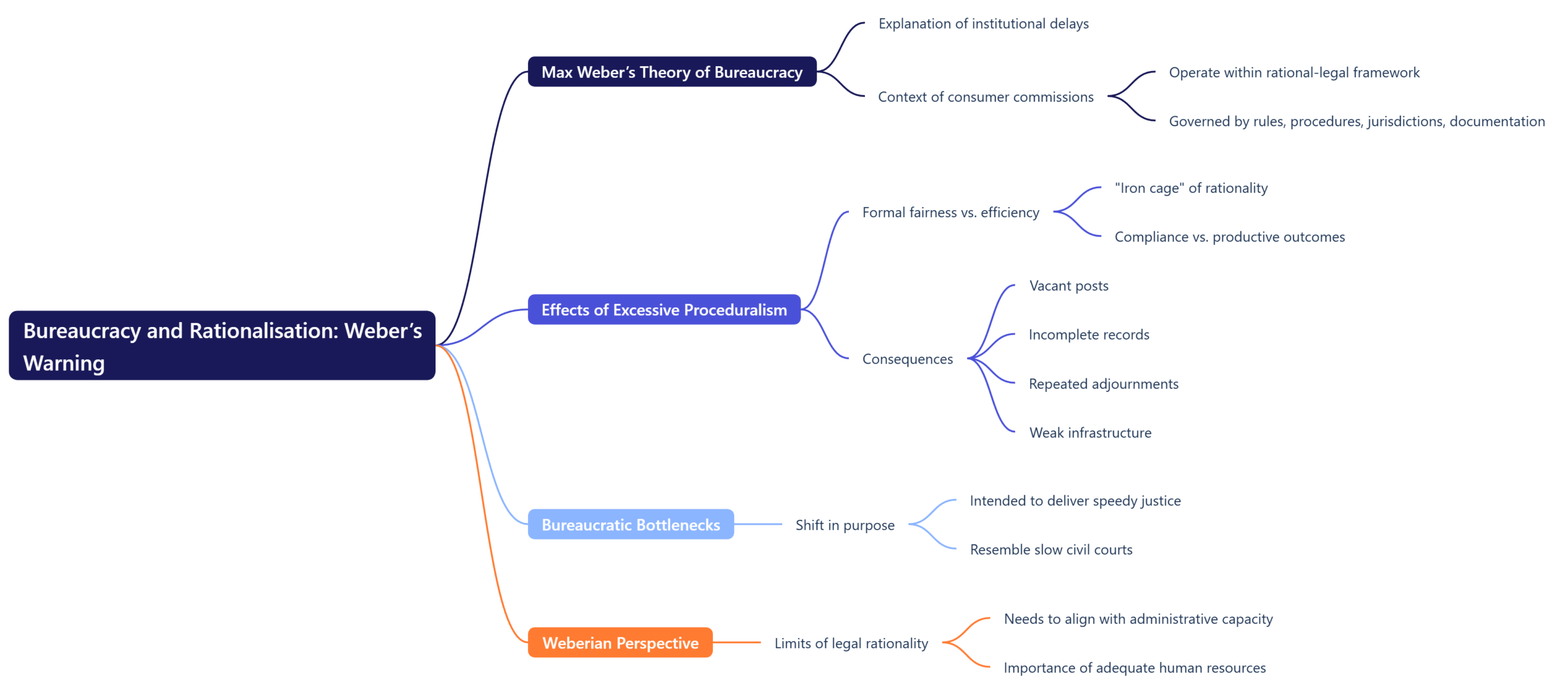
Max Weber’s theory of bureaucracy helps explain why institutions meant to deliver justice often end up producing delay. Consumer commissions operate within a rational-legal framework—rules, procedures, jurisdictions, and documentation govern every stage. While this ensures formal fairness, Weber warned that excessive proceduralism leads to an “iron cage” of rationality, where efficiency is lost in compliance. Vacant posts, incomplete records, repeated adjournments, and weak infrastructure transform consumer commissions into bureaucratic bottlenecks rather than instruments of speedy justice. The irony is striking: institutions created to bypass slow civil courts increasingly resemble them. From a Weberian lens, this reflects the limits of legal rationality when not matched by administrative capacity and human resources. Law, Morality, and Social Solidarity: A Durkheimian LensÉmile Durkheim believed that law expresses a society’s collective conscience—its shared moral values. Consumer protection laws signify a moral consensus that exploitation, deception, and unsafe goods are unacceptable in a modern society. However, when consumer commissions fail to deliver timely justice, this moral order weakens. Trust in institutions erodes, and citizens begin to normalise exploitation as inevitable. Durkheim would describe this as a form of anomie—a breakdown between social norms and institutional practice. The failure to enforce consumer rights thus has consequences beyond individual disputes. It undermines social solidarity, weakening the bond between citizens and the state. Surveillance, Regulation, and Digital Justice: Foucault’s PerspectiveRecent initiatives like e-Jagriti, AI-enabled consumer helplines, and digital monitoring of misleading advertisements represent a shift toward technological governance. Michel Foucault’s ideas on power and surveillance are useful here. Digital platforms increase visibility, traceability, and regulation of market behaviour. They allow the state to monitor corporations and discipline unfair practices. However, Foucault reminds us that power operates subtly. Digital justice can empower consumers, but it can also exclude those without digital literacy, access, or confidence. Thus, technology is not neutral. Without careful design, digital consumer justice risks reinforcing existing social hierarchies, marginalising rural populations, the elderly, and the urban poor. Cultural Capital and Access to Justice: Bourdieu’s InsightPierre Bourdieu’s concept of cultural capital—knowledge, language, and institutional familiarity—helps explain why some consumers navigate commissions more successfully than others. Filing complaints, understanding procedures, presenting evidence, or engaging with digital portals requires skills unevenly distributed across society. Educated, urban consumers possess greater institutional competence, while others experience intimidation and confusion. Even in supposedly “simple” quasi-judicial bodies, symbolic power operates. The promise of equal access is often undermined by unequal capacity to use the system effectively. Public Reason and Accountability: Habermas and Consumer Rights
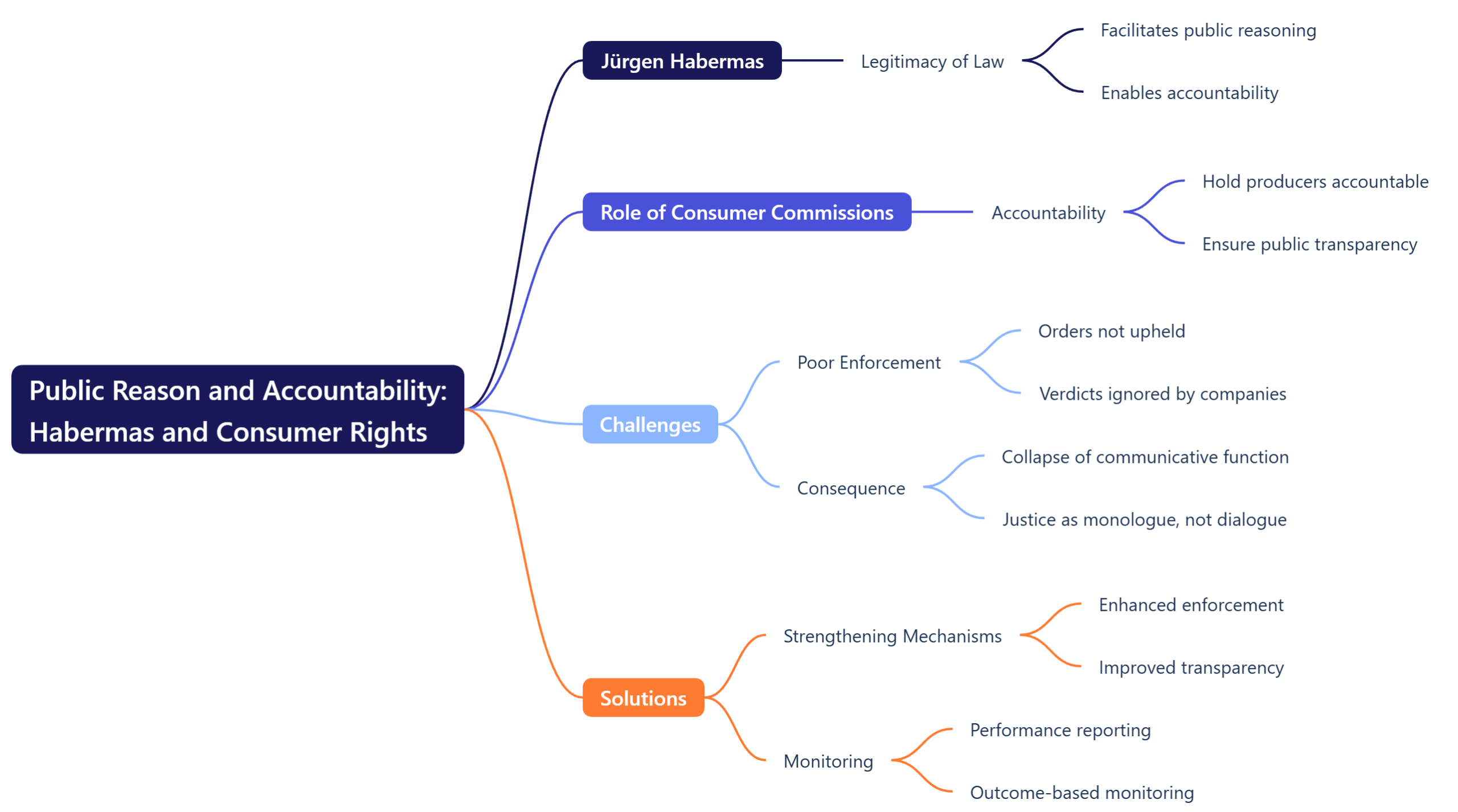
Jürgen Habermas viewed law as legitimate only when it facilitates public reasoning and accountability. Consumer commissions play a crucial role in this regard by holding producers publicly accountable for their actions. However, when orders are poorly enforced and companies ignore verdicts, the communicative function of law collapses. Justice ceases to be a dialogue and becomes a monologue of authority without consequence. Strengthening enforcement mechanisms and transparency—through performance reporting and outcome-based monitoring—can restore consumer commissions as spaces of democratic accountability. Delay as Structural ViolenceTaken together, these sociological perspectives reveal a central truth: delay is not neutral. It disproportionately harms the vulnerable, normalises exploitation, and quietly shifts power back to dominant market actors. Sociologist Johan Galtung’s idea of structural violence is relevant here. When institutional arrangements systematically prevent individuals from meeting their needs or claiming their rights, harm occurs without a visible perpetrator. Consumer delay functions precisely in this way. Reimagining Consumer JusticeAddressing these challenges requires more than technical reform. Fast-track appointments, mandatory mediation, digital integration, and performance audits are essential—but they must be guided by a sociological understanding of power and inequality. Consumer justice must be seen not merely as dispute resolution, but as a pillar of inclusive citizenship in a market economy. Conclusion: From Consumer to CitizenNational Consumer Day should prompt us to ask not only whether consumers have rights, but whether they can realistically exercise them. A society that celebrates consumption must also ensure protection, dignity, and voice. When consumer commissions work efficiently, they affirm the idea that citizens matter more than profits. When they fail, inequality quietly deepens. Ultimately, consumer justice is not just a legal issue—it is a mirror reflecting the health of democracy itself. |
To Read more topics, visit: www.triumphias.com/blogs
Read more Blogs:
Health Security and National Security: A Sociological Reading of the 2025 Cess Bill
Choosing Death, Negotiating Life: A Sociological Inquiry into Euthanasia in India
One comment