
Agnipath, CAPF Reservation, and the Indian Youth: A Sociological Analysis through Classical and Contemporary Thinkers
(Relevant for Sociology paper 1: Stratification and Mobility and Politics and Society)
IntroductionThe decision of the Ministry of Home Affairs to enhance reservation for ex-Agniveers in Group C posts of the Central Armed Police Forces from 10% to 50% is more than a policy tweak. It reflects a structural transformation in the relationship between the Indian state, youth, labour, and citizenship. While administrative discourse frames this move as a post-service rehabilitation measure, sociology compels us to ask deeper questions:
This blog situates the policy within classical sociological theory (Marx, Weber, Durkheim) and contemporary perspectives (Foucault, Bourdieu, Guy Standing, Ulrich Beck, T.H. Marshall) to offer a rigorous sociological reading. Agnipath as a New Form of State–Labour Contract: A Marxian Reading
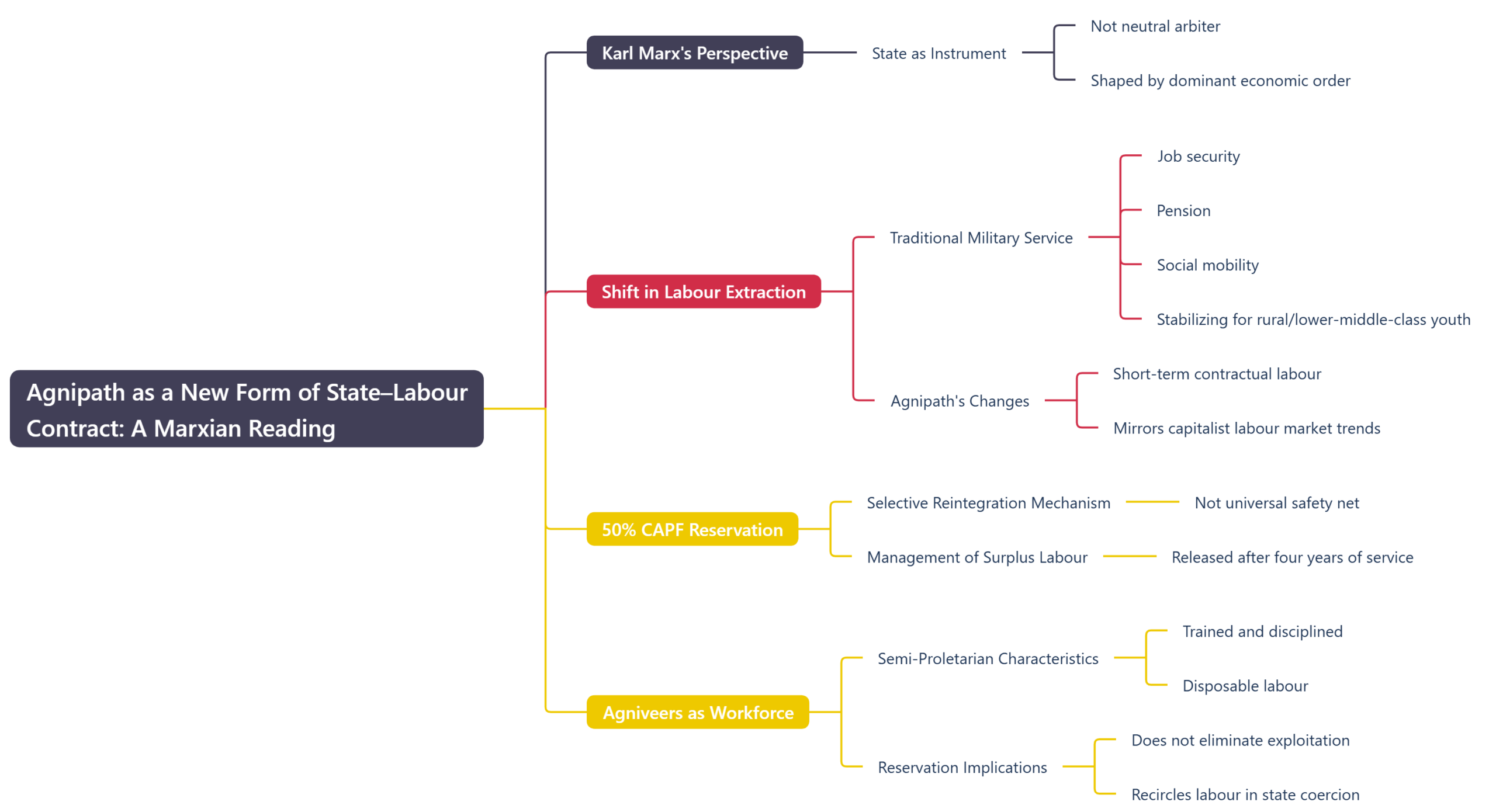
Karl Marx viewed the state not as a neutral arbiter but as an instrument shaped by the needs of the dominant economic order. From this perspective, Agnipath represents a shift in the mode of labour extraction by the state.
The 50% CAPF reservation can be seen as:
In Marxian terms, Agniveers resemble a semi-proletarian workforce—trained, disciplined, but disposable. The reservation does not eliminate exploitation; it merely recycles labour within the coercive apparatus of the state. Weber: Rationalisation, Bureaucracy, and Instrumental ActionMax Weber’s theory of rationalisation is crucial here. Modern states, Weber argued, function through bureaucratic efficiency, predictability, and control. Agnipath embodies Weberian rationality:
The CAPF reservation reinforces instrumental rationality (Zweckrationalität):
However, Weber also warned of the “iron cage” of rationality—where human values are subordinated to efficiency. The policy risks transforming soldiers into administrative inputs, valued not as citizens but as cost-effective units. Durkheim: Solidarity, Anomie, and Social IntegrationÉmile Durkheim would ask whether this policy enhances social integration or produces anomie.
The CAPF reservation attempts to restore integration, but only for a fraction of Agniveers. For the remaining majority, the abrupt transition from disciplined military life to an insecure civilian labour market can generate anomic conditions—frustration, alienation, and normlessness. Thus, the policy functions as a partial moral repair mechanism, insufficient to restore collective equilibrium. Foucault: Discipline, Biopolitics, and the Militarised Body
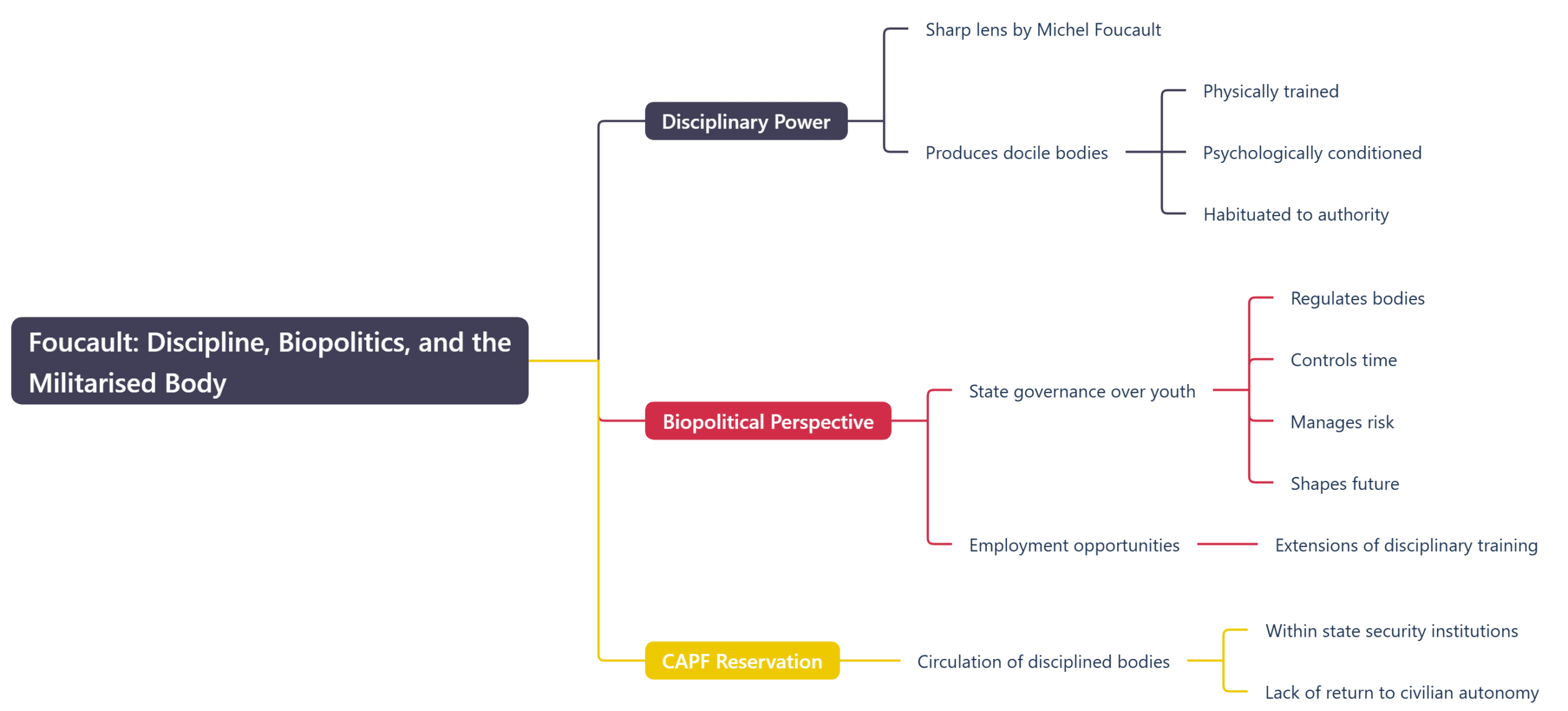
Michel Foucault’s concept of disciplinary power offers one of the sharpest lenses.
From a biopolitical perspective:
The CAPF reservation thus represents the circulation of disciplined bodies within state security institutions, rather than their return to civilian autonomy. Bourdieu: Capital, Habitus, and Unequal ConversionPierre Bourdieu’s framework of capital and habitus is particularly useful. Agniveers acquire:
However, the ability to convert this into economic or social capital remains uneven.
This leads to habitus mismatch—skills valued by the state but not by the broader labour market. Guy Standing and the Rise of the Precariat
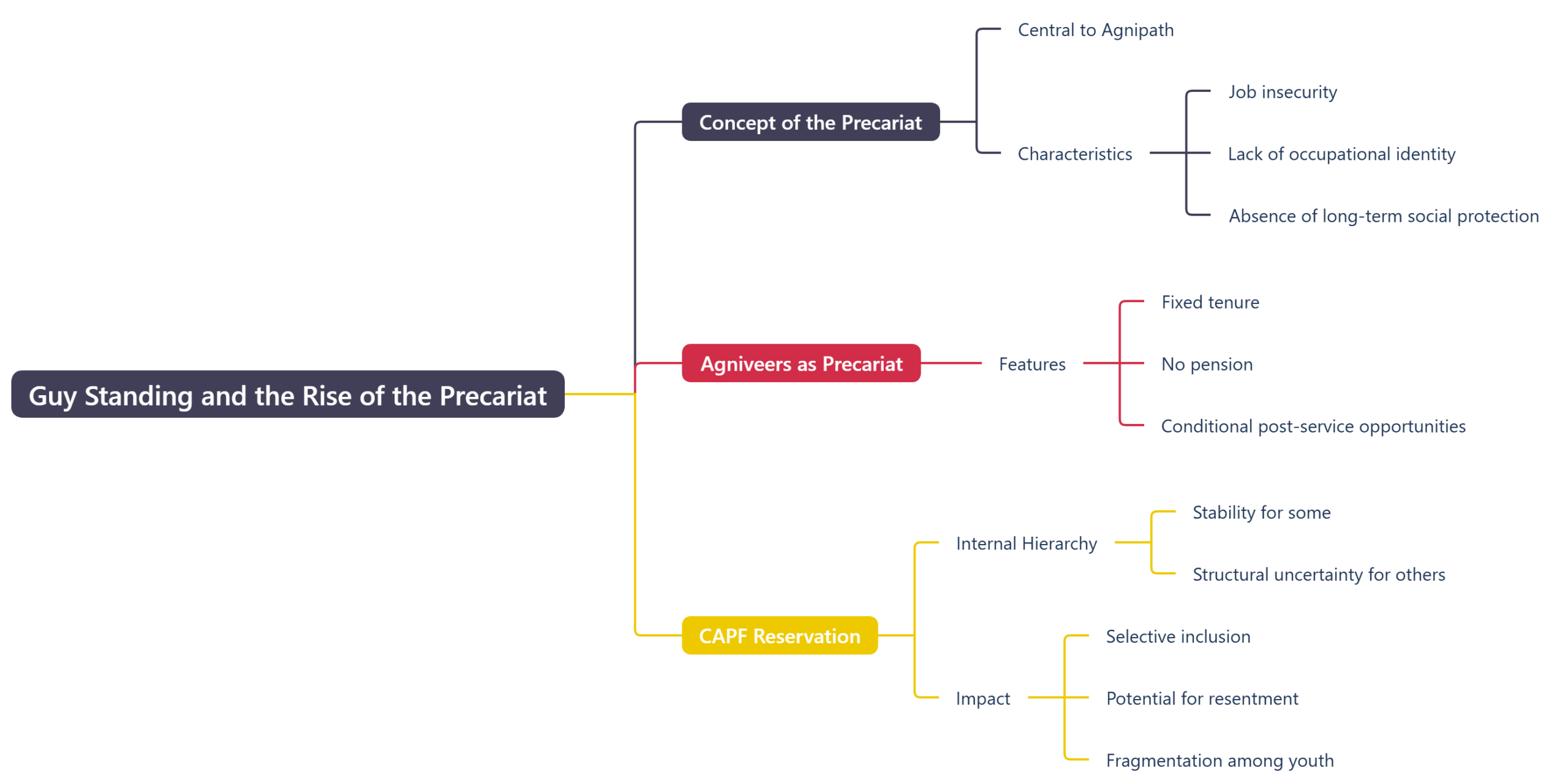
Guy Standing’s concept of the precariat is central to understanding Agnipath. The precariat is characterised by:
Agniveers fit this category:
The CAPF reservation creates an internal hierarchy within the precariat, offering stability to some while leaving others in structural uncertainty. This selective inclusion may deepen resentment and fragmentation among youth. Ulrich Beck: Risk Society and Individualised UncertaintyUlrich Beck argued that modern societies increasingly shift risk from institutions to individuals. Agnipath exemplifies this:
Youth must now strategically navigate risk, treating military service as a gamble rather than a guaranteed pathway. T.H. Marshall: Citizenship without Social Rights?T.H. Marshall conceptualised citizenship as comprising civil, political, and social rights. While Agnipath strengthens political symbolism (national service), it weakens social citizenship:
The CAPF reservation does not restore social rights; it replaces them with conditional privileges. Citizenship thus becomes earned through service, not guaranteed by membership. ConclusionThe 50% reservation for ex-Agniveers in CAPFs is best understood not as a welfare measure but as a mechanism of state-managed precarity. Through the lenses of Marx, Weber, Durkheim, Foucault, Bourdieu, Standing, Beck, and Marshall, the policy reveals a deeper transformation:
The central sociological question remains: |
To Read more topics, visit: www.triumphias.com/blogs
Read more Blogs:
From Right to Work to Managed Employment: A Sociological Reading of the VB-G RAM G Bill, 2025
Child Trafficking in India: A Sociological Reading of Power, Poverty, and Silenced Childhoods
One comment