
Justice in Slow Motion: A Sociological Analysis of India’s Judicial Pendency Crisis
(Relevant for Sociology Paper 1: Stratification and Mobility and Politics and Society)
Justice in Slow MotionIndia’s judiciary is facing an unprecedented crisis. With 4.80 crore cases pending in lower courts, nearly 90,000 in the Supreme Court, and severe manpower shortages across hierarchies, delays in justice have become routine and systemic. While the issue is commonly framed as administrative inefficiency or resource shortage, sociology reveals a far more complex picture. Judicial pendency is not just a backlog—it is a mirror of power relations, institutional design, social inequalities, and the moral foundations of the state. The Union Minister of Law and Justice recently acknowledged the gravity of the situation, emphasizing the widening gap between high judge vacancies and rising case loads. States like Uttar Pradesh—with 1.13 crore lower court cases and 11.66 lakh High Court cases—represent the epicenter of this crisis. But the phenomenon is national in scale, threatening the promise of Article 21’s right to speedy trial. To understand the crisis sociologically, we must examine the judiciary not merely as a legal institution, but as a social system shaped by structural pressures, political relations, and public expectations. Durkheim: Judicial Pendency as a Threat to Social SolidarityÉmile Durkheim viewed law as the “visible symbol of social solidarity.” In a modern society, where relationships are governed by organic solidarity, the legal system is supposed to maintain order by resolving disputes quickly and fairly. The massive pendency crisis disrupts this function in multiple ways:
For Durkheim, the judiciary’s inability to deliver timely justice signals a deep structural strain: society risks drifting into anomie, where norms lose their binding force and individuals pursue justice (or vengeance) outside institutional frameworks. Weber: Bureaucratic Overload and the Limits of Legal Rational Authority
Max Weber argued that modern governance is based on legal–rational authority, supported by formal rules, specialized roles, and bureaucratic efficiency. The Indian judiciary, however, is facing a bureaucratic crisis—not because of too much bureaucracy, but because of too little. India’s judge-to-population ratio is only 21 per million, far below the 50 per million recommended by the Law Commission and vastly lower than advanced democracies like the U.S. (150 per million). Weber would interpret this crisis as:
The judicial system lacks the personnel and infrastructure to execute its formal functions effectively.
Frequent adjournments, slow appointments, and complex procedures exemplify Weber’s warning that bureaucracy can become “irrational” when systems fail to adapt to workload realities.
When courts cannot deliver predictable and timely rulings, they lose their aura of rational authority, weakening public belief in law as a neutral arbiter. Marx: Justice, Class, and Structural InequalityKarl Marx would view pendency not as an administrative failure but as a structural feature of a capitalist society where institutions reproduce existing inequalities. The crisis disproportionately harms:
Meanwhile, wealthier litigants often use procedural delays to their advantage—pushing cases across years via adjournments, high-powered lawyers, and procedural maneuvering. From a Marxian lens:
Foucault: Courts, Power, and the Crisis of GovernmentalityMichel Foucault’s concept of governmentality—power exercised through institutions, norms, and knowledge—helps us analyze why pendency persists. For Foucault, the legal system is a technique of governance, shaping citizens’ behavior through rules, surveillance, and judgement. But when courts are overwhelmed:
Foucault would argue that the pendency crisis reveals a breakdown in the state’s ability to discipline and regulate populations through the legal apparatus. Bourdieu: Judicial Capital and Unequal Access to Justice
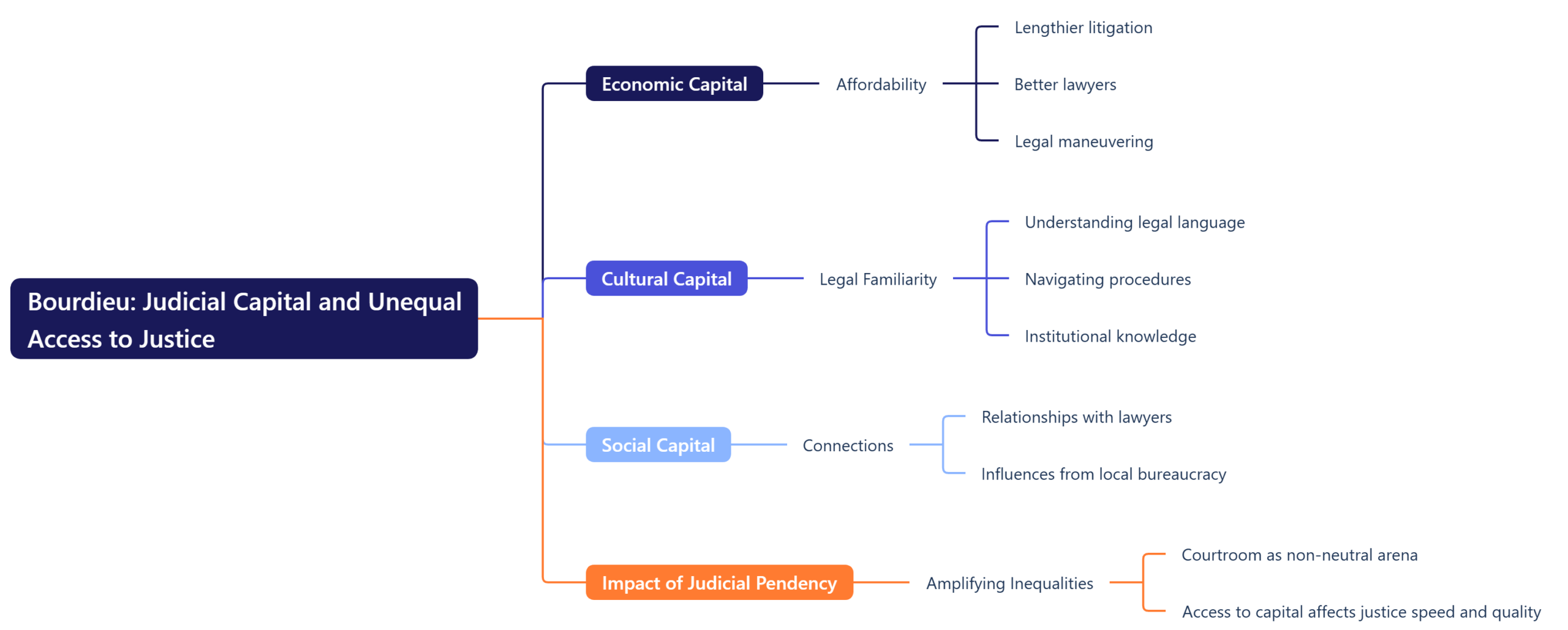
Pierre Bourdieu viewed law as a “field” where actors (lawyers, judges, litigants) compete for various forms of capital—economic, cultural, and social. Judicial delay, from his perspective, transforms this field into an arena of inequality.
Those with money can afford longer litigation, better lawyers, and legal maneuvering.
Litigants familiar with legal language, procedure, and institutional culture navigate the system better than others.
Connections with lawyers or local bureaucracy influence outcomes. Judicial pendency amplifies these inequalities. The courtroom becomes not a neutral arena, but a space where access to different forms of capital determines the speed and quality of justice. Habermas: Distorted Communication and Public Sphere BreakdownJürgen Habermas emphasized the importance of deliberative democracy, where institutions facilitate rational dialogue and protect the public sphere. A functioning judiciary is central to this ideal. But pendency creates:
This leads to what Habermas calls “systemic distortions in communication.” Instead of fair deliberation, the legal process becomes a site of noise, chaos, and delay—undermining legitimacy and democratic fairness. Sen: Justice as Capability and the Cost of DelayAmartya Sen’s Capability Approach reframes justice beyond formal procedures—it asks whether people actually have the freedom to exercise their rights. Judicial delay severely restricts capabilities:
From a Senian lens, pendency is a direct attack on human freedoms. Why Structural Reform Must Be Sociological, Not Just AdministrativeThe current policy proposals—e-courts, fast-track courts, ADR, judicial infrastructure authorities, AI-based case triage—are necessary but insufficient. They solve the symptoms, not the sociology of the crisis. A deeper sociological diagnosis points to the following structural reforms:
Ensure predictable, time-bound adjudication, especially for vulnerable groups.
Rapid, coordinated recruitment and administrative modernization.
Provide free legal aid, bail reform, and fast-track disposal for marginalized litigants.
Limit discretionary adjournments and procedural opacity.
Legal literacy programs, streamlined procedures, and accessible representation. Conclusion: The Future of Justice and the Sociology of TimeJudicial pendency is not merely a delay—it is a distortion of the moral, social, and political order. Time itself becomes unequal: the poor lose years waiting, while the powerful use delay strategically. Sociology teaches us that justice is not only a legal matter but a civilizational one. If the judiciary cannot keep pace with society, India risks drifting into a state where legality exists in form but not in substance. Reforming India’s justice system is therefore not only a matter of policy—it is a social imperative. |

To Read more topics, visit: www.triumphias.com/blogs
Read more Blogs:
When Genetics Meets Governance: Thalassemia, Contaminated Blood, and Social Inequalities in India