

Protection of Plant Varieties and Farmers’ Rights (PPV&FRA) Act, 2001
(Relevant for Sociology Paper 2: Rural and Agrarian in transformation in India)
|
India recently marked the Silver Jubilee of the PPV&FRA Act, 2001 along with the 21st Foundation Day of the PPV&FRA Authority, celebrated through the Plant Genome Saviour Awards. These awards honour individuals and communities that actively conserve and protect the genetic diversity of economically significant plants. Beyond the recognition, this event reflects the deep sociocultural significance of seeds and plant varieties in India. Seeds are more than agricultural inputs; they are carriers of knowledge, cultural memory, and rural identity. Scholars like Vandana Shiva have highlighted that seed preservation is not merely a technical activity but a form of resistance against industrial control and market monopolies. In this context, celebrating PPV&FRA is not just about agriculture; it underscores the intersection of science, law, and social justice, recognizing farmers as co-creators of biodiversity rather than passive producers. What is the Protection of Plant Varieties and Farmers’ Rights (PPV&FRA) Act, 2001?The PPV&FRA Act, 2001, implemented under the Ministry of Agriculture and Farmers’ Welfare, establishes a sui generis system for protecting plant varieties in India. Unlike standard intellectual property regimes, which often prioritize corporate breeders, this Act recognizes both commercial breeders and farmers as innovators. By providing legal recognition to farmers who develop or conserve plant varieties, the Act ensures that traditional knowledge and rural innovation are protected. This dual recognition aligns with Karl Polanyi’s notion of embedded markets, where economic activity is inherently tied to social relations and cultural norms. Seeds, under this law, are treated not solely as commodities but as cultural and economic assets intertwined with rural life. At the same time, the Act ensures India’s compliance with TRIPS obligations and the UPOV Convention, balancing global IPR norms with domestic agricultural realities. In short, PPV&FRA reflects a unique model where market incentives for innovation coexist with social safeguards for farmers, preserving both biodiversity and livelihoods. Rights under the Act
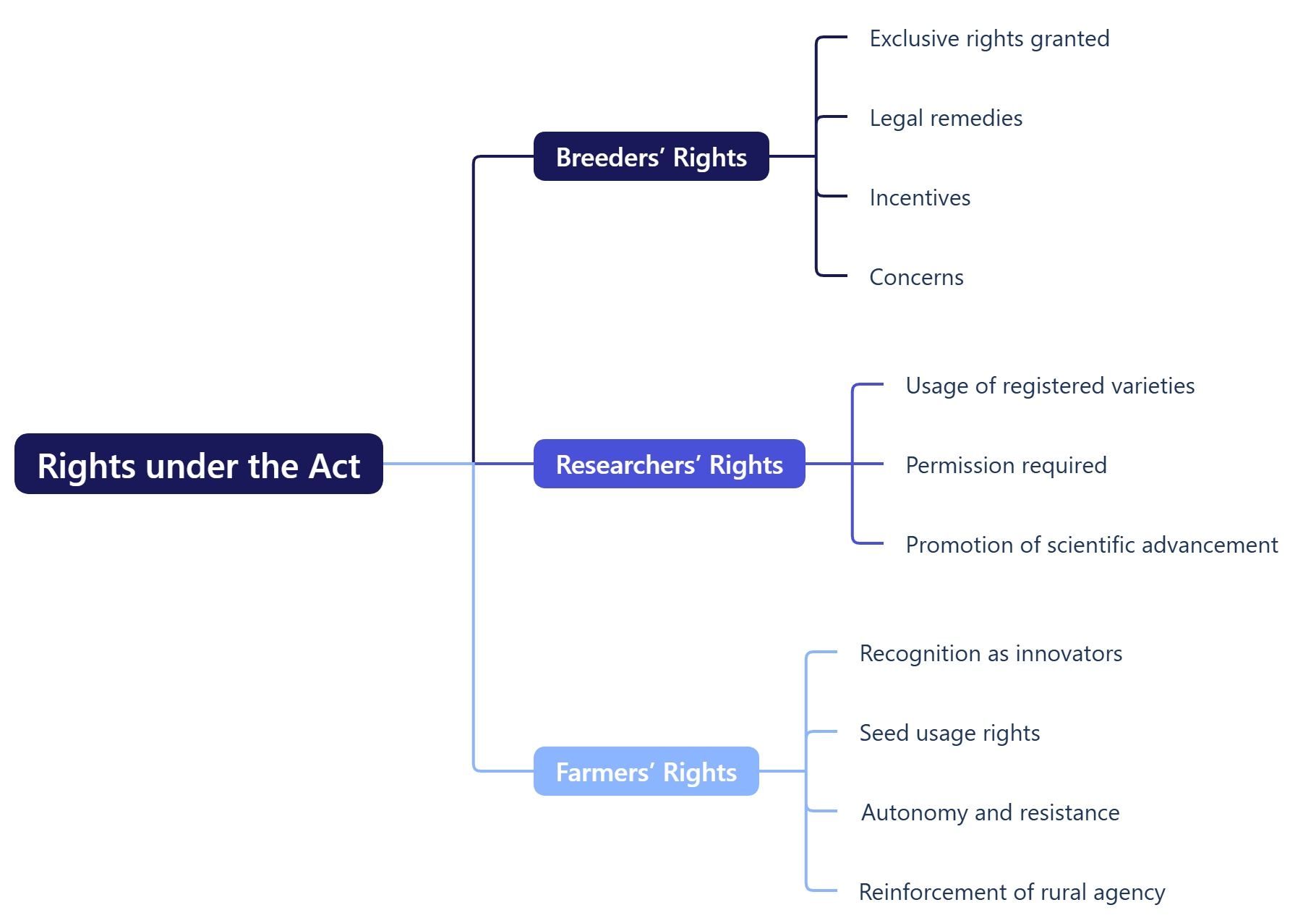
Breeders are granted exclusive rights to produce, sell, market, distribute, import, or export registered varieties. They may also appoint licensees and pursue legal remedies in case of infringement. This provision incentivizes formal research and innovation in plant breeding. However, as Jack Kloppenburg has argued in his studies on seed monopolies, such concentration of control can lead to asymmetries in power between commercial entities and smallholder farmers.
Researchers can use any registered variety for experimentation or the development of new varieties. Repeated usage, however, requires the permission of the registered breeder. This provision facilitates scientific advancement while retaining communal access to knowledge, echoing Robert Merton’s principle of communalism in scientific research—knowledge should be shared to promote societal benefit.
The Act’s sociological significance is most evident in its recognition of farmers as innovators. Farmers who have developed or conserved new plant varieties can register them and enjoy the same protection as commercial breeders. They are entitled to save, use, sow, re-sow, exchange, share, or sell seeds for personal and local use. However, selling seeds as branded varieties is restricted. James C. Scott’s concept of everyday resistance resonates here. Farmers, through traditional seed-saving practices, maintain autonomy against corporate or state control. This legal recognition reinforces rural agency, ensuring that smallholders remain active participants in the agricultural innovation ecosystem. Implementing AuthorityThe Protection of Plant Varieties and Farmers’ Rights Authority (PPV&FRA), formally established in 2005, serves as the statutory body responsible for implementing the Act. Headquartered in New Delhi, the Authority comprises a Chairperson, 15 members, and the Registrar General as ex-officio Member Secretary. The Authority’s mandate includes granting breeders’ rights, rewarding farmers for conservation, protecting farmers’ rights to farm-saved seed, and supporting research and innovation. It also maintains the National Register of Plant Varieties, preserving India’s biodiversity and codifying traditional knowledge. Sociologically, this can be seen as a form of symbolic capital, where farmers’ traditional practices gain formal recognition and social legitimacy, enhancing their bargaining power in agricultural and policy spaces. Significance of the Act
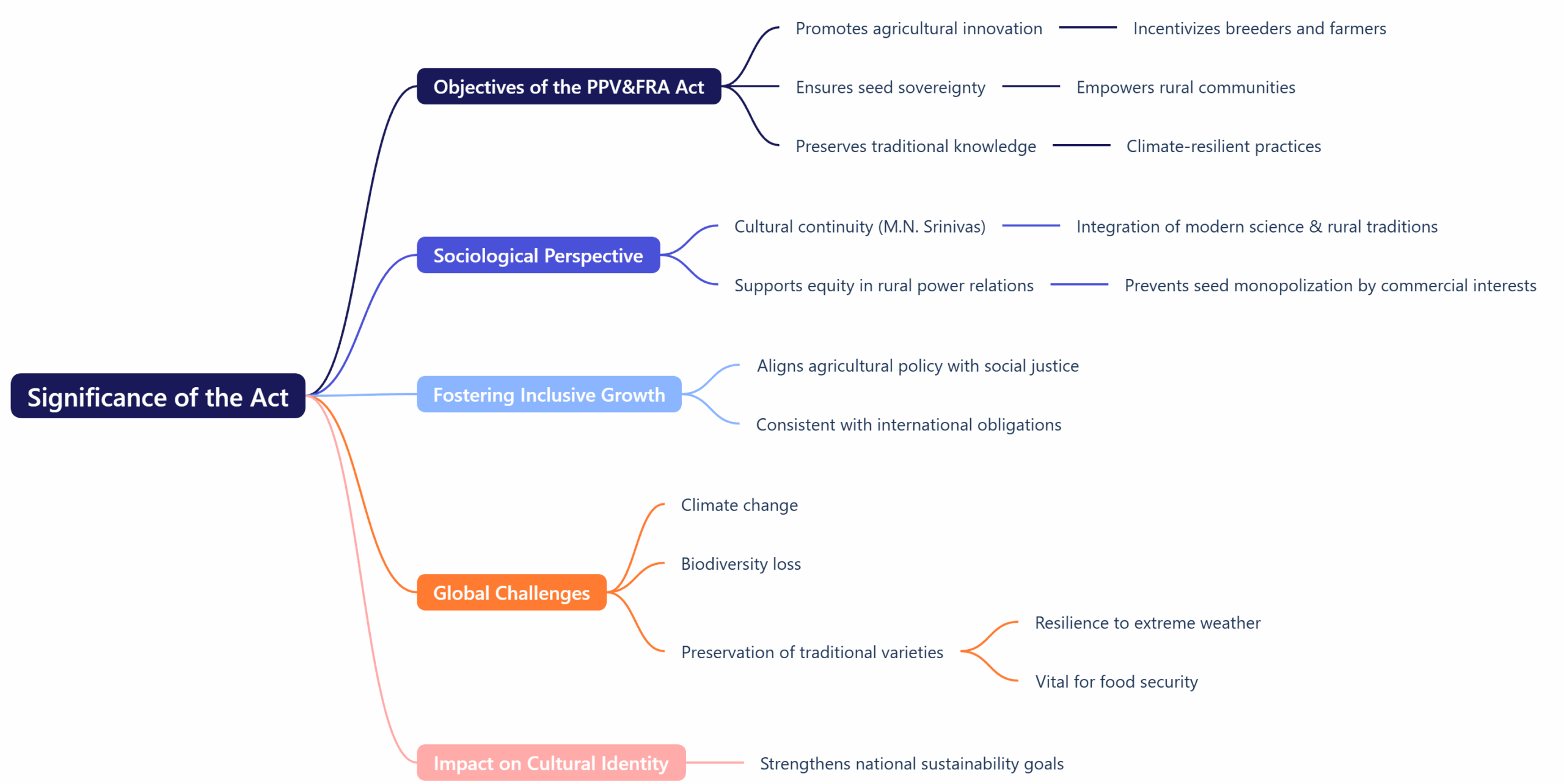
The PPV&FRA Act achieves several crucial objectives. Firstly, it promotes agricultural innovation by incentivizing both breeders and farmers. Secondly, it ensures seed sovereignty, enabling rural communities to maintain control over local genetic resources. By legally recognizing farmers’ contributions, it preserves traditional knowledge systems, which are often climate-resilient and culturally embedded. From a sociological perspective, the Act embodies M.N. Srinivas’s concept of cultural continuity, integrating modern scientific practices with long-standing rural traditions. Farmers’ rights under PPV&FRA also support equity in rural power relations, preventing the monopolization of seeds by commercial interests. Furthermore, the Act fosters inclusive growth, aligning India’s agricultural policy with social justice principles while remaining consistent with international obligations. Additionally, in the context of global challenges such as climate change and biodiversity loss, the Act’s emphasis on preserving traditional varieties gains strategic importance. These varieties often display resilience to extreme weather and local pest patterns, making them vital for food security. Recognizing farmers’ rights therefore strengthens not only cultural identity but also national sustainability goals. ConclusionThe PPV&FRA Act, 2001, is more than legislation; it is a framework for social and ecological justice. By balancing commercial innovation with traditional knowledge, it empowers farmers, safeguards biodiversity, and maintains rural agency. Seeds, under this Act, become symbols of power, knowledge, and resilience, reflecting India’s socio-cultural and agricultural ethos. Legal recognition of farmers’ contributions transforms everyday practices into nationally significant acts of conservation, aligning social, economic, and environmental objectives. Ultimately, the PPV&FRA Act exemplifies how policy can integrate social realities with scientific progress, creating a model of agricultural governance that is both just and forward-looking. As India continues to face climate pressures, population growth, and globalization of seed markets, the Act ensures that farmers remain at the heart of agricultural innovation, preserving the country’s ecological and cultural heritage. |
To Read more topics, visit: www.triumphias.com/blogs
3 comments