
National Migration Survey 2026–27: A Sociological Window into India’s Mobility, Inequality & Social Change
(Relevant for Sociology Paper 2: Population Dynamics)
|
India’s decision to launch the National Migration Survey (2026–27) marks the country’s most ambitious attempt in nearly two decades to understand how populations move, why they move, and what this means for society. Migration is not just a demographic event—it is a social process, a mechanism of inequality, and a powerful indicator of how families, labour markets, and aspirations are transforming. From classical migration theories to contemporary perspectives on precarity and social capital, the new survey invites a deeply sociological exploration. Migration as a Social Process: Theoretical FrameworksMigration has been central to sociological inquiry for more than a century. Ravenstein’s “Laws of Migration”Ernst Ravenstein argued in the 19th century that migration is shaped by:
His key observation—that women migrate more for social reasons (marriage)—is remarkably visible in India, where 87% of female migration is marriage-led, according to PLFS (2020–21). Everett Lee’s Push–Pull TheoryLee’s framework helps contextualize India’s post-Covid mobility:
The upcoming survey’s focus on short-term migration, access to services, and future mobility plans aligns perfectly with Lee’s model. Zelinsky’s Mobility Transition TheoryWilbur Zelinsky argued that migration increases as societies industrialise.
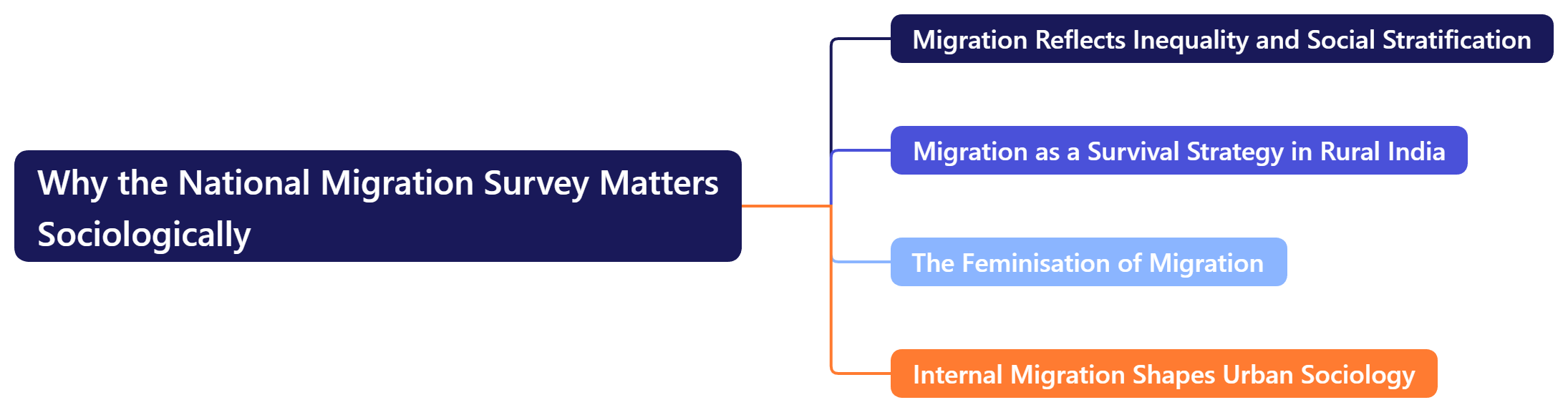
Why the National Migration Survey Matters Sociologically
Migration is not an equal-opportunity phenomenon. Jan Breman’s work on footloose labour shows how migrant workers exist in a system of circulatory labour, trapped in low wages and high insecurity.
For millions, mobility is a strategy to cope with:
This resonates with A.R. Desai’s analysis of rural transformation under capitalism and the shift of peasants into wage labour.
Though male migration is often highlighted in popular narratives, Indian data shows:
While most women migrate due to marriage, an emerging trend of female educational and employment migration—especially among the urban poor—reflects changing gender norms.
Cities like Delhi, Mumbai, Surat, and Bengaluru are built and sustained by migrants. The migration survey will assist urban planners in understanding:
Understanding the New Survey Through Sociology
Tracking individual migrants aligns with modern sociological understanding that:
The new definition (15 days to <6 months) will capture:
Short-term migration is critical in India but has long remained statistically invisible.
By adding questions on:
the survey aligns with Amartya Sen’s capabilities approach, which assesses well-being beyond income.
Understanding whether migrants intend to return, settle, or re-migrate provides insight into:
This links to Bourdieu’s concept of habitus—migration decisions reflect internalised hopes, fears, and cultural expectations. Historical Context: Migration Surveys Since 1955Since the 9th round of the NSS, India has periodically studied migration, but only two rounds—18th (1963–64) and 64th (2007–08)—were comprehensive.
The 2026–27 survey arrives at a crucial moment when mobility patterns have fundamentally shifted. Migration and Gender: A Sociological Re-examination Indian migration is deeply gendered. Marriage Migration and Patriarchal StructuresScholars like Leela Dube and Patricia Uberoi have shown how kinship systems dictate women’s movement.
Men’s Work Migration Male migration reflects:
These networks form what sociologists call social capital, facilitating movement and job access. Urban Integration: The New FrontierThe role of migrants in India’s cities is often paradoxical:
This exclusion resembles Saskia Sassen’s “global city” theory, where migrants sustain globalised economies but remain socially marginalised. The new survey’s data will help uncover:
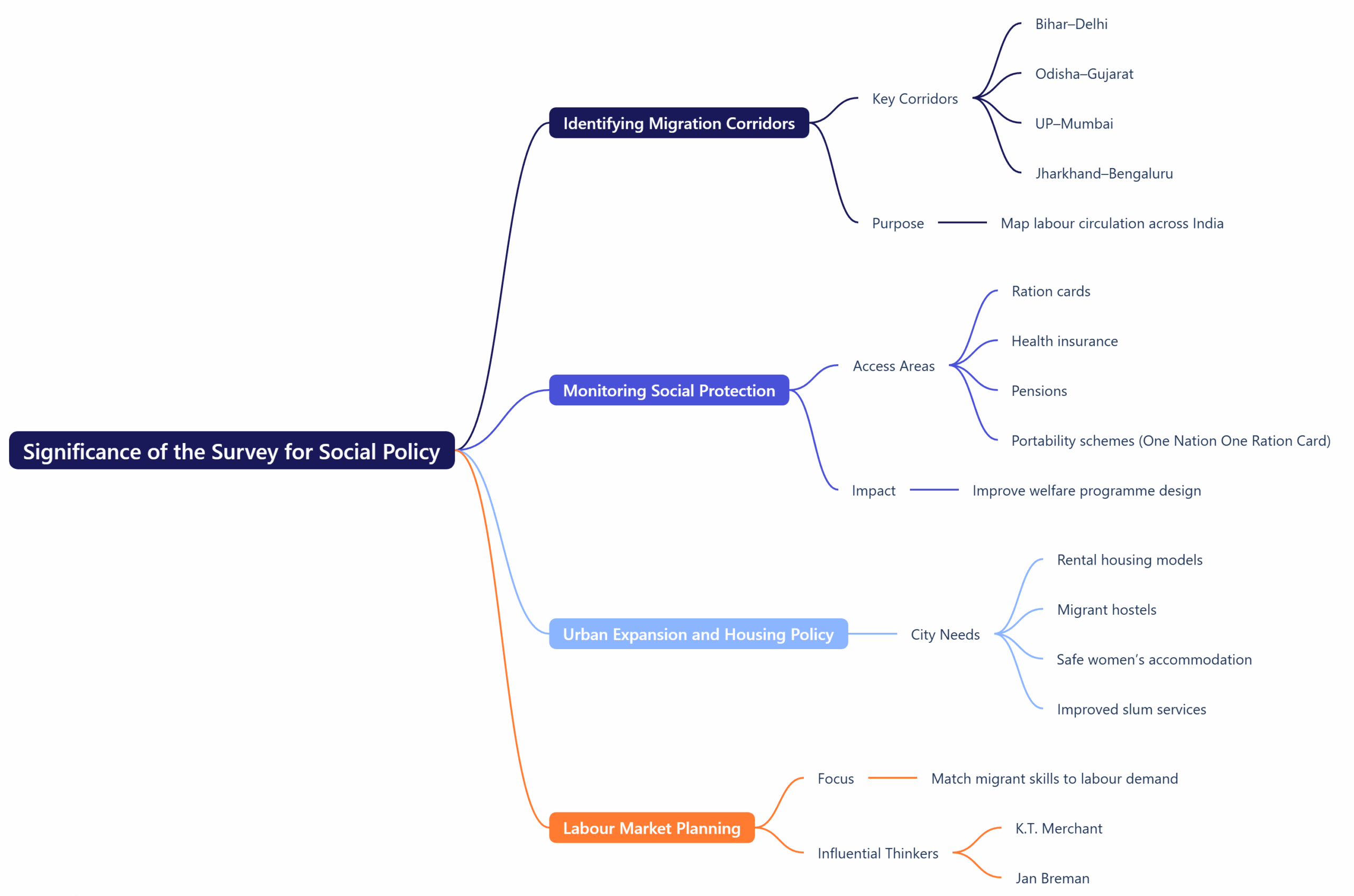
Significance of the Survey for Social Policy
The survey will help map:
revealing how labour circulates across India.
Understanding migrant workers’ access to:
will significantly improve welfare programme design.
Cities need:
India’s demographic dividend depends on matching migrant skills to labour demand—a core insight of labour sociologists like K.T. Merchant and Jan Breman. Conclusion: Migration Is the Story of Social ChangeThe National Migration Survey 2026–27 represents more than a statistical exercise—it is a study of India’s social transformation. Migration tells us:
Through the lenses of Ravenstein, Lee, Zelinsky, Bourdieu, Fraser, Breman, and contemporary Indian scholars, migration emerges not just as movement but as a mirror of our society’s deepest structures. The 2026–27 survey will finally give India the empirical foundation needed to connect policy with the complexities of social life—and to understand how mobility shapes the nation’s future. |
To Read more topics, visit: www.triumphias.com/blogs
Read more Blogs:
Reimagining Agriculture: Technology, Power, and Social Transformation in Rural India
2 comments