
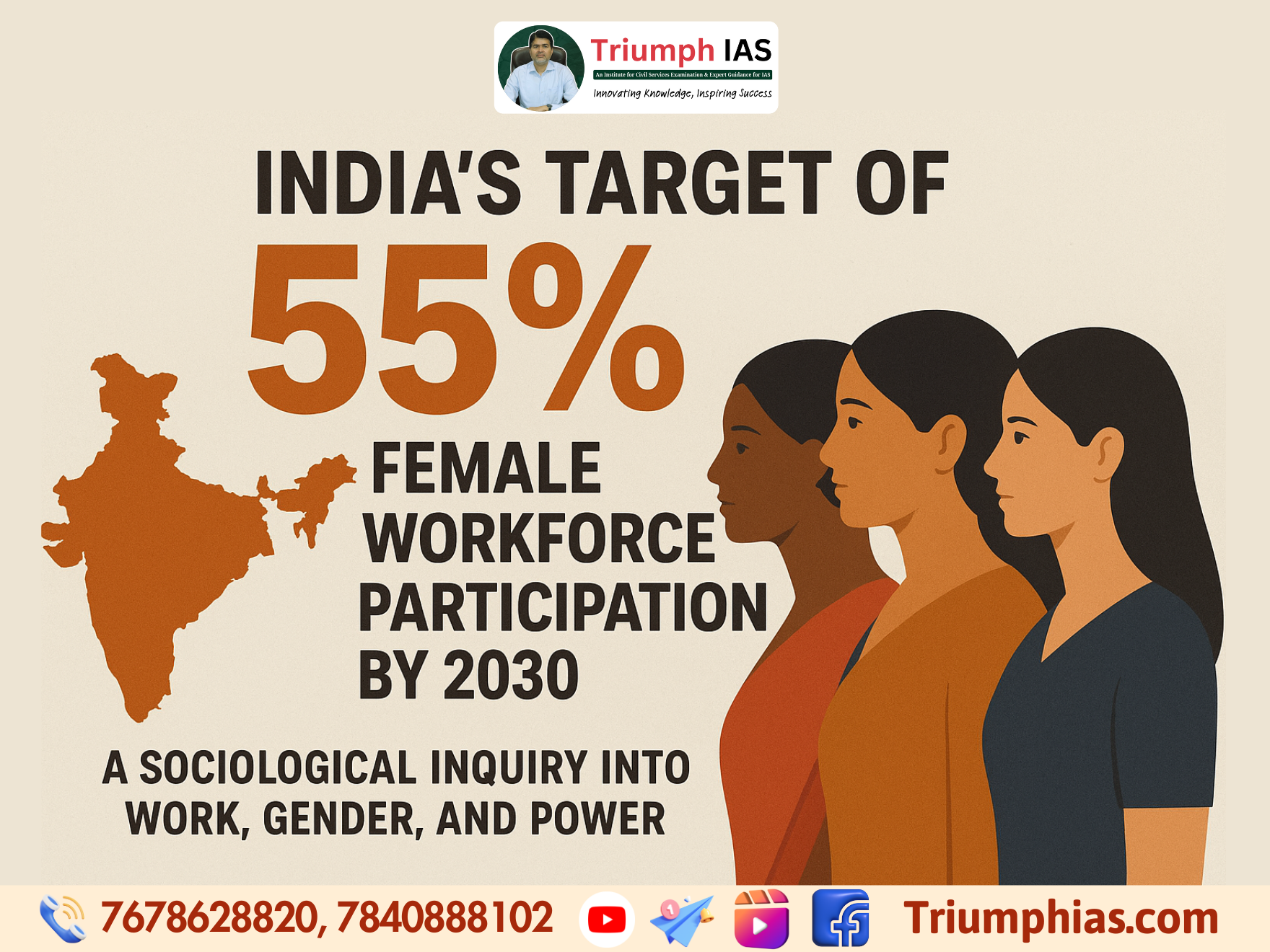
India’s Target of 55% Female Workforce Participation by 2030: A Sociological Inquiry into Work, Gender, and Power
(Relevant for Sociology Paper 1: Work and Economic life)
|
India’s announcement of raising the Female Labour Force Participation Rate (FLFPR) from 41.7% to 55% by 2030 is not merely a labour-market reform—it is a sociological project that forces us to ask deeper questions about gender norms, unpaid care, structural inequality, and the social construction of “work” itself. While economic forecasts highlight that gender parity could add trillions to India’s GDP, sociology reminds us that women’s employment is deeply entangled in societal values, family structures, patriarchy, and historical divisions of labour. The Social Meaning of Work: What FLFPR Really Tells UsFLFPR measures how many women are employed or seeking work. Yet, as Amartya Sen argues, participation does not automatically imply agency. Women may enter the labour force due to distress, not empowerment—a reality reflected in the recent rise of rural women’s participation primarily in unpaid agricultural labour and self-employment. Sociologically, this challenges the simplistic assumption that “more work = more empowerment.” Arlie Hochschild’s “Second Shift” in IndiaHochschild’s concept of the double burden captures how women perform both paid work and the bulk of household labour. Thus, rising FLFPR without reduction in unpaid care work merely increases women’s workload rather than enhancing freedom or autonomy. A Functionalist View: The Changing Roles of WomenFrom a functionalist lens (Talcott Parsons), societies evolve by reallocating roles to maintain equilibrium. Traditionally, Parsons framed women as suited for “expressive roles” (caregiving) and men for “instrumental roles” (economic support). But India’s labour push disrupts this structure. As more women enter the workforce, families renegotiate roles:
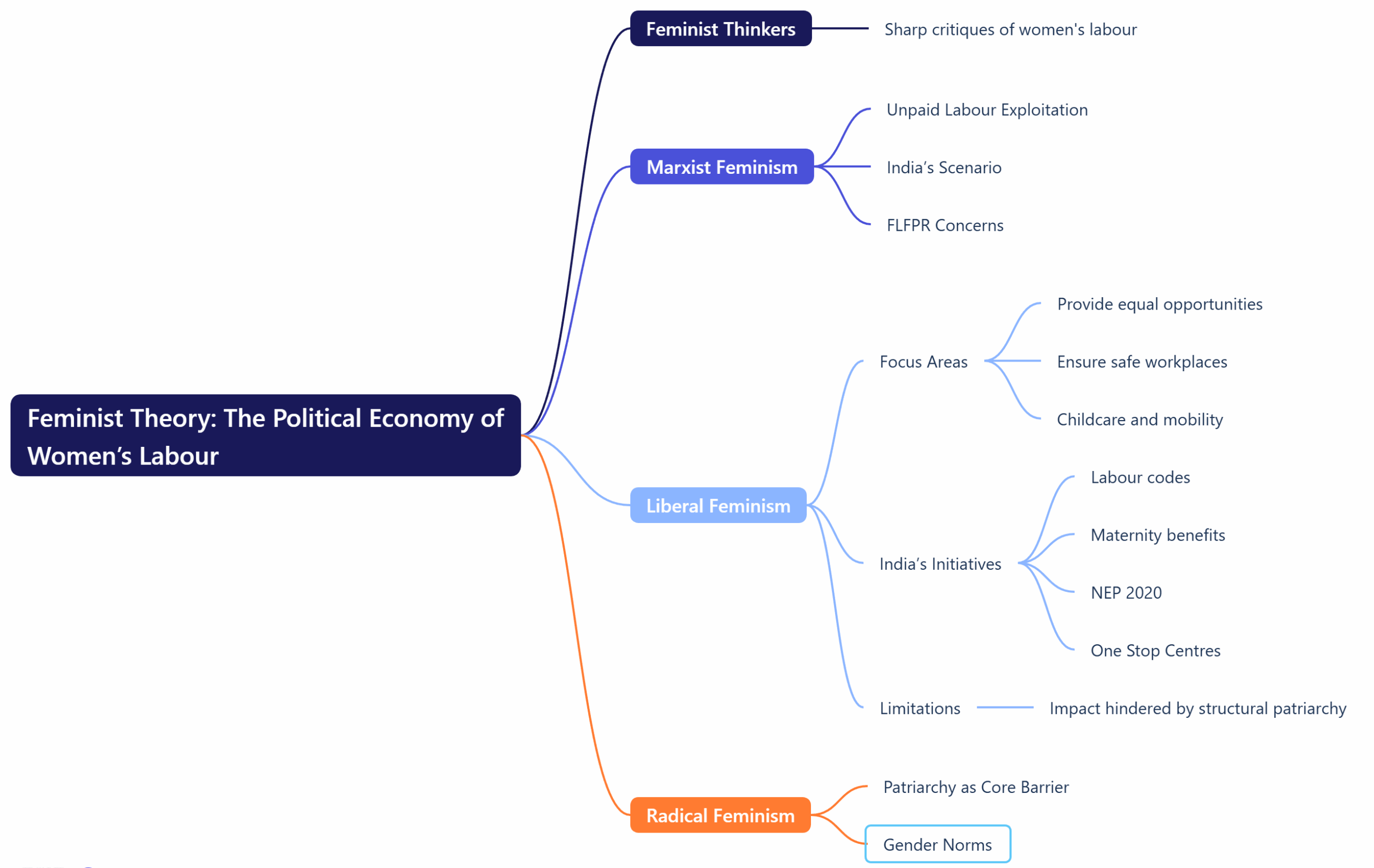
However, this transition is uneven. Urban nuclear families may adapt, but rural extended households often reinforce traditional norms, limiting the effects of policy interventions. Feminist Theory: The Political Economy of Women’s Labour
Feminist thinkers offer sharper critiques.
Marxist feminists like Silvia Federici and Margaret Benston argue that capitalism survives on the back of unpaid domestic labour performed by women. The apparent “rise” in FLFPR masks:
Thus, the labour market absorbs women without structurally empowering them.
From a liberal feminist perspective (Betty Friedan, Mary Wollstonecraft), the focus is on:
India’s labour codes, maternity benefits, NEP 2020, and “One Stop Centres” fit within this approach. Yet, structural patriarchy limits their impact.
Radical feminists argue that patriarchy is the foundational system shaping labour interactions. Thus, policy alone cannot change workforce behaviour unless gender ideology transforms. Intersectionality and Female Workforce ParticipationKimberlé Crenshaw’s intersectionality is vital to understand why rural women’s participation rises faster than urban women’s, yet with poor quality. Women are affected not only by gender, but by:
For example:
Thus, FLFPR is shaped by multiple overlapping inequalities. Bourdieu: Habitus, Cultural Capital, and Women’s EmploymentPierre Bourdieu’s habitus explains why even when jobs are available, many women hesitate to join. Habitus shapes:
Cultural capital—skills, education, language—also determines the types of jobs women can access. Thus, increasing FLFPR requires changing both material and cultural conditions. Nancy Fraser: Care Crisis and the Social Reproduction DebateNancy Fraser argues that modern economies face a crisis of social reproduction—the unpaid care work needed to sustain life is undervalued and unsupported. India exemplifies this crisis:
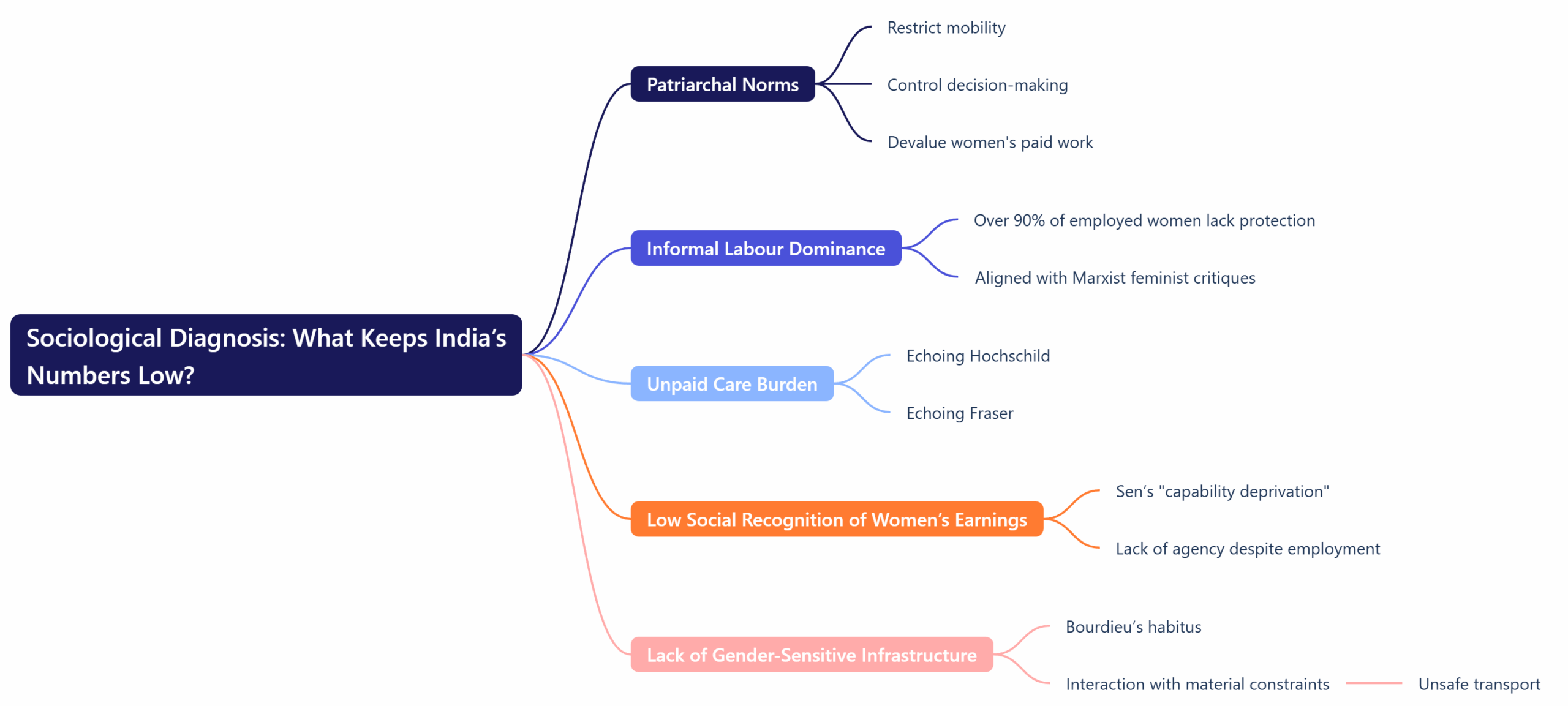
Expanding the care economy—childcare, eldercare, community kitchens—does not just help women enter the workforce; it restructures social reproduction itself. Sociological Diagnosis: What Keeps India’s Numbers Low?
What Would a Sociologically Informed Policy Look Like?
Incorporate Time Use Surveys.
Following Fraser, build childcare, eldercare, and community support systems.
Behavioural campaigns, school curriculum reform, and SHG empowerment can transform habitus.
Shift from unpaid/self-employment to formal, secure jobs.
Empower women through digital and sectoral skilling.
Incentivise female hiring, safe transport, flexible work hours, and workplace dignity. Conclusion: Beyond Participation—Towards EqualityIndia’s 55% FLFPR target is a sociological revolution, not merely an economic one. As feminist theorists remind us: |
To Read more topics, visit: www.triumphias.com/blogs
Read more Blogs:
Competitive Federalism: India’s Emerging Model of State Rivalry
The target of 55% FLFPR by 2030 is certainly ambitious, but addressing unpaid care work and gender norms is essential to making real progress. If policies don’t tackle these structural issues, the goal might just remain a number on paper.