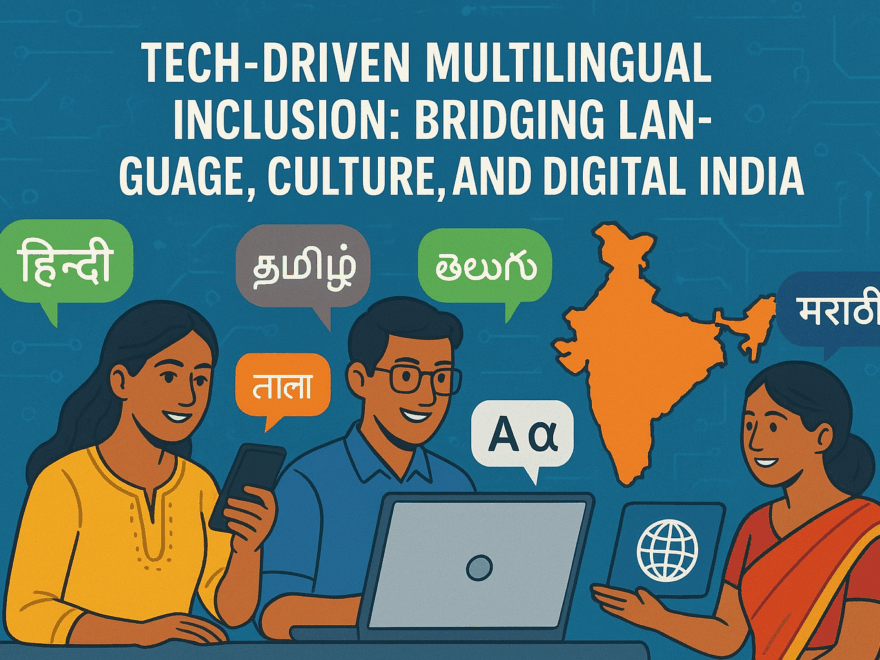
Tech-Driven Multilingual Inclusion: Bridging Language, Culture, and Digital India

Tech-Driven Multilingual Inclusion: Bridging Language, Culture, and Digital India

Tech-Driven Multilingual Inclusion: Bridging Language, Culture, and Digital India

(Relevant for Sociology Paper 1 and 5: Sociology- The Discipline and Stratification and Mobility)

Tech-Driven Multilingual Inclusion: Bridging Language, Culture, and Digital India

📰 Why in the News?

India, home to 22 Scheduled Languages and hundreds of regional and tribal dialects, is making rapid strides in digital multilingual inclusion. Recent initiatives by the central government harness Artificial Intelligence (AI), Natural Language Processing (NLP), and machine learning to make governance, education, and public services more accessible in native languages.

Platforms such as Bhashini, BharatGen, Adi-Vaani, and GeMAI are not just preserving linguistic diversity—they are transforming citizen engagement, digital literacy, and economic participation across India’s vast geography.

🖥️ How Technology is Shaping Language Inclusion

Bhashini

Launched under the National Language Translation Mission (NLTM) by MeitY, Bhashini provides AI-driven translation, speech recognition, and language understanding services.

  • Supports all 22 Scheduled Languages and several tribal languages.
  • Enables multilingual access for governance portals, online education, and digital communication.
  • Serves as a foundational platform for other AI-driven language tools.

Sanchika

Managed by the Central Institute of Indian Languages (CIIL), Sanchika is a digital archive of dictionaries, primers, storybooks, and audiovisual content.

  • Aims to digitally preserve endangered languages.
  • Provides datasets crucial for AI-based translation systems.

BharatGen

A multilingual AI model suite developed under MeitY, BharatGen enables:

  • Text-to-Text (T2T) and Text-to-Speech (TTS) translations.
  • Integration with datasets from SPPEL and Sanchika to support endangered and tribal languages.

Adi-Vaani

India’s first AI-driven platform dedicated to tribal language translation (launched 2024 by MoTA).

  • Supports languages such as Santali, Bhili, Mundari, and Gondi.
  • Uses NLP and speech recognition to document oral traditions and cultural narratives.

GeMAI (Government e-Marketplace AI Assistant)

Facilitates voice and text-based support in multiple Indian languages for vendors and entrepreneurs.

  • Ensures inclusive access to government e-marketplaces.
  • Strengthens the ability of small businesses to navigate digital platforms.

Anuvadini & e-KUMBH

Developed by AICTE, these platforms:

  • Translate technical, engineering, law, and medical textbooks into Indian languages.
  • Provide free access to higher education resources, aligning with NEP 2020’s mother-tongue learning vision.

SWAYAM

A Massive Open Online Course (MOOC) platform under MoE:

  • Offers multilingual online courses to over five crore learners.
  • Reduces the digital learning divide and promotes equitable educational opportunities.

Tech-Driven Multilingual Inclusion: Bridging Language, Culture, and Digital India

🏛️ National and Institutional Initiatives

SPPEL (Scheme for Protection and Preservation of Endangered Languages)

  • Launched in 2013 by MoE, implemented by CIIL.
  • Digitally archives languages spoken by fewer than 10,000 people.
  • Provides text, audio, and video corpora for AI research.

TRI-ECE (Tribal Research, Information, Education, Communication and Events)

  • Managed by MoTA, promotes AI-based translation tools for tribal languages.
  • Ensures community participation and culturally sensitive content.

National Translation Mission (NTM)

  • Converts academic knowledge into Indian languages to democratize access to education and research.

National Mission on Manuscripts (NMM)

  • Preserves and digitizes ancient Indian manuscripts in Sanskrit, Pali, Prakrit, and regional languages.
  • Promotes research and accessibility of India’s literary heritage.

🌍 Broader Impact of Technology-Led Multilingual Platforms

  1. Governance and Public Service Delivery
  • Platforms like Bhashini and GeMAI enable citizens to access government services in their own languages, enhancing transparency, participation, and trust.
  • Particularly impactful for rural and non-Hindi-speaking populations.
  1. Education and Skill Development
  • Tools such as Anuvadini, e-KUMBH, and SWAYAM provide regional language resources for higher education.
  • Supports mother-tongue learning, improves comprehension, and helps bridge digital literacy gaps.
  1. Cultural and Linguistic Preservation
  • Platforms like SPPEL, Sanchika, and Adi-Vaani document endangered and tribal languages, preserving oral histories and knowledge systems.
  • Ensures India’s linguistic heritage evolves with technology rather than fading.
  1. Economic and Social Inclusion
  • Language-inclusive platforms allow farmers, entrepreneurs, and small businesses to engage with government schemes, e-commerce, and financial services in their native languages.
  • Reduces information barriers and fosters equitable participation in the digital economy.
  1. Research and Innovation
  • Multilingual datasets strengthen AI research and encourage indigenous language technology development.
  • Positions India as a global leader in multilingual AI solutions.

🤔 Sociological Insights

India’s multilingual initiatives are not only technological achievements—they reflect deeper social dynamics and inclusive governance.

  • Pierre Bourdieu’s theory of cultural capital: Language skills determine access to resources. AI-enabled translation democratizes knowledge, reducing inequities.
  • Amartya Sen’s capability approach: Ensuring citizens can access information, education, and markets in their native language expands real freedoms and agency.
  • Durkheimian perspective: Language preservation supports social cohesion, shared identity, and cultural continuity, even as society modernizes digitally.

These platforms showcase how technology can complement social policy, bridging gaps between tradition and innovation, inclusion and efficiency.

Conclusion

India’s language preservation and digital inclusion strategy represents a synthesis of heritage and high-tech governance. Platforms like Bhashini, BharatGen, and Adi-Vaani are not merely tools; they are instruments of cultural preservation, educational democratization, and economic inclusion.

By leveraging AI, NLP, and machine learning, India is creating a future-ready, linguistically inclusive digital ecosystem, ensuring that technological progress does not come at the cost of cultural erasure or social inequality.

The lesson is clear: Digital India must be multilingual India. The convergence of technology, policy, and culture ensures that linguistic diversity becomes a source of strength, not a barrier, driving inclusive growth and global leadership in innovation.

To Read more topicsvisit: www.triumphias.com/blogs

Read more Blogs:

The Urban Paradox: India’s Cities, Power, and the Crisis of Local Governance

Pharmaceutical Safety and the State: A Sociological Lens on Schedule M Reforms

One comment

Leave a Reply

Your email address will not be published. Required fields are marked *