

The Six-Pocket Syndrome: When Love Turns into Overdose — Raising Generation Alpha in a Liquid World
(Relevant for Sociology Paper 2: System of Kinship in India)
|
It began with a viral episode of Kaun Banega Crorepati. Welcome to the age of the Six-Pocket Syndrome. What Is the Six-Pocket Syndrome?The term “Six-Pocket Syndrome” emerged in China during its one-child policy era (1979–2015). Each child, the sole heir to familial affection, had six financial and emotional pockets devoted to them — two parents and four grandparents. The child became the sun around which six adults orbited, their love measured not in words or hugs, but in gifts, indulgence, and instant gratification. In India’s urban middle class, the same pattern thrives. Two working parents, often guilty about limited time, and four doting grandparents together create a cocoon of overindulgence. Every demand — the latest gadget, comfort food, or digital privilege — is granted before the child even learns to wait. In sociological terms, we are witnessing a shift from a responsibility-based family to a right-based one, where affection flows freely but boundaries fade silently. The Sociology of Overindulgence: When Family Becomes a Marketplace
Once upon a time, families were sites of discipline, cooperation, and shared responsibility. Children contributed to chores, cared for siblings, and learned patience through scarcity. Today, the post-liberalization family, especially in cities, mirrors the marketplace — love is transactional, and emotional needs are outsourced to consumption. French sociologist Jean Baudrillard would call this the consumerization of affection. Children learn to measure love through what they receive, not what they learn or give. Parenting becomes performative — every gift, every selfie, a public declaration of affection. The family is no longer a moral community; it’s a miniature economy of gratification. This shift has profound consequences. The child’s sense of worth becomes tethered to external validation. They begin to believe they deserve everything they desire — without understanding effort, delay, or denial. As sociologist Zygmunt Bauman describes in his idea of Liquid Modernity, ours is an era where solidity — of values, relationships, and patience — melts into fluid desires, scrolling endlessly through new wants. The Performance of Childhood: Goffman in the PlayroomIn his Dramaturgical Perspective, sociologist Erving Goffman argued that social life is a performance — people play roles before audiences, managing impressions. Today’s children are born onto that stage, their lives broadcast through Instagram reels, YouTube channels, and reality TV. From school talent shows to viral dance clips, childhood itself has become a performance. What once was private play has turned into public spectacle. The child learns early that attention equals affection; applause equals approval. Moral learning gives way to image management. When the KBC child acted overconfident, it wasn’t merely defiance — it was performance. A young mind imitating the exaggerated confidence it sees rewarded online. As Goffman might put it, the “front stage” of childhood has grown so dominant that the “backstage” — where humility, discipline, and introspection once developed — is vanishing. The Fragility Beneath the ConfidenceAt first glance, Generation Alpha — born between 2010 and 2024 — seems dazzling. They are articulate, tech-savvy, and globally aware. Yet beneath their confident exteriors lies a fragile emotional core. The Six-Pocket child grows up shielded from failure, constantly affirmed, rarely denied. Psychologists call this low frustration tolerance. A “no” feels like a personal attack; a criticism feels like rejection. Without friction, there is no resilience. Without delay, there is no depth. This generation’s overconfidence masks anxiety — an insecurity fed by constant comparison on social media and performance pressure at home. They are not arrogant by nature; they are anxious by design. Sociologically, this fragility represents what Bauman called “liquid fear” — anxiety without object, restlessness without reason. When every failure is cushioned and every wish fulfilled, children grow up emotionally rich but spiritually poor — unable to handle ambiguity, loss, or conflict. Parenting in the Age of Pixels and Pockets
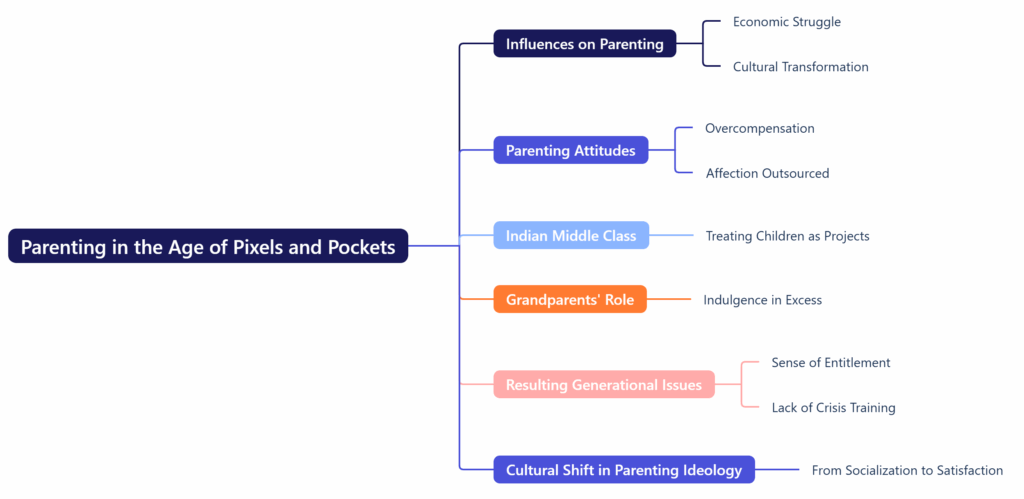
Today’s parents, themselves products of economic struggle and cultural transformation, often overcompensate. Their love is sincere, but their methods are misplaced. Between Zoom meetings and EMIs, affection gets outsourced to material generosity. The Indian middle class, in particular, treats its children as projects — investing in tuition, gadgets, and extracurriculars, expecting perfection in return. Grandparents, shaped by scarcity, now indulge in excess. The result is a generation of children who feel entitled to comfort but untrained for crisis. In sociological terms, this is a cultural shift in parenting ideology — from socialization to satisfaction. Parenting is no longer about preparing children for society, but about protecting them from it. The Consequences: The Rise of the Emotionally UnderpreparedBy their teens, many children of the Six-Pocket Syndrome display a paradox: high intelligence, low emotional maturity. They can code apps but can’t handle criticism; they can debate online but can’t resolve real-world conflict. Their empathy muscles have atrophied from lack of use. With digital devices replacing face-to-face play, many struggle to read emotions, negotiate differences, or express vulnerability. Sociologist Arlie Hochschild called this the commercialization of intimacy — where emotions are managed like commodities. In Generation Alpha, emotions are not nurtured; they are negotiated. Rethinking Parenting: Love with Limits, Freedom with GuidanceIf the Six-Pocket Syndrome reflects indulgence, the cure lies in reclaiming boundaries. Love must be redefined as guidance, not granting. Parents should link rewards to effort, not entitlement. Small doses of failure — losing a game, earning criticism, facing disappointment — are essential to building emotional immunity. India’s National Policy for Children (2013) and the Juvenile Justice Act (2015) both emphasize a child’s right to guidance consistent with evolving capacities. In sociological terms, this means raising citizens, not consumers. Families must share emotional responsibility: grandparents should model resilience, not indulgence; schools must teach empathy as rigorously as coding; media must reward authenticity over spectacle. Society’s task is to shift from “How much can I give my child?” to “What kind of person am I helping them become?” Conclusion: Raising Citizens, Not CustomersThe Six-Pocket Syndrome is not just about spoiled children — it’s about a society learning to love without limits but forgetting the power of limits in love. Generation Alpha is brilliant but brittle, expressive but anxious — a reflection of our liquid age, where affection flows freely but meaning leaks away. The real challenge before parents, educators, and policymakers is not to produce prodigies but to nurture empathetic, grounded human beings — children who can fail gracefully, listen deeply, and live meaningfully. As Amitabh Bachchan gently reminded that overconfident contestant, humility and respect never go out of style. In that quiet moment, India glimpsed a truth no statistic can measure: in the race to raise achievers, we must not forget to raise humans. |

To Read more topics, visit: www.triumphias.com/blogs
Read more Blogs:
Cultivating Knowledge Societies: A Sociological Perspective on Innovation and Development
Strengthening Rural Growth with Enhanced Agricultural Credit: A Pathway to Inclusive Development