
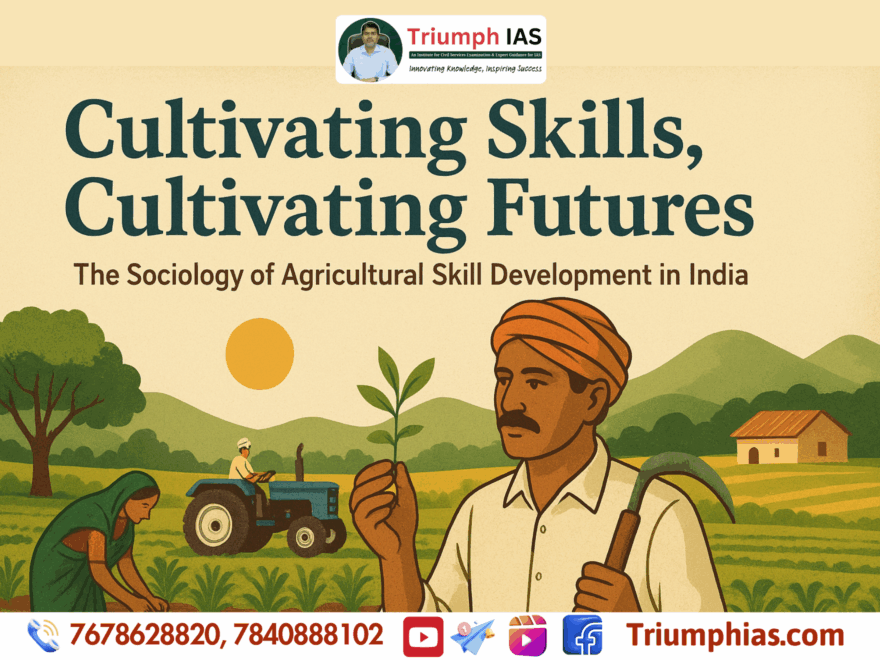
Cultivating Skills, Cultivating Futures: The Sociology of Agricultural Skill Development in India
(Relevant for Sociology Paper 2: Rural and Agrarian Transformation in India)
Cultivating Skills, Cultivating FuturesAgriculture has long been the backbone of Indian society — not only economically, but socially and culturally. With nearly two-thirds of India’s population dependent on agriculture, the sector is far more than a livelihood; it is a way of life that shapes rural identity, kinship, and community. Yet, agriculture in India stands at a crossroads. Rapid climate change, fragmented landholdings, market volatility, and declining youth interest have exposed the limits of traditional farming systems. Recognizing this, the government has shifted focus toward agricultural skill development, seeking to transform farmers into knowledge workers of the rural economy. As sociologists, we must ask: can skilling initiatives truly empower farmers, or do they risk reproducing existing rural inequalities? How do skills translate into social mobility in a deeply stratified agrarian landscape? Institutional Frameworks for Farmer TrainingThe government’s approach to skilling farmers rests on strong institutional platforms that blend scientific research with community learning. Krishi Vigyan Kendras (KVKs), established by the Indian Council of Agricultural Research (ICAR), are district-level hubs offering hands-on training to farmers. Between 2021 and 2024, these centres trained over 58 lakh farmers, with another 18.5 lakh trained by early 2025. Their role is not merely technical — they function as sites of rural modernization, where farmers interact with scientists, extension officers, and fellow cultivators, bridging the gap between lab and land. Similarly, the Agricultural Technology Management Agency (ATMA) has institutionalized decentralized extension reforms. By training 1.27 crore farmers between 2021 and 2025, ATMA promotes farmer-to-farmer knowledge sharing and participatory innovation. In sociological terms, such platforms foster what Pierre Bourdieu might call social capital — networks of trust and cooperation that are essential for community-based learning and innovation. Skilling Rural Youth and Promoting MechanisationModern agriculture increasingly demands mechanical and managerial competencies. The Skill Training of Rural Youth (STRY) program provides short-term vocational training in allied sectors such as dairy, poultry, and fisheries — training over 43,000 rural youth between 2021 and 2024. This initiative represents a crucial effort to re-engage rural youth with agriculture, countering the growing exodus from villages to cities. Meanwhile, the Sub-Mission on Agricultural Mechanisation (SMAM) has trained 57,000+ farmers in the use and maintenance of machinery. Beyond boosting productivity, this mechanisation signals a shift in class relations within rural India — where ownership of technology can redefine status, control, and bargaining power within agricultural communities. Deepening Knowledge: Soil, Sustainability, and Value ChainsSkill development in agriculture today extends beyond the act of cultivation to encompass resource management and value chain participation. The Soil Health Card Scheme, for instance, has distributed 25 crore cards and conducted over 93,000 trainings, teaching farmers about balanced nutrient management. This represents a move toward scientific rationalization of traditional practices, blending local wisdom with data-driven decision-making. Equally transformative are Farmer Producer Organizations (FPOs), of which over 10,000 are registered. By training farmers in agribusiness, digital marketing, and e-platforms like e-NAM and GeM, FPOs turn smallholders into collective entrepreneurs. Through these cooperatives, farmers access markets, share resources, and enhance their bargaining capacity — effectively challenging the atomization that has historically weakened rural producers. Sector-Specific Skilling InitiativesSeveral sector-specific programs underscore the government’s comprehensive approach to rural skill-building:
Together, these initiatives reflect a systemic reimagining of rural labour, transforming the farmer from a subsistence cultivator into a skilled professional embedded in national and global value networks. The Numbers Tell a Story: Economic Survey 2024–25India’s agricultural sector has shown remarkable resilience. The Economic Survey 2024–25 reported 5% annual growth between 2016 and 2023, with agriculture’s share of Gross Value Added rising from 24% to 30%. Agricultural income, too, has grown by 5.23% annually over the last decade. Notably, fisheries (13.7%) and livestock (13%) emerged as the fastest-growing sub-sectors, reflecting the benefits of targeted skilling and diversification. Irrigation coverage rose from 49% to 55% of total cropped area, while irrigation intensity increased to 154%, signaling both infrastructural progress and ecological stress. These numbers highlight a key sociological paradox — as the sector modernizes, the divide between well-resourced and resource-poor farmers may widen unless skilling initiatives are equitably distributed and culturally contextualized. Theoretical Reflections: Sociological Thinkers on Rural TransformationThe transformation of India’s agrarian economy through skill development can be read through the lens of several sociological thinkers.
Challenges and the Way ForwardDespite these advances, several challenges persist. Skill programs must reach marginalized groups — smallholders, women farmers, and landless labourers — who often remain outside institutional training systems. Moreover, agricultural mechanisation, while efficient, risks displacing manual labourers unless complemented by new employment avenues in logistics, agri-services, and processing. Sociologically, this moment demands participatory governance, where farmers co-design training programs suited to their socio-economic and ecological contexts. Empowerment must not be limited to skills but extended to decision-making, market participation, and digital literacy. Conclusion: From Skilled Farmers to Empowered CitizensSkill development in agriculture is not just about raising productivity — it is about redefining citizenship in rural India. When farmers gain access to knowledge, technology, and markets, they move from being passive recipients of subsidies to active participants in national development. As India’s agriculture grows at 5% per year, the next revolution will not be of seeds or subsidies, but of skills and solidarity. The success of these initiatives will depend on whether they can translate technological advancement into social inclusion, ensuring that every cultivator — regardless of caste, class, or gender — finds dignity and opportunity in the fields they till. |
To Read more topics, visit: www.triumphias.com/blogs
Read more Blogs:
Feminisation of Indian Agriculture: The Sociological Paradox of Unpaid Labour
Rituals, Habits, and Social Norms: A Sociological Exploration
One comment