
The Digital Panchayat: A Sociological Lens on Technology, Power, and Rural Transformation
(Relevant for Sociology Paper 2: Politics and Society)
|
The Indian government’s push to digitize Gram Panchayats—through initiatives like SabhaSaar, SVAMITVA, and eGramSwaraj—is more than a administrative upgrade. It is a profound social experiment, a moment where technology intervenes in the deep-seated structures of rural society. To understand its true impact, we must move beyond the press releases and employ the analytical tools of sociology, viewing these reforms through the lenses of power, bureaucracy, social capital, and inequality. Max Weber: The Iron Cage of Digital BureaucracyThe German sociologist Max Weber warned of the increasing rationalization of society and the rise of bureaucracy, an impersonal system governed by abstract rules and hierarchies. While efficient, he feared this could create an “iron cage,” trapping individuals in systems that prioritize procedure over humanity. The digital Panchayat initiatives are a textbook case of Weberian rationalization. eGramSwaraj and Panchayat NIRNAY replace traditional, often informal, community decision-making with standardized, rule-based digital processes. The AI tool SabhaSaar is the ultimate embodiment of this: it removes the nuance, the emotional rhetoric, and the local idioms from Gram Sabha meetings, reducing them to structured, impartial data. From a Weberian perspective, this has a dual effect. Positively, it counteracts the “patrimonial” authority common in traditional villages, where power was often exercised based on personal loyalty, caste status, or hereditary privilege. The digital system, in theory, treats all citizens as equal data points, undermining traditional patronage networks. However, it also risks forging a new “iron cage.” The focus may shift from substantive justice and local context to mere procedural compliance—filling the right digital forms, generating the correct reports—potentially alienating villagers from a governance process that feels cold, impersonal, and distant. Pierre Bourdieu: The Shifting Field of Power and Capital
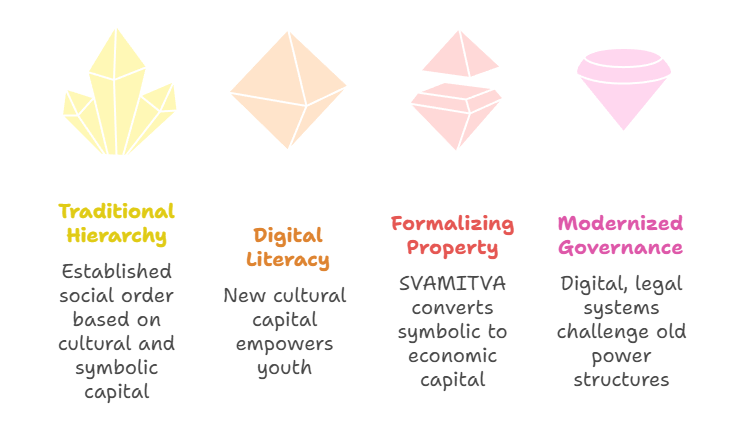
French sociologist Pierre Bourdieu provides a sophisticated framework for understanding social stratification through different forms of “capital”: economic, social, cultural, and symbolic. The digital revolution in Panchayats is actively reshaping the value of these capitals.
The Digital Divide: Amplifying Existing Inequalities
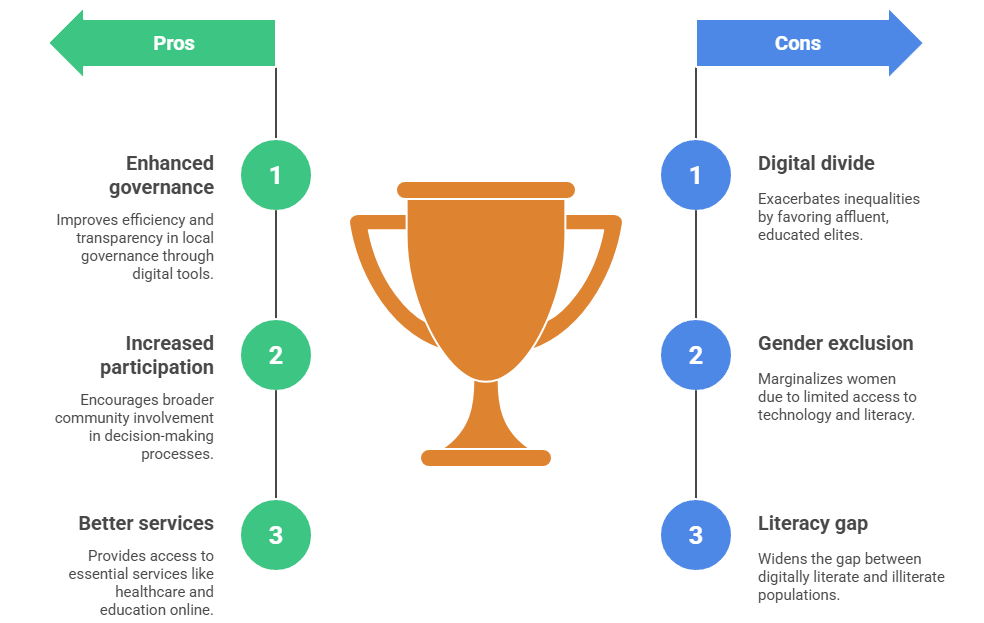
A core sociological insight is that social interventions often reproduce, rather than eliminate, existing inequalities. The work of thinkers like Amartya Sen and Mahbub ul Haq on human development reminds us that access to a tool is not enough; one must have the capability to use it effectively. The digital Panchayat reforms risk creating a new social cleavage: the digital divide.
Jürgen Habermas: The Digitization of the Public SphereGerman philosopher-sociologist Jürgen Habermas theorized the “public sphere” as a space for rational-critical debate among citizens, separate from the state. The Gram Sabha is the closest institutional equivalent in rural India. Digital tools are fundamentally altering this public sphere. SabhaSaar’s AI-generated minutes create a perfect, unbiased record, which promotes transparency. However, it also de-personalizes and archives public discourse. The messy, passionate, and context-rich deliberation of the village square is transformed into a sterile, structured document. This could lead to a more disciplined but less vibrant public discourse, where citizens self-censor, knowing their words are being permanently and impersonally recorded. The “public sphere” moves from a dynamic, oral space to a curated, digital archive. Conclusion: A Contested TerrainThe digitization of Panchayats is not a simple tale of progress. Through a sociological lens, it emerges as a contested terrain where old and new forms of power are clashing. Weber helps us see the push for efficiency and impersonality, potentially at the cost of human connection. Bourdieu allows us to see how digital literacy is becoming a new currency of power, challenging traditional hierarchies based on caste and age. The concept of the digital divide warns us that these tools can amplify existing inequalities of gender, class, and caste if not carefully implemented. Ultimately, technology is not an external force acting upon society; it is woven into its very fabric, reshaping social relationships in unpredictable ways. The success of these digital reforms will not be measured in terabytes or app downloads, but in their ability to navigate this complex sociological reality—to dismantle oppressive hierarchies without creating new, digital ones, and to empower the marginalized, not just the connected. |
To Read more topics, visit: www.triumphias.com/blogs
Read more Blogs:
Right to Die or Duty to Suffer? A Sociological Critique of Euthanasia in India