Introduction
The informal sector is the hidden backbone of most developing societies. In India, sub-Saharan Africa, or Latin America, millions survive by working in spaces that are outside the regulatory framework of the state—street vending, domestic work, construction, small manufacturing, gig work, and agricultural labour. The paradox is clear: while informal workers keep economies running, they are invisible in laws, policies, and protections.
What Is the Informal Sector?
The International Labour Organization (ILO) defines the informal sector as work and enterprises not regulated by the state, not protected by labour laws, and often excluded from social security. In India, it covers over 80–90% of the workforce, according to the Periodic Labour Force Survey (PLFS).
Examples:
- Street vendors in Delhi or Lagos
- Domestic workers in Mumbai or Nairobi
- Cycle rickshaw pullers in Dhaka
- Gig workers driving for Ola, Uber, or Swiggy
This sector provides flexibility, survival opportunities, and low entry barriers—but also precariousness, low wages, and vulnerability.
Historical and Structural Context
In developing societies, the informal sector is not a leftover of tradition but an integral part of capitalist development. Keith Hart first coined the term “informal sector” in his 1973 study of urban Ghana. He showed that informal work is dynamic, not merely “illegal” or “traditional.”
- Dependency theorists argued that the informal sector grows when formal, capitalist sectors cannot absorb surplus labour, leading to underemployment.
- Marxist analysis (R. Desai, Indian context) highlights that informal labour provides cheap, flexible work that sustains capitalist profit.
- Dual Economy Theories (Lewis model) considered informal work as a transitory stage, but in reality, it has persisted and expanded.
Characteristics of Informal Sector in Developing Societies
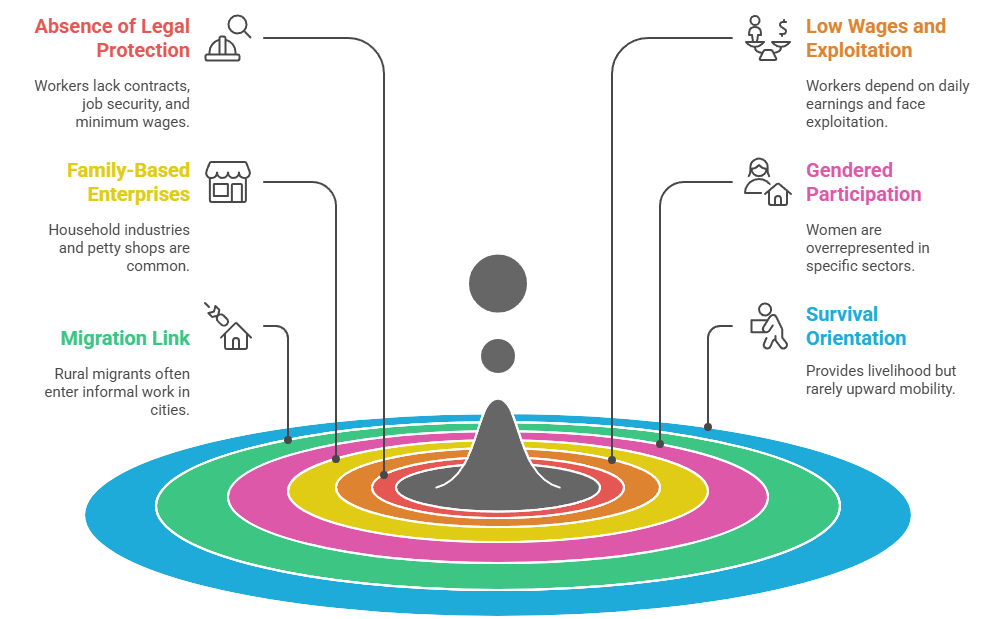
- Absence of legal protection: No contracts, job security, or minimum wages.
- Low wages and exploitation: Workers depend on daily earnings.
- Family-based enterprises: Household industries, petty shops.
- Gendered participation: Women are overrepresented in domestic work, beedi rolling, and garment piece-work.
- Migration link: Rural migrants in cities often enter informal work (construction, hawking).
- Survival orientation: It provides livelihood but rarely upward mobility.
Sociological Analysis
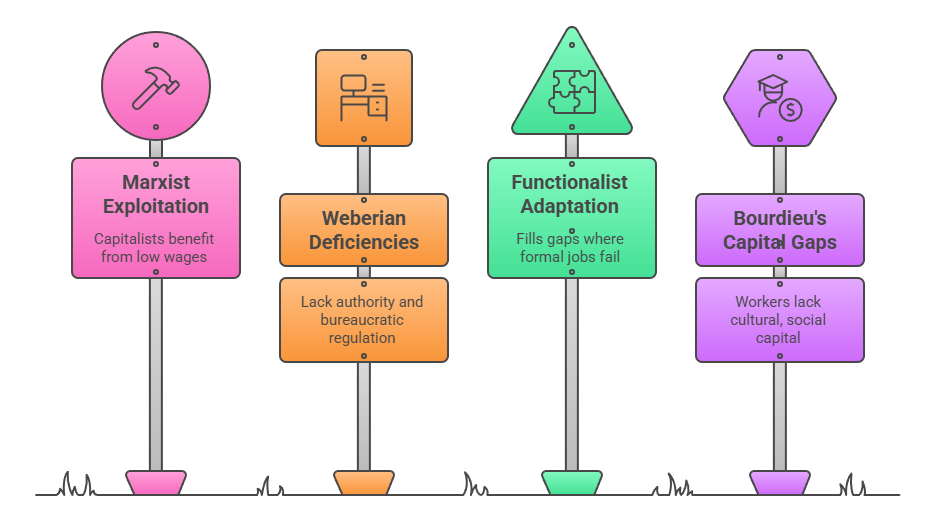
- Marxist view: Informal workers are part of the “reserve army of labour,” keeping wages low and benefiting capitalists.
- Weberian view: Informal sector reflects lack of rational-legal authority and bureaucratic regulation, leading to personalized patron-client relations.
- Functionalist perspective (Parsons): Informal sector performs adaptive functions by providing work where formal jobs are absent.
- Bourdieu’s concept of habitus and capital: Informal workers often lack cultural and social capital to transition into formal employment.
Why the Informal Sector Persists in Developing Societies
- Demographic Pressure: High population growth in countries like India or Nigeria pushes millions into the labour market, while the formal sector cannot absorb them.
- Weak Industrialisation: Developing societies face premature deindustrialisation, where formal manufacturing fails to expand enough.
- Cost of Formalisation: Many micro-enterprises avoid compliance due to complex bureaucracy, corruption, and high taxes.
- Globalisation: Instead of shrinking, informal work has adapted—outsourcing, contract work, gig economy. Saskia Sassen notes how global cities rely on migrant and informal labour.
- State Policies
Weak enforcement of labour laws and inadequate welfare schemes perpetuate informality.
Informal Sector and Class, Caste, and Gender in India
Class: Most informal workers belong to lower-income classes, with limited bargaining power. They form the “working poor”—employed but still in poverty.
Caste: Caste and informality intersect: Dalits and lower castes dominate manual and low-paid work like sanitation, construction, or leather work. Sociologist André Béteille emphasized caste-class overlaps in occupational hierarchies.
Gender: Women are heavily concentrated in informal work. For instance, SEWA (Self-Employed Women’s Association) highlights the struggles of women vendors, domestic workers, and artisans. Feminist sociologists argue that informalisation reinforces patriarchal dependence.
Current Relevance
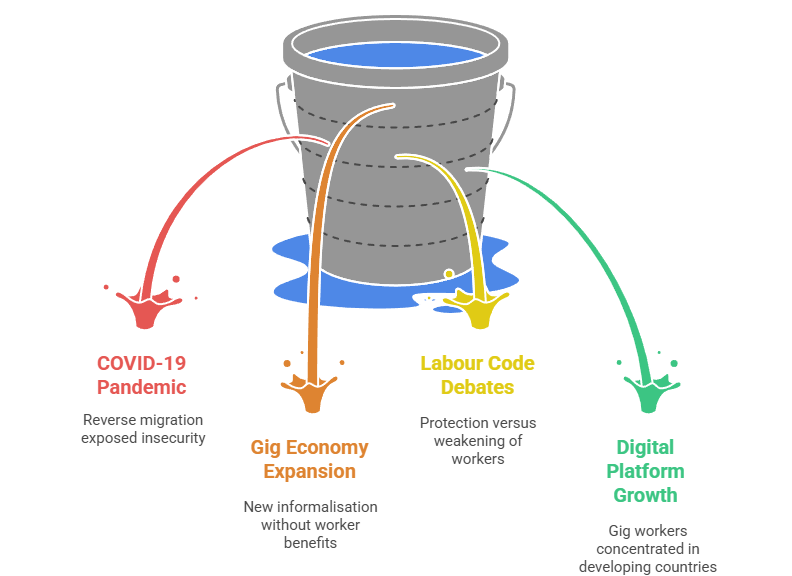
- COVID-19 Pandemic: Migrant workers in India faced reverse migration during lockdowns, exposing the absence of social security.
- Gig Economy: Platforms like Zomato, Ola, and Amazon Flex show the “new informalisation.” Workers are labelled “partners” without benefits.
- Labour Codes (2020–21): India attempted labour law simplification, but debates continue on whether they protect or weaken informal workers.
- Digital Labour Platforms: The ILO’s 2021 report showed that over 50% of gig workers worldwide are in developing countries.
Sociological Issues Linked with Informal Sector
- Urbanisation: Slums often house informal workers. Informal economy and informal settlements are intertwined.
- Education and Skills: Lack of access to quality education traps generations in informal jobs.
- Social Mobility: Informal work rarely leads to upward mobility, reinforcing inequality.
- Unionisation Challenges: Fragmented, unregulated, and dispersed workers struggle to collectivise.
State Response and Policy Measures
- National Rural Employment Guarantee Act (MGNREGA): Provides rural employment but doesn’t fully address urban informal workers.
- Street Vendors (Protection of Livelihood) Act, 2014: Attempts to secure rights of hawkers, but implementation is patchy.
- E-Shram Portal: A database to include informal workers in social security schemes.
- Skill India and PM SVANidhi Scheme: Aim to formalise micro-enterprises and self-employment.
Yet, despite these, the sector remains highly precarious.
Global Comparisons
- Latin America: Informal employment accounts for nearly half the workforce. Countries like Brazil experimented with conditional cash transfers (Bolsa Família) to support informal families.
- Africa: Informality is the dominant mode of economic life—subsistence agriculture, street vending, and artisanal mining.
- South Asia: Common trends include informalisation of agriculture and export-oriented industries like garments (Bangladesh, India).
The Way Forward

- Simplify Formalisation: Reduce compliance barriers for small enterprises.
- Extend Social Security: Health insurance, pensions, and accident benefits for informal workers.
- Promote Unionisation: Encourage informal sector unions like
- Use Technology: Digital IDs and payment systems for inclusion.
- Education and Skills: Vocational training and literacy programs to break the cycle.
- Urban Policies: Recognise Street vending, waste-picking, and gig work as legitimate.
Conclusion
The informal sector is not a temporary residue of tradition but a structural feature of developing societies. It sustains livelihoods, absorbs surplus labour, and even fuels urban consumption. But its persistence also reflects inequality, exploitation, and weak state capacity.
From a sociological standpoint, the informal sector is both a safety net and a trap. It reflects class exploitation (Marx), absence of rational-legal order (Weber), functional adaptability (Parsons), and reproduction of inequality (Bourdieu).
For India and other developing societies, the challenge lies in moving from informality to decent work—not by erasing informal work, but by recognising, regulating, and protecting it. A democracy that ignores its informal workers risks deepening inequality and unrest.
PYQs
Paper 1:
- “What do you understand by ‘informalisation of labour’? Write your answer with special reference to India.” (2017)
- “Capitalism has brought increasing informalisation of work in society. Substantiate your answer.” (2020)
- “What is ‘informal labour’? Discuss the need for and challenges in regulating informal labour in the post‑industrial society.” (2019)
- “Distinguish between the social organization of work in feudal society and in capitalist society.” (2015)
- “Capitalism has brought increasing informalisation of work in society.” (2020)
- Critically analyze the sociological significance of informal sector in the economy of developing societies.(2025)
Paper 2:
- “Distinguish between formal and informal sectors in India.” (2013)
- “Discuss the impact of globalisation on the workers in the Informal sector.” (2014)
- “Write short note with a sociological Perspective: Issues relating to the informal labour market in urban India.” (2015)
- “Discuss the changing nature of the problems of working class in the informal sector of the economy.” (2016)
- “Do you agree that the issue of child labour raises questions about and beyond the informal sector? Give reasons.” (2017)
- “How do you view the growth of informal sector in India?” (2022)
|

One comment