Introduction
The dowry system in India remains one of the most entrenched social evils despite legal prohibitions under the Dowry Prohibition Act, 1961 and the inclusion of Section 304B IPC (dowry death). The tragic death of 26-year-old Nikki Bhati in Greater Noida (August 2025) once again reveals the dark intersection of patriarchy, violence against women, and failure of social reform. From a sociological perspective, dowry is not just an individual crime but a structural manifestation of gender inequality deeply rooted in cultural practices, caste endogamy, and consumerist aspirations.
This case also compels us to examine the ethical responsibility of families, law enforcement, and society in preventing such atrocities.
The Incident:
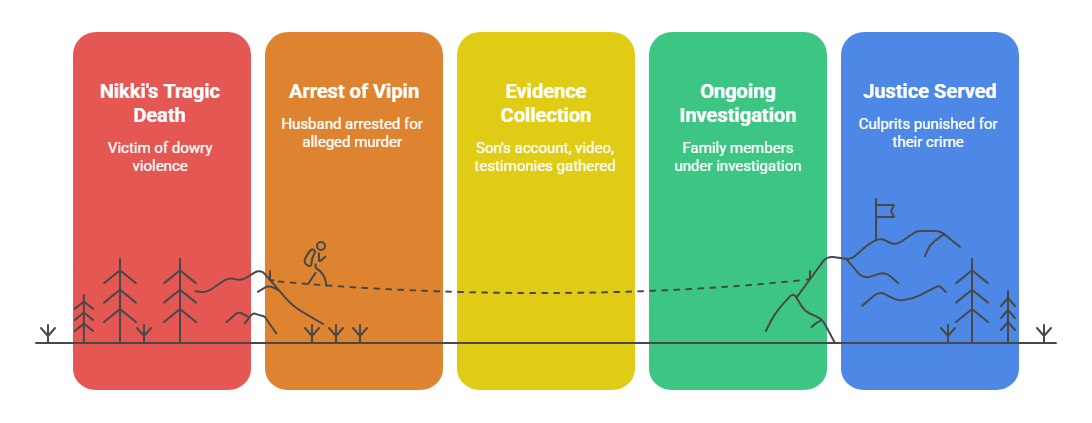
- Victim: Nikki Bhati, 26, died of 70% burn injuries after being set ablaze.
- Cause: Alleged dowry demand of ₹36 lakh by her husband, Vipin Bhati, and in-laws.
- Evidence: Her six-year-old son’s eyewitness account, video footage of assault by her elder sister Kanchan, and testimonies of long-term harassment.
- Aftermath: Vipin was arrested but attempted escape during custody, leading to a police encounter. Investigation is ongoing against other family members.
- Family’s Statement: The father accused the in-laws of prolonged torture and demanded capital punishment.
This case starkly highlights how dowry harassment evolves into domestic violence and ultimately femicide.
Dowry as a Social Evil
- Patriarchy and Property: Dowry began as a way of giving daughters their share in family wealth but turned into a patriarchal tool where women are seen as financial burdens. It reinforces male dominance and women’s economic dependence.
- Caste and Marriage Markets: Dowry operates as a mechanism to maintain caste boundaries. The system of hypergamy (marrying into a higher-status family) often fuels demands for larger dowries.
- Consumerism and Status: Post-1991 economic liberalization increased consumerist aspirations, turning marriages into showcases of wealth. Dowry became a symbol of family prestige, pushing many into debt and violence.
Sociological Analysis
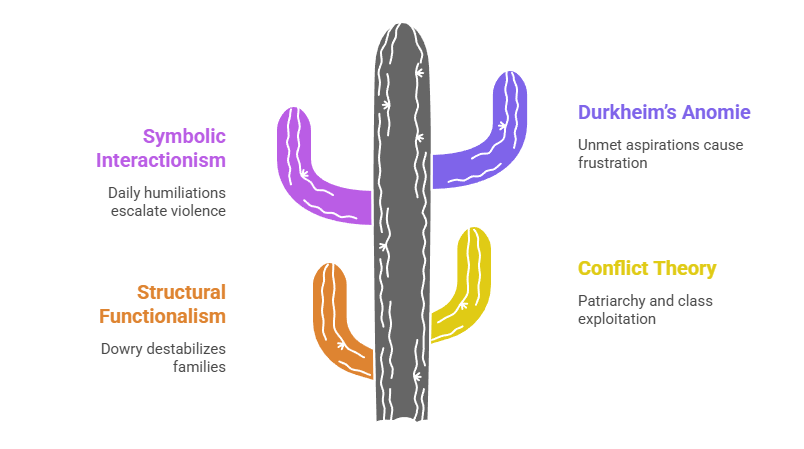
- Structural Functionalism: Marriage is expected to stabilize families, but dowry introduces dysfunction. Instead of cohesion, it creates tension, conflict, and in this case, fatal violence.
- Conflict Theory: The case reflects patriarchy and class exploitation. Women’s bodies become bargaining tools where in-laws exert power through coercion and violence.
- Symbolic Interactionism: Everyday humiliations—control over mobility, verbal abuse, physical assault—shaped Nikki’s reality. The violent act was the final escalation of these daily interactions.
- Durkheim’s Anomie: Rising material aspirations without legitimate means to achieve them create frustration. This strain often manifests in demands for dowry and violent outcomes when expectations are unmet.
Legal Dimensions
- Dowry Prohibition Act (1961): Criminalizes giving and taking of dowry, but implementation remains weak.
- Section 304B IPC (Dowry Death): Punishment of 7 years to life imprisonment if a woman dies within 7 years of marriage under dowry harassment.
- Section 498A IPC: Protects women from cruelty by husband or relatives.
- Domestic Violence Act (2005): Provides civil remedies against abuse.
Gaps in Implementation
- Underreporting due to stigma and family honor.
- Police insensitivity and delays in filing FIRs.
- Judicial backlog leading to delayed justice.
- Societal pressure forcing women to return to abusive homes, as in Nikki’s case.
Ethical Implications
- Family Responsibility: Why do natal families often compel women to endure violence for “social respectability”?
- Community Silence: Why do neighbors and extended kin remain silent spectators?
- Law Enforcement Ethics: Police encounters and delayed response raise questions about ethical law enforcement.
Social Implications
- Normalization of Violence: Frequent cases have desensitized society.
- Impact on Children: Nikki’s son witnessed his mother’s death, leading to long-term psychological trauma.
- Gender Justice Crisis: Despite India’s constitutional promise of equality (Article 14 & 15), women’s lives remain vulnerable.
Way Forward:
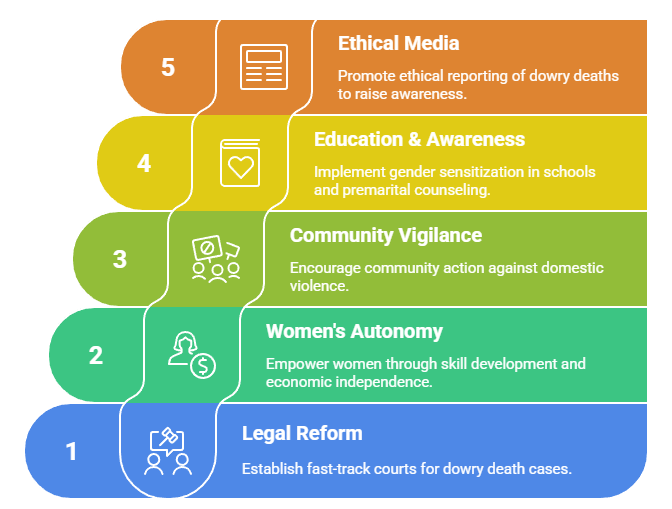
- Legal Reform + Speedy Justice: Establish fast-track courts for dowry death cases.
- Strengthening Women’s Autonomy: Economic independence through skill development, MNREGA, and SHGs.
- Community Vigilance: Gram Sabhas and RWAs must act against domestic violence instead of hiding it.
- Education and Awareness: Gender sensitization in schools and premarital counseling.
- Media Role: Ethical reporting of dowry deaths to create awareness without sensationalism.
Conclusion
The Greater Noida dowry death of Nikki Bhati is not an isolated crime but part of a larger structural violence against women in Indian society. Laws exist, but unless society transforms its patriarchal mindset, such cases will continue.
As Gandhi once said, “Any society that fails to respect its women cannot claim to be civilized.” The battle against dowry is not only legal but ethical and cultural, demanding a collective awakening.
PYQs
Paper I
- Explain the relationship between patriarchy and violence against women. (2015)
- How do social institutions like family and kinship perpetuate gender inequality? (2017)
- How do power relations operate within patriarchal family structures? (2018)
- Discuss the concept of domestic violence as structural violence with sociological perspectives. (2019)
- Discuss the relationship between gender, patriarchy, and poverty. (2020)
- What are the sociological implications of age gap in marriage using symbolic interactionism? (2021)
Paper II
- Evaluate the impact of dowry system on Indian family and kinship. (2016)
- Explain the rise of women’s movements against domestic violence and dowry harassment in India. (2016)
- “Changing patterns of marriage in urban India—Challenges and implications.” (2017)
- Discuss the social consequences of domestic violence and dowry deaths in Indian society. (2018)
- Examine the relationship between caste, patriarchy, and violence against women in India. (2019)
- Critically analyze the role of laws like Section 498A IPC and Domestic Violence Act, 2005 in ensuring gender justice. (2020)
- Examine the persistence of patriarchal values in contemporary Indian marriages despite legal reforms. (2022)
|


One comment