Introduction
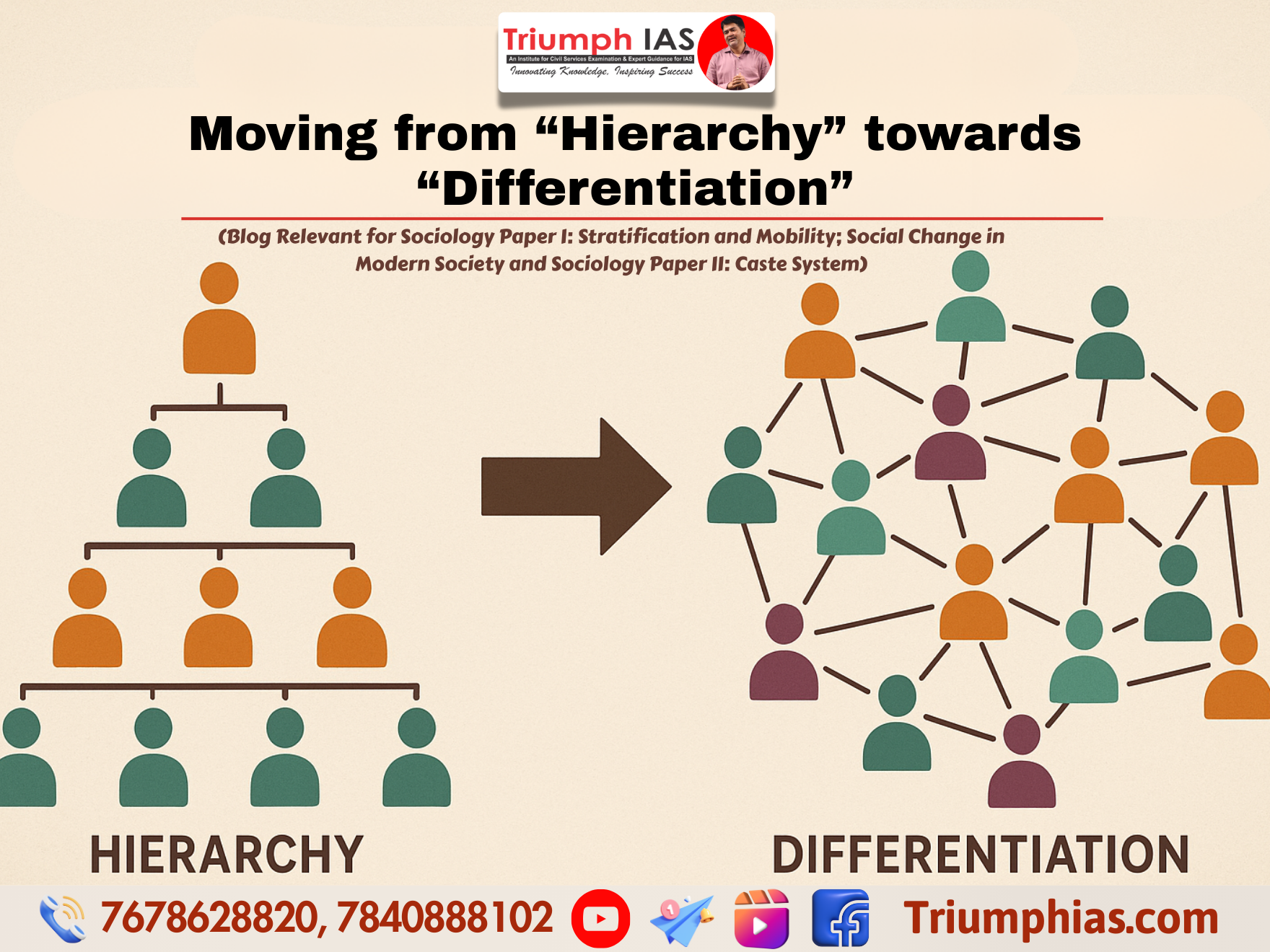
Indian society has historically been defined by hierarchy, where people were ranked according to fixed social positions, largely determined by caste, birth, and ritual status. In this system, social stratification was rigid, mobility was minimal, and inequality was justified through religious and cultural norms. Over time, especially after independence, India has been transitioning toward differentiation, a system in which roles and positions are determined more by function, skill, and achievement rather than inherited rank. This shift is central to UPSC Sociology discussions, linking concepts of social change, modernisation, urbanisation, and industrialisation.
Understanding the Concepts
Hierarchy
- In sociology, hierarchy refers to a rank-based ordering of individuals and groups where higher positions enjoy more prestige, privilege, and power.
- In India, the caste system was the primary form of hierarchy, as described by Louis Dumont in Homo Hierarchicus. It was based on purity-pollution norms, hereditary occupations, and endogamy.
Differentiation
- Differentiation means the division of society into specialised roles and institutions based on functional needs rather than inherited status.
- Sociologists like Émile Durkheim linked it with the transition from mechanical solidarity (traditional, homogeneous societies) to organic solidarity (modern, diverse societies).
Historical Roots of Hierarchy in Indian Society
- Caste system with its varna–jati
- Hierarchical occupations (Brahmins at the top, Dalits at the bottom).
- Ritual purity governing social interactions.
- Patriarchal gender order where women’s status was tied to men.
- Land ownership patterns reinforcing upper-caste dominance.
Forces Driving the Shift toward Differentiation
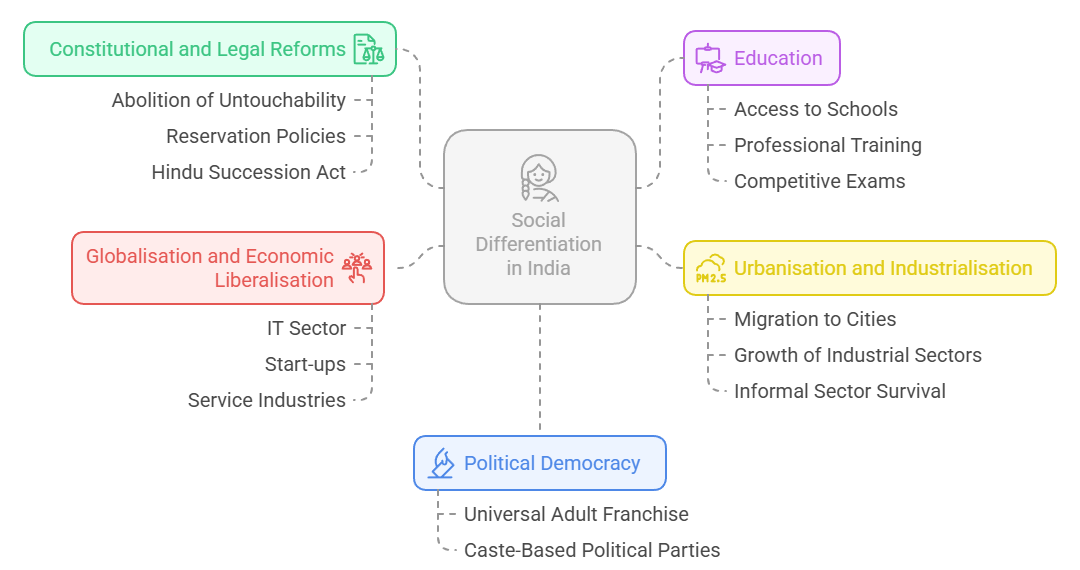
- Constitutional and Legal Reforms: Post-independence legal measures such as Articles 14, 15, and 17 abolished untouchability, guaranteed equality, and prohibited discrimination. Reservation policies for SCs, STs, and OBCs, along with reforms like the Hindu Succession Act, have reduced caste-based occupational rigidity and created pathways for mobility.
- Education: The spread of mass education and professional training has weakened hereditary occupational roles. Access to schools, universities, and competitive exams has allowed marginalised groups to enter professions once reserved for higher castes, creating a more diverse middle class.
- Urbanisation and Industrialisation: Migration to cities and the growth of industrial and service sectors have diluted traditional caste boundaries. In urban workspaces, technical skills often outweigh caste identity, and economic survival in informal sectors reduces the importance of ritual status.
- Political Democracy: Universal adult franchise has empowered marginalised communities, making caste a tool for political mobilisation rather than social exclusion. Representation through caste-based political parties has challenged old hierarchies and pushed for policy changes.
- Globalisation and Economic Liberalisation: The IT sector, start-ups, and service industries have fostered merit-based hiring. Global exposure and return migration have brought more egalitarian attitudes, challenging ritual hierarchy with a focus on competence and performance.
Sociological Analysis
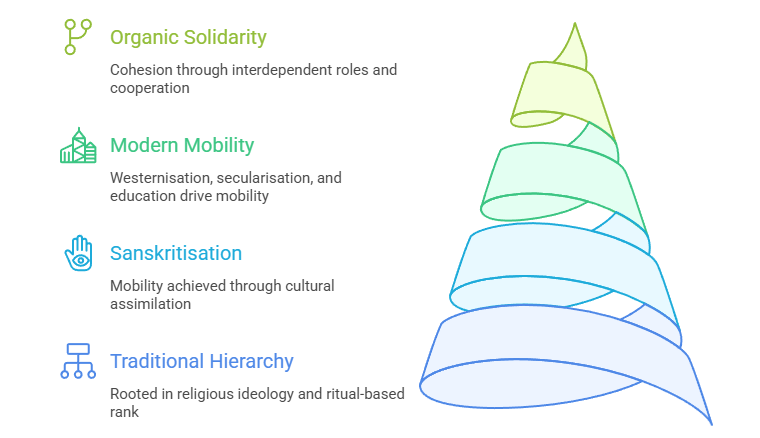
- Louis Dumont argued that Indian hierarchy is rooted in religious ideology rather than economic structures. Differentiation disrupts this by replacing ritual-based rank with functional interdependence, making social positions more fluid.
- N. Srinivas showed that in the traditional hierarchy, mobility was achieved through Sanskritisation. In a differentiated society, Westernisation, secularisation, and educational attainment have become more significant agents of mobility.
- André Béteille highlighted the separation of caste, class, and power in modern India. He observed a shift from status-based relations, defined by birth, to contract-based relations, defined by skill, performance, and mutual agreement.
- Durkheim’s idea of organic solidarity explains the growing reliance on specialised, interdependent roles in modern India. As society becomes more complex, cohesion is maintained through function and cooperation rather than hierarchy.
Manifestations of Differentiation in Contemporary India
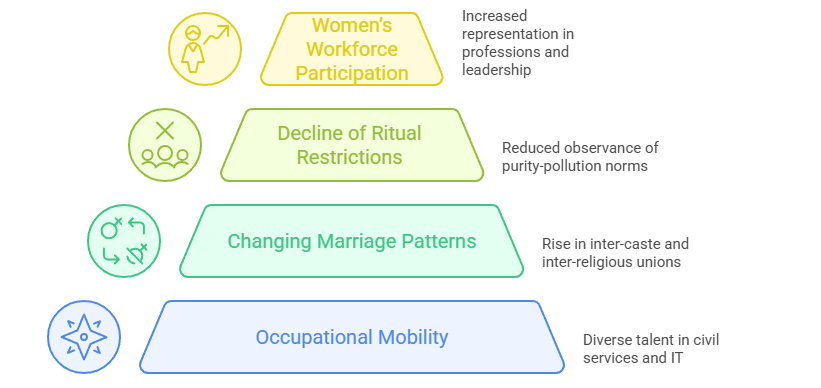
- Occupational Mobility: Employment in sectors like civil services, IT, defence, and corporate leadership now draws talent from varied caste and class backgrounds. UPSC toppers increasingly include first-generation graduates and candidates from rural areas, reflecting a move from birth-based privilege to merit-based achievement.
- Changing Marriage Patterns: Urbanisation and higher education have encouraged a rise in inter-caste and inter-religious marriages, especially among the educated youth. The Special Marriage Act enables such unions, signalling a shift from caste-endogamy toward individual choice in marital decisions.
- Decline of Ritual Restrictions: Urban lifestyles have reduced the observance of purity-pollution norms in public spaces. People from different caste and religious backgrounds share workspaces, dine together, and engage in social events without rigid segregation.
- Women’s Workforce Participation: Women are increasingly represented in professions like law, medicine, corporate management, and defence services. While gender gaps persist, the shift from traditional dependency roles to professional and leadership positions indicates growing functional equality.
Challenges in the Shift
While differentiation is on the rise, hierarchical remnants persist:
- Caste-based violence in rural areas (Khap panchayats, honour killings).
- Discrimination in housing, jobs, and politics.
- Persistence of patriarchal norms despite legal reforms.
- Digital spaces also replicate social biases.
Conclusion
Indian society is in a transitional phase—while the ideals of equality, meritocracy, and functional specialisation are gaining ground, the shadows of hierarchy remain. Differentiation has redefined opportunities for many, yet to ensure inclusive modernity; India must address structural inequalities, social prejudices, and power imbalances that slow this transformation.
PYQs
Paper 1
- Examine the impact of modernisation and industrialisation on the caste system in India. (2013)
- Explain the concept of social mobility. Discuss the factors responsible for upward mobility in Indian society. (2014)
- Distinguish between caste and class. Evaluate how far it is true to say that class is replacing caste in contemporary India. (2015)
- How far do you agree that the caste system is assuming the features of class system in India? (2017)
- Explain Louis Dumont’s view on hierarchy in Indian society. How far is it relevant in understanding social change today? (2018)
- Explain the concept of ‘status’ and ‘role’ with suitable examples. How do they help us understand the shift from status-based hierarchy to achievement-based differentiation? (2019)
Paper 2
- Discuss the processes of Westernisation and secularisation in changing Indian social structure. (2013)
- Discuss the role of urbanisation in the weakening of caste system in India. (2016)
- How far has education contributed to the decline of caste-based social order in India? (2017)
- Critically examine the role of reservation policy in promoting social mobility among Scheduled Castes and Other Backward Classes. (2019)
- What changes have been observed in the patterns of social stratification in India in the era of globalisation? (2020)
- Evaluate the relevance of Dumont’s theory of hierarchy in understanding caste relations in contemporary India. (2021)
- Explain with examples the interplay between caste, class, and power in contemporary India. (2022)
|