
The Roots and Rise of Left-Wing Extremism in India
(Relevant for GS Paper-3, Internal security, Left wing extremism)
|
Left-Wing Extremism (LWE), commonly referred to as the Naxalite or Maoist insurgency, has posed one of the most persistent internal security challenges in India. Despite considerable progress over the past decade, remnants of the movement still persist in parts of Central and Eastern India. Understanding the historical roots, underlying causes, and current status of LWE is crucial for policy makers, security agencies, and civil society to work collaboratively towards sustainable peace and development. Historical BackgroundLWE in India can be traced back to 1967, when a peasant uprising led by Charu Majumdar and Kanu Sanyal erupted in the village of Naxalbari in West Bengal. Inspired by Maoist ideology, this movement aimed to overthrow the Indian state through armed revolution and establish a “people’s government.” Though initially suppressed, the movement found fertile ground in various parts of the country, particularly among the marginalised tribal and rural populations. Over time, it evolved into a full-fledged insurgency, spearheaded by the Communist Party of India (Maoist), formed in 2004 by the merger of the People’s War Group (PWG) and the Maoist Communist Centre (MCC). Geographical Spread and Red CorridorAt its peak around 2010, LWE affected over 200 districts across 20 states, covering what is known as the “Red Corridor”—stretching from Andhra Pradesh and Telangana in the south to Bihar and West Bengal in the east, and from Odisha to parts of Maharashtra, Jharkhand, and Chhattisgarh. However, due to sustained counter-insurgency efforts and development initiatives, the number of affected districts has significantly declined. As per the Ministry of Home Affairs (MHA) report (2024), LWE-related violence is now largely confined to 45 districts across 8 states, with the “most affected” category reduced to 10 districts, primarily in Chhattisgarh, Jharkhand, and parts of Maharashtra and Odisha. Root Causes of Left-Wing Extremism
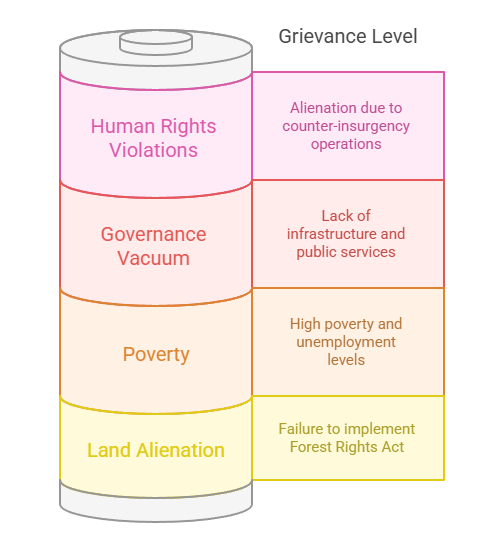
Tribal communities, often dependent on forests for livelihood, have historically suffered land alienation due to exploitative landlords, industrial projects, and displacement. Failure to effectively implement the Forest Rights Act (2006) in several areas has deepened grievances.
The regions affected by LWE typically have high levels of poverty, illiteracy, and unemployment. The NITI Aayog Multidimensional Poverty Index (MPI) 2023 highlights that many LWE-affected districts rank among the poorest in India.
Remote tribal areas often lack basic administrative infrastructure, public services, and security presence. This vacuum has allowed Maoists to set up parallel governance systems, often termed “Janatana Sarkar”.
Heavy-handed counter-insurgency operations and cases of fake encounters, custodial deaths, and lack of accountability have often alienated the local population, eroding trust in state institutions. Government Response: Multi-Pronged Strategy
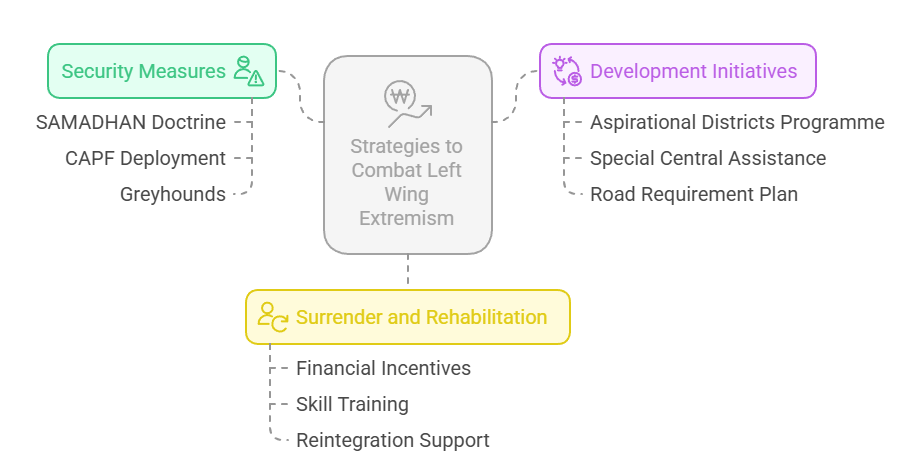
States like Chhattisgarh, Odisha, and Jharkhand have implemented attractive surrender and rehabilitation policies providing financial incentives, skill training, and reintegration support for former cadres. Current Status and TrendsAccording to the MHA Annual Report 2024–25:
Notably, Chhattisgarh continues to remain a major hotspot, particularly the Bastar region, despite high investment in counter-insurgency operations. However, recent operations like the Tekulguda encounter (2024), where over 20 Maoists were neutralised, show significant operational success. Challenges Ahead
Despite a declining trend, splinter groups and revival attempts remain a concern. Maoists continue to exploit local issues like displacement due to mining or land acquisition.
Human rights violations by security forces can erode legitimacy. A people-centric approach is essential to winning hearts and minds.
Superficial development without participation of local communities may breed further resentment. Sustainable, inclusive, and tribal-sensitive development is the key. Way Forward
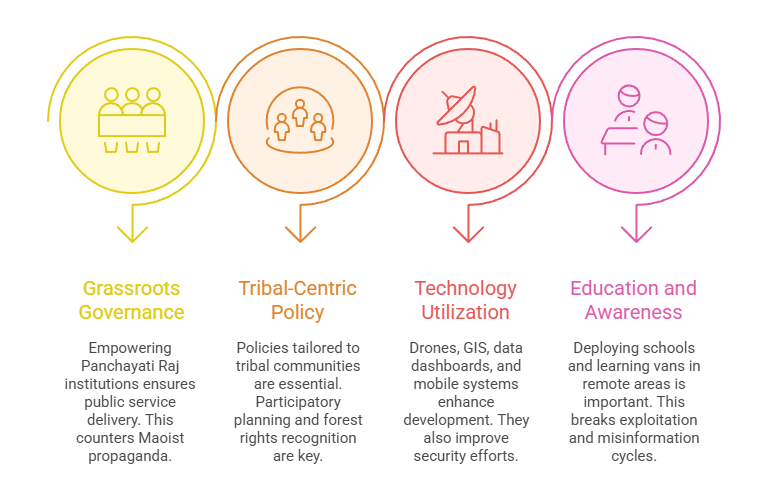
Empowering Panchayati Raj institutions and ensuring last-mile delivery of public services is critical to counter Maoist propaganda.
Policies must be tailored to the unique socio-cultural realities of tribal communities. Participatory planning, recognition of forest rights, and respect for indigenous knowledge are essential.
Use of drones, GIS, real-time data dashboards, and mobile-based grievance redress systems can enhance both development and security efforts.
Schools, vocational centres, and mobile learning vans should be deployed in remote areas to break the cycle of exploitation and misinformation. ConclusionThe fight against Left-Wing Extremism is not merely a law-and-order issue but a battle for justice, dignity, and inclusive development. While security operations have delivered measurable results, the root causes of alienation must be addressed through sustained development, good governance, and tribal empowerment. Only then can India truly neutralise the remnants of LWE and integrate the affected regions into the national mainstream. |
To Read more topics, visit: www.triumphias.com/blogs
One comment