Introduction: Gender Gap Emerge in Mathematical Abilities
In a world striving for gender equality, persistent disparities in educational outcomes remain deeply concerning. One such gap—the gender difference in mathematical abilities—has been historically debated. A groundbreaking study published in Nature (2024) sheds new light on this issue. It reveals that boys and girls start school with similar math abilities, but a gender gap favoring boys emerges as early as four months into formal schooling.
This blog explores the gender gap in math performance from a sociological perspective, highlighting the role of socialization, stereotypes, family background, and educational structures in shaping abilities—not biological differences. This topic is highly relevant especially under topics like Gender and Education, Social Stratification, Family and Socialization, and Women and Development.
Key Findings
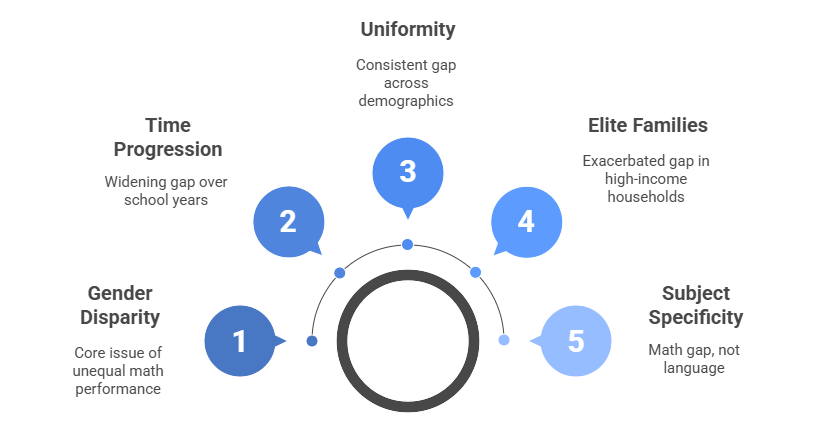
The study, conducted in France between 2018 and 2022, analyzed data from 2.65 million children aged 5 to 7 using a standardized testing platform called EvalAide. Key insights include:
- Identical starting point: At school entry (age 5), boys and girls displayed nearly identical math performance.
- Emergence of gap within four months: A small but significant gender gap favoring boys appeared just four months into formal schooling.
- Widening disparity over time: By second grade, boys outnumbered girls 2:1 among the top 5% math performers.
- Uniform pattern: The gender gap was consistent across all regions, public/private schools, and socioeconomic groups.
- Counterintuitive pattern in elite families: The gap was more pronounced in high-income households, particularly when both parents were from STEM backgrounds.
- No similar gap in language skills, suggesting subject-specific factors at play.
These findings force us to reconsider how social factors shape cognitive outcomes and reinforce gender inequalities early in life.
Sociological Analysis
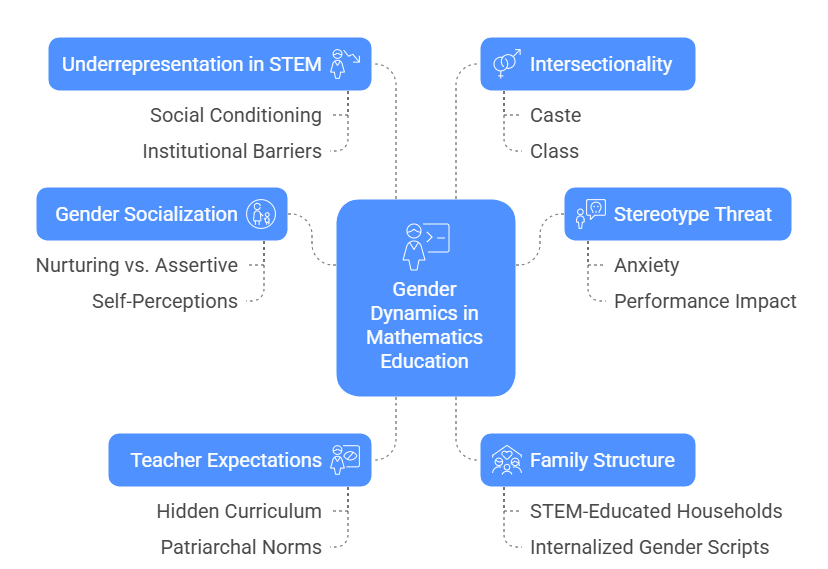
- Gender Socialization from Early Childhood:
Children are socialized into gender roles long before formal education begins. Girls are often encouraged to be nurturing and compliant, while boys are praised for being assertive and competitive. These early roles, as discussed by Ann Oakley, create differing self-perceptions that impact how boys and girls engage with subjects like mathematics.
- Stereotype Threat and Internalized Roles:
Claude Steele’s concept of stereotype threat explains how the fear of confirming negative stereotypes (g., “girls are bad at math”) can lower actual performance. Girls, even if equally capable, may underperform due to anxiety, especially in competitive settings, where such stereotypes get activated subconsciously.
- Teacher Expectations and Classroom Dynamics:
Teachers may unknowingly hold gendered expectations, leading them to call on boys more often or praise their problem-solving skills more readily. This hidden curriculum, as per Bowles and Gintis, subtly transmits societal biases, reinforcing patriarchal academic norms.
- Family Structure and Cultural Capital:
Pierre Bourdieu’s theory of cultural capital shows how family values and knowledge shape academic success. Ironically, even in STEM-educated, high-income households, girls may be steered away from math-intensive paths due to internalized gender scripts within the family.
- Underrepresentation in STEM Fields:
Early gender gaps in mathematics contribute to the broader gender divide in STEM careers. Globally and in India, women remain significantly underrepresented in science and technology, not because of a lack of ability, but due to persistent social conditioning and institutional barriers.
- Intersectionality in Education:
Kimberlé Crenshaw’s theory of intersectionality highlights how gender, caste, and class combine to disadvantage girls differently. For instance, a Dalit girl in a rural area faces more compounded barriers in math learning compared to a girl from an urban upper-caste background.
Policy Interventions & Sociological Solutions
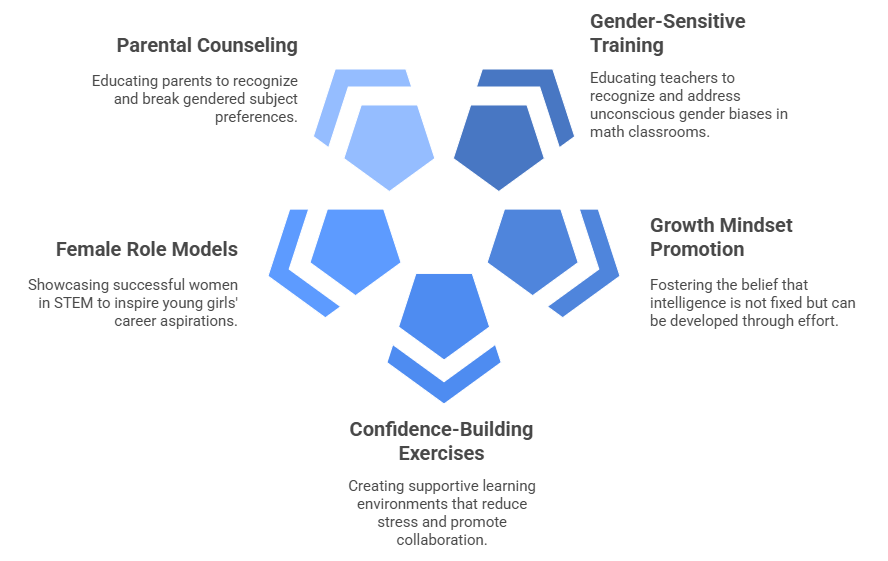
- Gender-Sensitive Training for Educators:
Teachers need to be sensitized about unconscious gender biases. Professional development programs should train them to provide equal opportunities and encouragement to both boys and girls in math classrooms.
- Promoting Growth Mindset:
Adopting Carol Dweck’s growth mindset approach, schools can help children believe that intelligence is not fixed but developed. Reinforcing that math ability grows through practice can reduce fear of failure among girls.
- Confidence-Building Exercises:
Schools can design learning environments that minimize stress and encourage collaboration. Introducing games, untimed assessments, and peer-based problem solving can reduce math anxiety, especially in girls.
- Highlighting Female Role Models:
Bringing in successful women in STEM as guest speakers, or integrating their stories in textbooks, can inspire young girls. Early exposure to such role models can reshape their self-image and career aspirations.
- Parental Counseling and Awareness:
Parents, even in well-educated households, may unknowingly reinforce gendered subject preferences. Awareness workshops can help families recognize and break such patterns, enabling girls to explore math without internal or external limitations.
Conclusion
The emergence of the gender gap in mathematics as early as four months into school is a wake-up call. It reminds us that social factors, not biology, are the primary drivers of academic inequality. From family expectations to classroom practices, children absorb gender cues that can boost or break their confidence. For India, where increasing women’s participation in STEM is vital for inclusive development, this insight demands urgent attention. Sociologists, educators, and policymakers must work together to deconstruct stereotypes, empower girls, and transform education into a truly egalitarian space. Because every child can excel in math—if society stops telling them they can’t.
Previous Year Questions
Paper 1:
- How do socialization processes influence gender roles in society? (2022)
- What is the hidden curriculum? Explain how it contributes to the reproduction of social inequality. (2020)
- Critically examine the relationship between cultural capital and educational attainment. (2019)
- How does intersectionality impact the lived experiences of individuals? Illustrate with examples. (2023)
- Discuss how structural functionalist and conflict perspectives explain the role of education in society. (2017)
- Explain the concept of stereotype threat. How does it affect academic achievement? (2016)
- How do inequalities based on gender and class affect educational opportunities? (2015)
- Discuss the role of school as a formal agency of social control. (2014)
Paper 2:
- Discuss the factors responsible for the underrepresentation of women in STEM fields in India. (2021)
- Explain how social background and cultural capital influence access to education in India. (2023)
- How do caste and gender intersect to shape educational inequality in India? (2022)
- Examine the role of family and school in reinforcing gender roles in Indian society. (2019)
- Critically analyze the impact of patriarchal values on women’s education in India. (2018)
- Discuss how educational institutions perpetuate gender stereotypes. (2017)
- Evaluate the effectiveness of government initiatives for promoting girls’ education in India. (2016)
- What are the socio-cultural factors hindering women’s participation in science and technology in India? (2015)
- How does the intersection of gender and class affect access to quality education in rural India? (2020)
- What role do women’s movements play in advocating for educational equity in India? (2014)
|



One comment