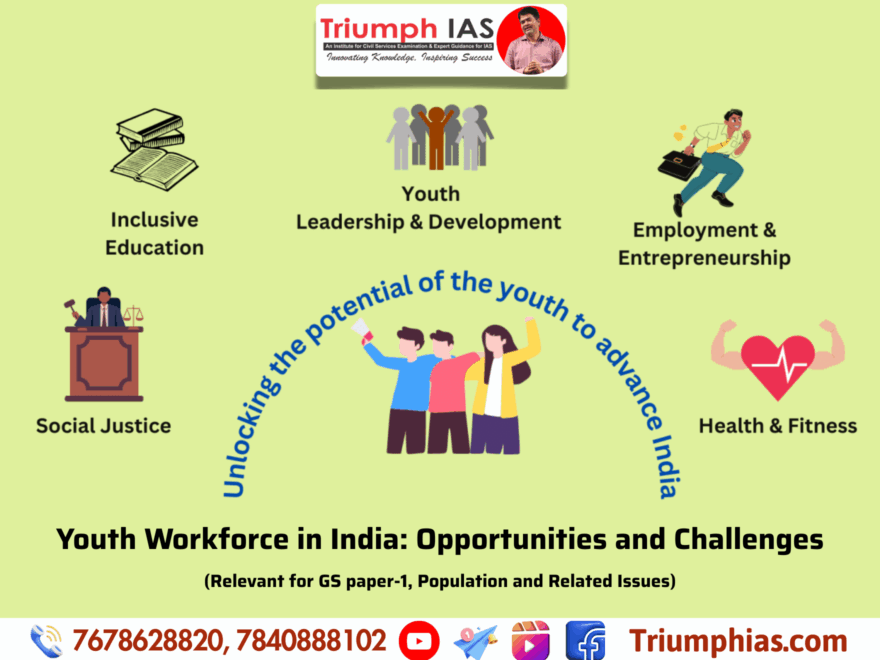
Youth Workforce in India: Opportunities and Challenges
India’s demographic structure is a defining global feature: over 50% of its population is under 25, and more than 65% below 35, making it home to roughly 371 million youths aged 15–29. This “demographic dividend” offers immense potential—if harnessed through adequate education, skills training, and inclusive policies. However, the rapidly expanding young workforce also faces significant hurdles. This blog examines both the opportunities and challenges—rooted in current facts and figures—to provide a nuanced understanding.
-
Demographic Potential and Rising Aspirations
India’s youthful profile could fuel sustained economic growth:
- Massive youth base: With over 371 million individuals aged 15–29 and a median age of just 29 years, India’s workforce is young and energetic.
- Digital & entrepreneurial promise: Over 70,000 startups are operational, many led by the young. Initiatives like Startup India have seeded 80,000+ startups since 2016.
- Digital economy: The IT and digital services sector contributes ~8% of GDP and employs over 4.5 million young professionals.
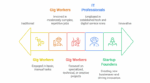
- Gig revolution: The gig economy comprises ~7.7 million workers (2020–21), projected to hit ~23.5 million by 2030. Nearly 47% engage in medium-skilled, 22% in high-skilled, and 31% in low-skilled gigs.
-
Employment Landscape: Mixed Progress
a) Formal Jobs & EPFO Insights
- In April 2025, the EPFO reported 1.914 million net membership additions—up 31.3% from March and 1.17% from the previous year—indicating stronger formal employment, especially among youth and women
b) Graduate & Youth Unemployment
- The World Bank (2022) highlighted a youth unemployment rate of 23.2%, compared to ~7% overall.
- The ILO/India Employment Report states that youth constitute around 83% of India’s unemployed workforce.
- Graduate unemployment is high: 42.3% of Indian graduates were unemployed in 2023.
- Urban youth unemployment rates: 17.2% (ages 15–29), versus 10.6% in rural areas. Among young women: 21.6%, compared to 15.8% for men.
c) Informal Employment & Wage Stagnation
- Around 90–93% of India’s workforce operates informally .
- Despite economic growth, most jobs are low-paying: ~80% of jobs offer ₹20,000/month or less
- Educational attainment does not ensure job security: underemployment among graduates and postgraduates stands at 50% and 44% respectively
-
Key Challenges
a) Skill Mismatch
- The Graduate Skill Index 2024 pegs employability at just 42.6%.
- Only 4.4% of India’s youth workforce is formally trained; 16.6% have informal training.
- Over 65% of companies report skill gaps hindering scale-up.
- Widespread digital illiteracy: ~75% unable to send emails, ~90% lack spreadsheet skills.
b) Gender Disparity
- Female workforce participation sits at just 37–38%
- NEET: nearly 48.4% of young women are not employed, in education, or training—versus 9.8% for young men.
- Graduate-level female unemployment (2022) stood at 34.5%, compared to 26.4% for male graduates
- Only 43% of STEM graduates are women, but only 14% secure STEM jobs.
c) Quality of Training
- Only 18% of those trained under PMKVY find jobs.
- Apprenticeship uptake is low: ~277,000 apprentices in FY 2024–25.
- Many institutions lack industry linkages, modern infrastructure, and trainers.
d) Informal & Gig Sector Vulnerabilities
- Informal workers lack job security, social safety nets, and are prone to exploitation
- Gig workers—especially migrants—often face unstable incomes and have limited labor protections .
4. Emerging Opportunities & Initiatives
a) Government Skill Programs
- Launch of Skill India Mission (2015) aims to train ~30–40 crore by 2022 via agencies including PMKVY, NAPS, SANKALP, and STRIVE
- New NSTIs being set up in five cities, including Bhubaneswar, with ₹60,000 crore budget to train 2 million plus youth
b) Apprenticeship and Internship Push
- Targeting 10 million internships over five years; ~277,000 apprentices engaged in FY 2024–25
- UNICEF-backed YuWaah initiative’s “Bano Job Ready” program has connected 1 million youths with employment resources
- YouthHub platform aggregates jobs, digital courses, and volunteering opportunities across nine languages.
c) Boost via Industry and Private Sector
- Rise of digital and start-up ecosystems provides alternative employment and entrepreneurial routes
- Ankler economic drivers include IT outsourcing (55% global share) and “Make in India” manufacturing push
d) Formal Employment Growth
- EPFO data shows strong net formal job creation, especially for youth and women
- Gen Z workforce mobility rising: 70% willing to change jobs for better pay.
- Haryana launching skill colleges and Model ITIs aligned with NEP and industry collaboration
-
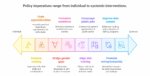
Policy Imperatives
To translate the demographic dividend into real gains, India must:
- Enhance quality of vocational training
- Standardize ITIs, invest in trainers, modernize infrastructure, and integrate digital skills.
- Scale apprenticeships and internships
- Provide incentives for enterprises to train, and embed apprenticeships into academic curricula.
- Bridge gender gaps
- Expand women-focused skill programs, childcare support, and industry ties in STEM fields.
- Formalize informal workforce
- Extend labor protections, access to social security, and accreditation to gig workers via schemes like RPL.
- Align skill training with evolving sectors
- Update curricula to include AI, renewable energy, healthcare, advanced manufacturing.
- Encourage public-sector jobs
- Develop urban employment schemes mirroring MGNREGS and create quality public service opportunities.
- Promote entrepreneurship
- Strengthen MSME support, credit access, mentorship, and startup ecosystems, particularly in Tier‑2/3 cities.
- Improve data and monitoring system
- Implement unified skilling databases, use technology for tracking performance and impact.
Conclusion
India’s youth workforce embodies both promise and paradox. While the vast young population and emergent digital economy offer pathways to growth, persistent skill gaps, informal employment traps, and stark gender disparities threaten to stymie progress. Government initiatives—from Skill India to internship missions, the NSTI scheme, and industry partnerships—are steps in the right direction. But upscaling these efforts with quality, equity, and agility is critical. |

Blog Comment Creation ProcessThis post rightly highlights the paradox of India’s youth bulge—while the demographic dividend is a huge opportunity, it’s clear that without matching investment in education and skill development, it could become a missed chance. It would be interesting to explore how regional disparities and urban-rural divides further complicate this dynamic.