Introduction
In recent years, same-sex parenting has emerged as a crucial subject in the discourse on gender rights, family diversity, and LGBTQ+ inclusion. With the decriminalization of homosexuality in India (Section 377 judgment, 2018) and increasing global acceptance, same-sex couples have begun asserting their rights to form families and raise children. This evolving dynamic challenges heteronormative notions of parenting and brings fresh perspectives to the sociological understanding of family, kinship, and parenthood.
What is Same-Sex Parenting?
Same-sex parenting refers to parenting by couples of the same gender identity—gay, lesbian, transgender, or queer. This parenting model can involve:
- Biological children from previous heterosexual relationships
- Adoption
- Surrogacy
- In-vitro fertilization (IVF)
Sociologically, it questions traditional binaries of “mother-father” and introduces inclusive family models centered on emotional bonding, shared responsibilities, and social parenting.
Sociological Theories
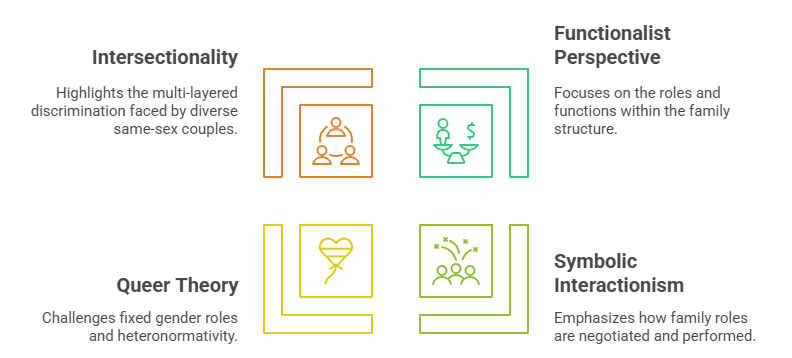
- Functionalist Perspective: Talcott Parsons argued that the nuclear family is structured around instrumental (male) and expressive (female) Same-sex parenting challenges this by showing functional equivalence in caregiving regardless of gender. Studies demonstrate that same-sex couples can equally fulfill nurturing, socializing, and economic roles.
- Symbolic Interactionism: This micro-sociological approach focuses on how family roles are negotiated and performed. Same-sex parents often redefine parental roles, creating inclusive rituals and symbols (like dual “mom” or “dad” households) which redefine kinship beyond biology.
- Queer Theory: Queer theory by Judith Butler, Michel Foucault destabilizes fixed gender roles and heteronormativity. It emphasizes that family and parenthood are social constructs, not biologically bound institutions. Same-sex parenting exposes how power, discourse, and state laws shape who is seen as a “legitimate parent.”
- Intersectionality: Same-sex couples from lower socio-economic backgrounds, religious minorities, or non-urban spaces face multi-layered discrimination, illustrating Kimberlé Crenshaw’s idea of intersecting identities and marginalization.
Legal Framework in India:
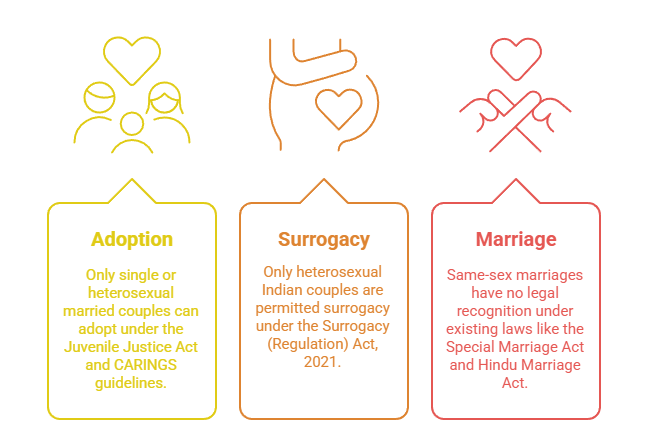
Despite progress in LGBTQ+ rights, same-sex couples in India still cannot legally adopt or marry, which directly affects parenting rights.
Key Legal Hurdles:
- Adoption: Under the Juvenile Justice Act and CARINGS (Central Adoption Resource Authority) guidelines, only single or heterosexual married couples can adopt.
- Surrogacy: The Surrogacy (Regulation) Act, 2021 permits only heterosexual Indian couples.
- Marriage: No legal recognition of same-sex marriages under existing laws (Special Marriage Act, Hindu Marriage Act, etc.).
Without legal marriage, same-sex partners face issues in naming rights, guardianship, inheritance, and school documentation of children.
Global Trends
- The American Psychological Association (APA) confirms that children of same-sex parents show no difference in emotional, cognitive, or social development compared to children of heterosexual couples.
- Countries like Canada, Netherlands, South Africa, and Australia legally recognize same-sex parenting, including adoption and surrogacy.
India’s Emerging Reality:
- Though legally barred, many urban LGBTQ+ couples raise children through informal adoption, co-parenting with friends, or surrogacy abroad.
- Social media visibility and support networks are normalizing same-sex family structures in metros like Mumbai, Delhi, and Bengaluru.
Barriers in Indian Society:
- Patriarchal norms: Stronghold of the traditional nuclear family ideal.
- Religious conservatism: Many belief systems see homosexuality and non-traditional parenting as
- Institutional discrimination: Schools, hospitals, and legal systems often refuse to recognize non-biological same-sex parents.
Policy Recommendations and Way Forward
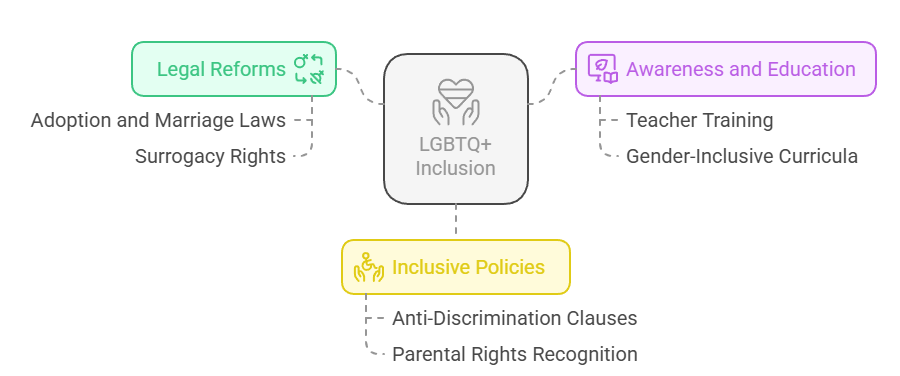
Legal Reforms:
- Amend adoption and marriage laws to include LGBTQ+ couples.
- Extend surrogacy rights to all consenting adults, regardless of sexual orientation.
Awareness and Education:
- Train teachers, social workers, and legal professionals on diverse family structures.
- Encourage gender-inclusive textbooks and curricula.
Inclusive Policies:
- Mandate anti-discrimination clauses in public services (healthcare, education).
- Recognize parental rights in government forms beyond “mother/father”
Case Studies
- Sushma and Sneha (2021): A lesbian couple from Bengaluru who openly discussed raising a child via sperm donation abroad, highlighting the emotional strength and legal vulnerabilities of queer parents.
- Supreme Court Petition (2022): A PIL sought marriage equality under Special Marriage Act to provide legal status for same-sex parents. Though dismissed in 2023, it opened public debate on queer parenting rights.
Conclusion
Same-sex parenting in India is not just a legal or moral question, but a sociological shift in how we understand family, love, and responsibility. As society evolves, so must our institutions, laws, and perceptions to reflect the diversity of human relationships. The recognition of same-sex parenting is not a threat to Indian values—but a testament to their resilience, adaptability, and inclusiveness.
PYQs
Paper 1 –
- How has the feminist perspective broadened our understanding of family?(2013)
- What are the implications of the shift from joint to nuclear family systems in India(2015)
- Discuss the changing forms of family in contemporary society.(2016)
- Discuss how social changes have influenced the role of marriage and family.(2017)
- Critically evaluate the functionalist perspective on the family in the context of changing gender roles.(2018)
- Examine the functional and dysfunctional aspects of the nuclear family.(2020)
Paper 2 –
- Critically examine the impact of new reproductive technologies (IVF, surrogacy) on the family system in India.(2015)
- Explain the implications of social legislation on the status of women in India.(2017)
- How is the institution of family changing in response to legal, economic, and technological changes in India?(2018)
- Evaluate the role of media and civil society in shaping gender discourse in India(2019)
- What are the emerging challenges to the institution of marriage in India?(2020)
- Discuss the role of judiciary in social transformation with reference to gender justice in India.(2022)
|