Robust Critical Mineral Ecosystem
In the rapidly evolving global landscape, critical minerals have emerged as the cornerstone of modern technologies, clean energy transitions, and national security. For India, ensuring a resilient and diversified supply chain for these minerals is not just an economic necessity but a strategic imperative.
Understanding Critical Minerals and Their Significance
Critical minerals are essential raw materials used in the manufacturing of advanced technologies, including electric vehicles (EVs), renewable energy systems, semiconductors, and defense equipment. Key minerals such as lithium, cobalt, nickel, rare earth elements (REEs), and graphite are indispensable for India’s ambitions in clean energy and digital transformation.
India’s dependency on imports for several of these minerals poses significant risks. For instance, the country is entirely reliant on imports for lithium, cobalt, and nickel, making it vulnerable to global supply disruptions and price volatility
Current Challenges in India’s Critical Mineral Supply Chain
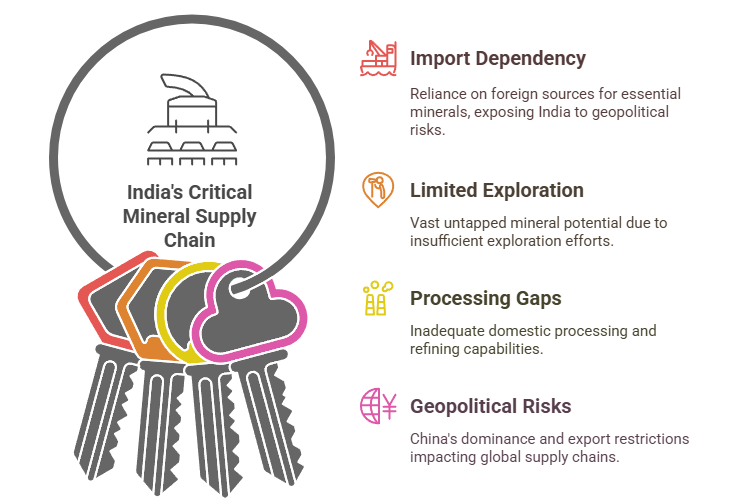
- Import Dependency: India lacks sufficient domestic reserves of several critical minerals, leading to a heavy reliance on imports. This dependency exposes the country to geopolitical risks and supply chain disruptions.
- Limited Exploration: Only about 20% of India’s geological potential has been explored, leaving vast areas untapped for potential mineral resources.
- Processing and Refining Gaps: The country has limited capabilities in processing and refining critical minerals, further exacerbating its reliance on foreign entities.
- Geopolitical Risks: China’s dominance in the critical minerals market, especially in processing and refining, poses a strategic challenge. Recent export restrictions by China on rare earth elements have highlighted the vulnerabilities in global supply chains.
Strategic Initiatives Undertaken by India
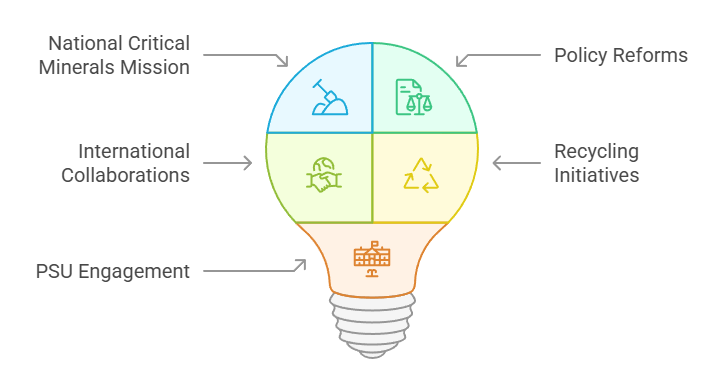
To address these challenges, India has embarked on several strategic initiatives:
- National Critical Minerals Mission (NCMM): Launched in 2025, the NCMM aims to establish a robust framework for self-reliance in the critical mineral sector. The mission encompasses exploration, mining, processing, and recycling of critical minerals. The Geological Survey of India (GSI) has been tasked with conducting 1,200 exploration projects by 2031.
- Policy Reforms: The Mines and Minerals (Development and Regulation) Amendment Bill, 2023, removed certain minerals like lithium and titanium from the list of atomic minerals, opening them up for commercial mining. Additionally, 100% foreign direct investment (FDI) under the automatic route has been permitted for mining and exploration activities.
- International Collaborations: India has signed Memoranda of Understanding (MoUs) with countries like Australia, Argentina, and the Democratic Republic of Congo to secure access to critical mineral resources. These collaborations focus on joint exploration, technology transfer, and investment in mining projects.
- Recycling Initiatives: Recognizing the importance of a circular economy, India plans to launch incentives for the recycling of 24 critical minerals, including lithium and cobalt. This move aims to reduce dependency on imports and promote sustainable practices.
- Public Sector Undertakings (PSUs) Engagement: Entities like IREL (India) Limited and Khanij Bidesh India Limited (KABIL) are actively involved in the exploration and acquisition of critical mineral assets both domestically and internationally.
The Global Context and India’s Position
The global race for securing critical minerals has intensified, with countries seeking to diversify their supply chains. China’s near-monopoly on certain critical minerals and its recent export restrictions have underscored the urgency for alternative sources.
India’s proactive measures, including policy reforms and international collaborations, position it as a potential alternative hub for critical minerals. By leveraging its strategic partnerships and focusing on domestic capacity building, India can play a pivotal role in the global critical minerals landscape.
Recommendations for Strengthening India’s Critical Mineral Supply Chain
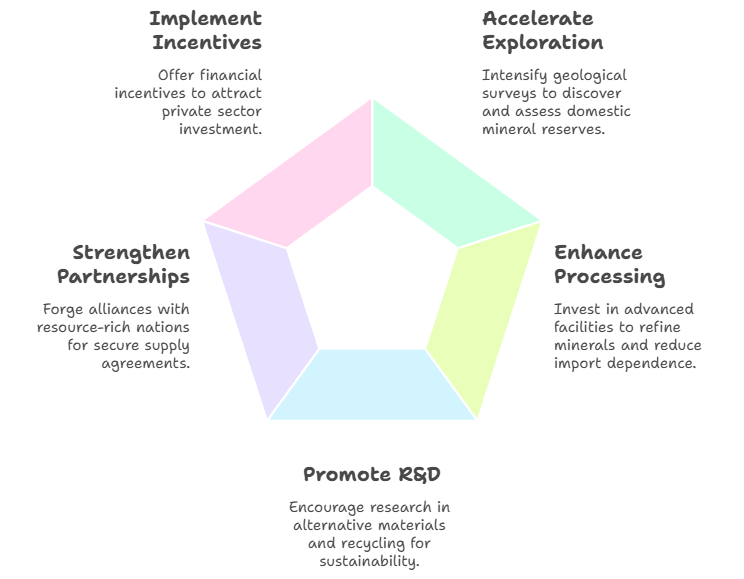
- Accelerate Exploration: Intensify geological surveys and exploration activities to identify and assess domestic critical mineral reserves.
- Enhance Processing Capabilities: Invest in developing state-of-the-art processing and refining facilities to reduce reliance on imports.
- Promote Research and Development: Encourage R&D in alternative materials and recycling technologies to ensure sustainability and efficiency.
- Strengthen International Partnerships: Continue to forge strategic alliances with resource-rich countries to secure long-term supply agreements.
- Implement Financial Incentives: Provide subsidies and incentives to attract private sector investment in the critical minerals sector.
Conclusion
Securing a stable and diversified supply of critical minerals is essential for India’s economic growth, energy security, and technological advancement. By addressing existing challenges and leveraging strategic initiatives, India can build a resilient critical mineral supply chain, positioning itself as a global leader in the clean energy transition.
|



One comment