Introduction
Identity politics in India refers to political activities and mobilizations that are based on specific social identities—primarily caste, religion, ethnicity, region, gender, and language. While identity assertion has empowered many marginalized communities, it has also led to vote bank politics, sectarianism, and polarization. Understanding identity politics is crucial for analyzing the intersection of society and state, and how collective identities shape democratic processes in India.
Sociological Analysis
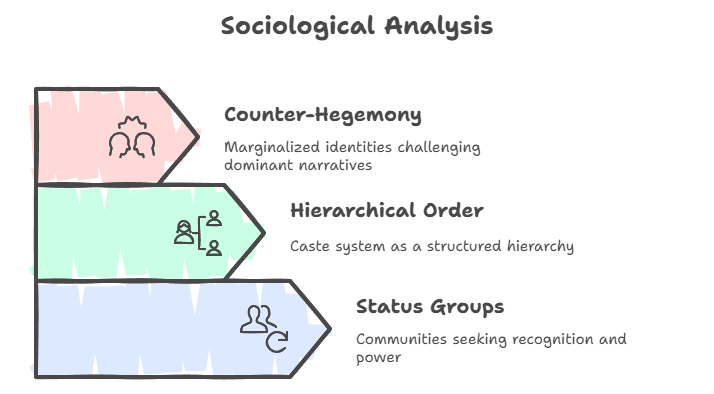
- Max Weber’s Concept of Status Groups: Weber explains how status-based communities (like caste or religion) strive for recognition and power, shaping political behavior in stratified societies like India.
- Louis Dumont’s Homo Hierarchicus: Dumont’s interpretation of the caste system as a hierarchical order helps explain why caste identities remain politically potent, especially in electoral politics.
- Antonio Gramsci’s Hegemony and Subaltern Consciousness: Gramsci’s ideas illuminate how marginalized identities create counter-hegemonic narratives through movements like Dalit assertion and ethnic regionalism.
Identity Politics in Practice
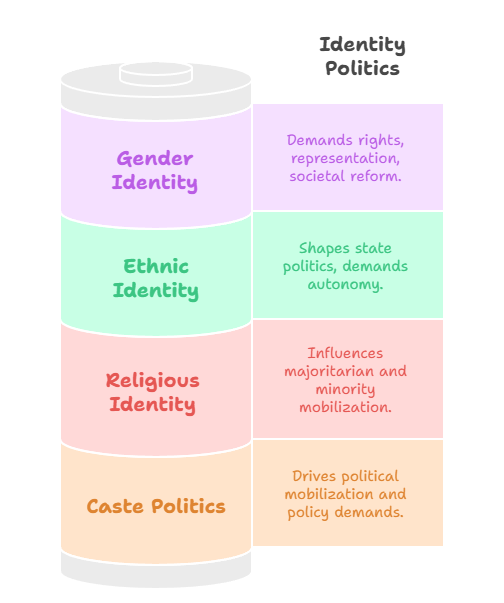
- Caste-Based Politics: Caste remains central to Indian politics, seen in the rise of the BSP and the impact of the Mandal Commission in 1990. The ongoing debate over OBC reservations and the demand for a caste census show how caste identities continue to drive political mobilization and policy demands.
- Religious Identity and Polarization: Religious identity plays a powerful role in shaping political narratives. Issues like Ram Janmabhoomi, UCC, Triple Talaq, and the Hijab ban reflect growing polarization. The rise of Hindutva politics and minority consolidation among Muslims and Christians reveal how religion influences both majoritarian and minority mobilization.
- Ethnic and Regional Identity: Ethnic and regional politics thrive in India’s diverse landscape. Movements in the Northeast, the Dravidian identity in Tamil Nadu, and Gorkhaland demands highlight how linguistic, ethnic, and regional assertions shape state politics and demand greater autonomy and recognition.
- Gender and Sexual Identity: Gender and sexual identity are gaining visibility in political discourse. Women’s reservation in local governance, the Transgender Rights Bill, and movements like Pinjra Tod and MeToo India reflect how gender-based identities are being politicized to demand rights, representation, and societal reform.
Critical Perspectives
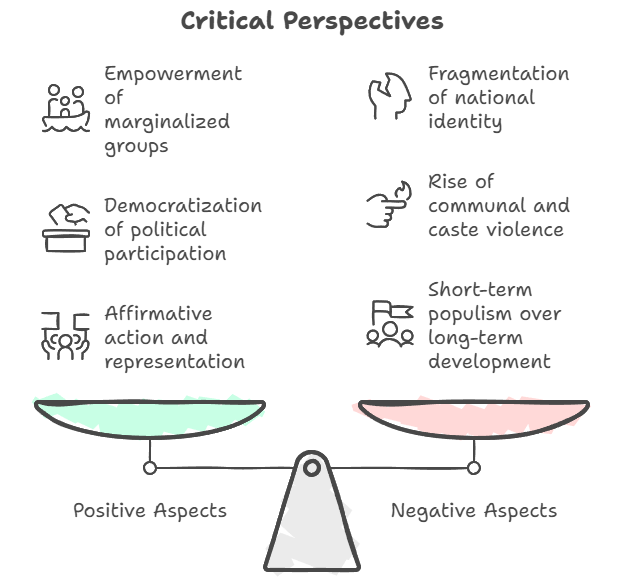
Positive Aspects
- Empowerment of marginalized groups
- Democratization of political participation
- Affirmative action and representation
Negative Aspects
- Fragmentation of national identity
- Rise of communal and caste violence
- Short-term populism over long-term development
Conclusion
Identity politics in India is a reflection of its rich social diversity and historical inequalities. While it has empowered marginalized communities and brought issues of representation to the forefront, it also carries the risk of deepening divisions when driven by exclusionary or populist agendas. A balanced democratic framework must ensure that identity-based assertions lead to inclusive development, social justice, and national unity—not fragmentation. For UPSC aspirants, understanding the nuanced role of identity politics is essential to grasp the evolving dynamics of Indian democracy and society.
PYQs
Paper 1
- Explain how the concept of ‘status group’ by Max Weber helps us understand identity politics. (2022)
- How does social stratification contribute to the perpetuation of identity politics? (2020)
- Explain how intersectionality influences identity formation in a stratified society. (2019)
- Examine the role of caste in contemporary political mobilization. (2017)
- Discuss the concept of ethnicity and its significance in plural societies. (2016)
- How do subordinate classes use identity-based movements for empowerment? (2015)
- What is the impact of regionalism on national integration in multi-ethnic societies? (2014)
Paper 2
- Discuss the implications of minority identity assertions on secularism in India. (2022)
- Discuss the relationship between caste and politics in India. (2021)
- How does gender identity impact political participation in India? (2020)
- How do religious identities influence political behavior in India? (2019)
- Discuss the emergence of regional identities and their impact on Indian federalism. (2018)
- Examine the role of tribal identity and politics in the context of displacement and development. (2018)
- Evaluate the role of identity-based movements in promoting social justice in India. (2017)
- Explain the role of caste-based movements in the democratization of Indian society. (2016)
- Analyze the challenges posed by identity-based mobilization to national integration. (2015)
- How do regional movements reflect the assertion of linguistic and cultural identities in India? (2014)
|



One comment