

Northeast India: Rising from the Periphery to National Priority
(Relevant for GS paper-3, Internal security)
Northeast IndiaOnce perceived as a remote and underdeveloped region, Northeast India is now emerging as a strategic and economic hub. Comprising eight states—Arunachal Pradesh, Assam, Manipur, Meghalaya, Mizoram, Nagaland, Tripura, and Sikkim—the region is witnessing transformative changes across infrastructure, economy, digital connectivity, and cultural preservation. This evolution aligns with India’s broader vision of inclusive growth and regional integration. Infrastructure: Building the Backbone
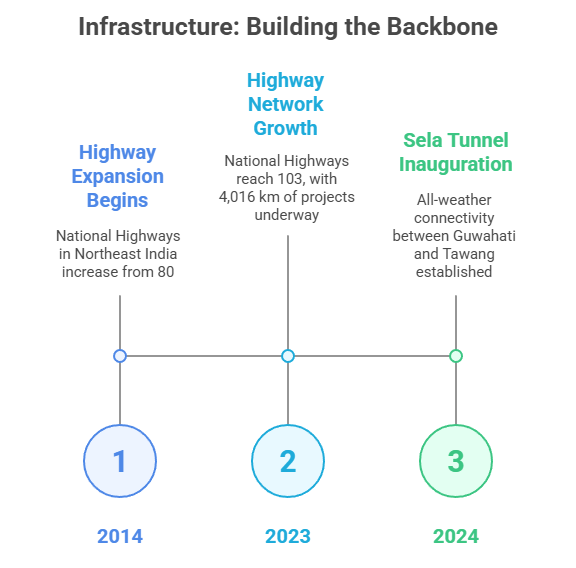
Infrastructure development has been pivotal in integrating the Northeast with the rest of India. The number of National Highways in the region increased from 80 in 2014 to 103 in 2023, with over 4,016 km of road projects underway. Rail connectivity has also improved, with 100% electrification of broad-gauge lines and the commissioning of over 193 km of rail lines annually. A landmark project, the Sela Tunnel in Arunachal Pradesh, inaugurated in March 2024, ensures all-weather connectivity between Guwahati and Tawang, enhancing both civilian and military logistics. Economic Growth: Unlocking Potential
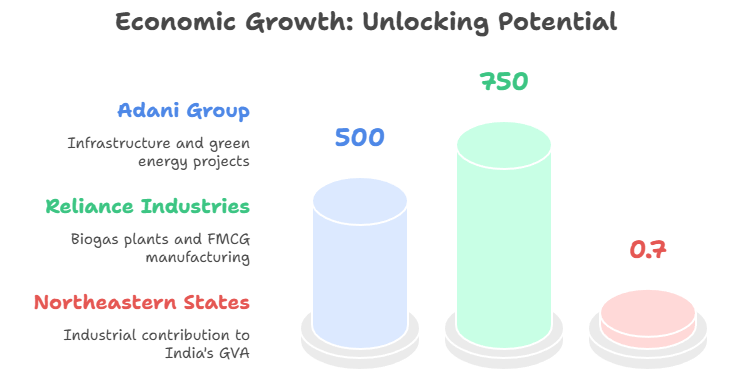
The region’s economic landscape is evolving, with significant investments from both public and private sectors. The Adani Group announced a ₹500 billion investment over the next decade for infrastructure and green energy projects. Similarly, Reliance Industries plans to boost its investment from ₹300 billion to ₹750 billion within five years, focusing on biogas plants and FMCG manufacturing. However, challenges persist. The Economic Survey 2024-25 highlights that six Northeastern states, excluding Sikkim and Assam, contribute only 0.7% to India’s industrial Gross Value Added, indicating the need for tailored industrial strategies. Digital Connectivity: Bridging the Divide
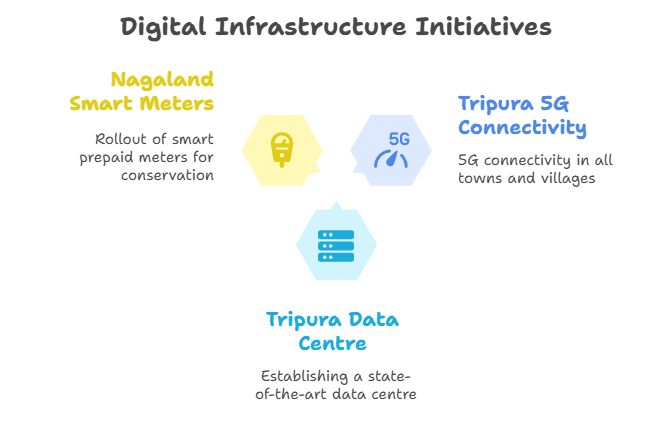
Digital infrastructure is expanding rapidly. Tripura, for instance, has achieved 5G connectivity in all towns and 583 villages, positioning itself as a digital hub for the Northeast. The state is also set to establish a state-of-the-art data centre in Agartala to serve eastern and northeastern India. Additionally, initiatives like the rollout of smart prepaid meters in Nagaland aim to reduce technical and commercial losses and promote energy conservation. Skill Development and Employment: Empowering YouthTo harness the region’s demographic dividend, the Union Ministry of Skill Development and Entrepreneurship launched a pilot apprenticeship training scheme in Aizawl, Mizoram, targeting over 26,000 youth. The program offers structured, paid apprenticeships with an additional stipend, aiming to bridge the industry-education gap and promote gender inclusion. Cultural Preservation: Honoring HeritageRecognizing the rich cultural tapestry of the Northeast, efforts are underway to preserve local history and tribal cultures. In Arunachal Pradesh, initiatives include enhancing district museums and constructing community convention centres to serve as multifunctional spaces for cultural, social, and official gatherings. ConclusionThe transformation of Northeast India from a peripheral region to a pivotal one is a testament to concerted efforts in infrastructure development, economic investment, digital connectivity, skill enhancement, and cultural preservation. While challenges remain, the region’s trajectory points towards a future where it plays a central role in India’s growth story. |


To Read more topics, visit: www.triumphias.com/blogs
One comment