Introduction:
In classical sociology, Georg Simmel introduced the term ‘Sociation’ to emphasize the dynamic process of interaction that forms the basis of society. Unlike traditional definitions of society as a fixed structure or institution, Simmel conceptualized society as a web of interactions—a continuous flow of forms of association among individuals. In the digital, urbanized, and highly networked world of the 21st century, the concept of sociation helps us understand the evolving nature of relationships, group formations, and individual identities. This is especially relevant for UPSC aspirants studying Sociological Thinkers (Paper 1) and applying those insights to contemporary Indian society (Paper 2).
What is ‘Sociation’?
Georg Simmel defined sociation as the dynamic process through which individuals engage in interaction, resulting in the formation of temporary or permanent groups and relationships. Unlike traditional thinkers who saw society as a fixed entity, Simmel viewed it as a fluid process formed and reformed through recurring patterns of interaction. He emphasized the form of interaction—such as cooperation, conflict, or exchange—over the motive behind it. As he famously said, “Society exists where several individuals enter into interaction.”
Modern Life and New Forms of Sociation

- Urbanization and Anonymity: In urban environments, individuals often engage in brief but functional interactions—such as in service sectors or public transport—which lack emotional depth. Georg Simmel explained this as the development of a blasé attitude, where people grow indifferent due to the constant sensory stimulation and social complexity of city life.
- Digital Sociation: Digital sociation has become a defining feature of modern interaction, taking place on social media platforms, virtual communities, and messaging apps like Telegram or Reddit. These digital spaces enable networked individualism, where people express multiple identities across platforms—a phenomenon highlighted by Manuel Castells.
- Workplace and Professional Networks: In the workplace and professional domain, startups, corporations, and gig platforms like Swiggy and Uber foster goal-oriented sociation. These interactions are typically impersonal, task-specific, and fluid, replacing traditional, stable group ties—exactly the kind of modern sociation that Simmel theorized in his analysis of modern society.
Sociological Analysis
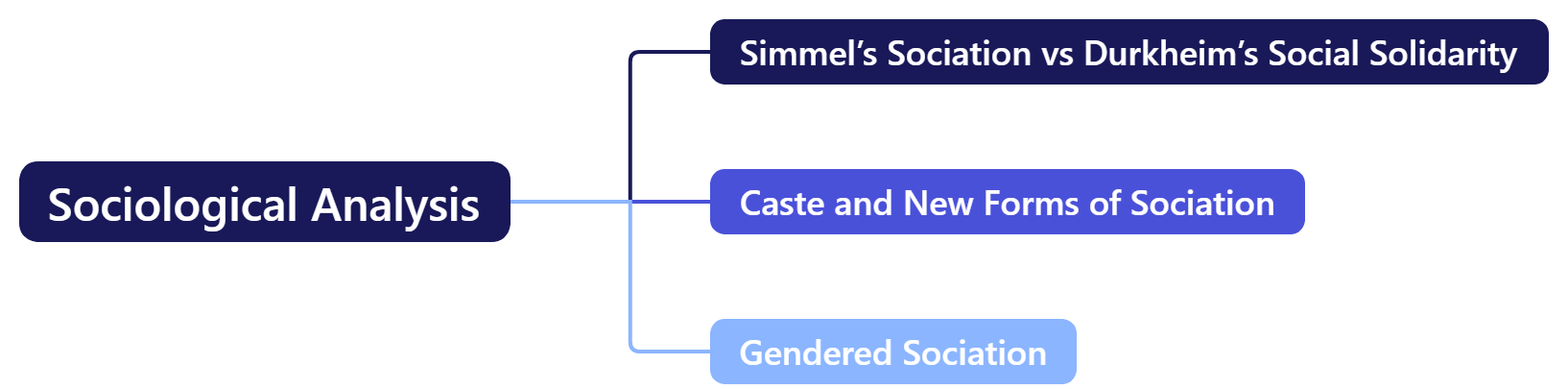
- Simmel’s Sociation vs Durkheim’s Social Solidarity: In the Indian context, both Simmel’s concept of sociation and Durkheim’s idea of social solidarity coexist. While Durkheim emphasized collective norms and values in maintaining social order—seen in structured environments like corporations—Simmel focused on micro-interactions and relational forms. His idea of sociation is reflected in informal, fleeting interactions, particularly within digital networks and urban life.
- Caste and New Forms of Sociation: Urbanization and technology are reshaping caste-based interactions in India. While caste remains a strong identity marker, boundaries are increasingly renegotiated in urban slums, tech hubs, dating apps, coworking spaces, and student movements. These new sites of interaction facilitate inter-caste sociation, although tensions and social resistance persist, revealing the coexistence of tradition and modernity.
- Gendered Sociation: Women’s groups such as Self-Help Groups (SHGs) and Mahila Mandals represent solidarity-based sociation that empowers women and challenges patriarchal norms. Simultaneously, movements like #MeTooIndia embody issue-based sociation—temporary but powerful associations that emerge in response to injustice. These align with Simmel’s notion of flexible, interest-based interaction in modern life.
Sociation and the Crisis of Modern Individuality
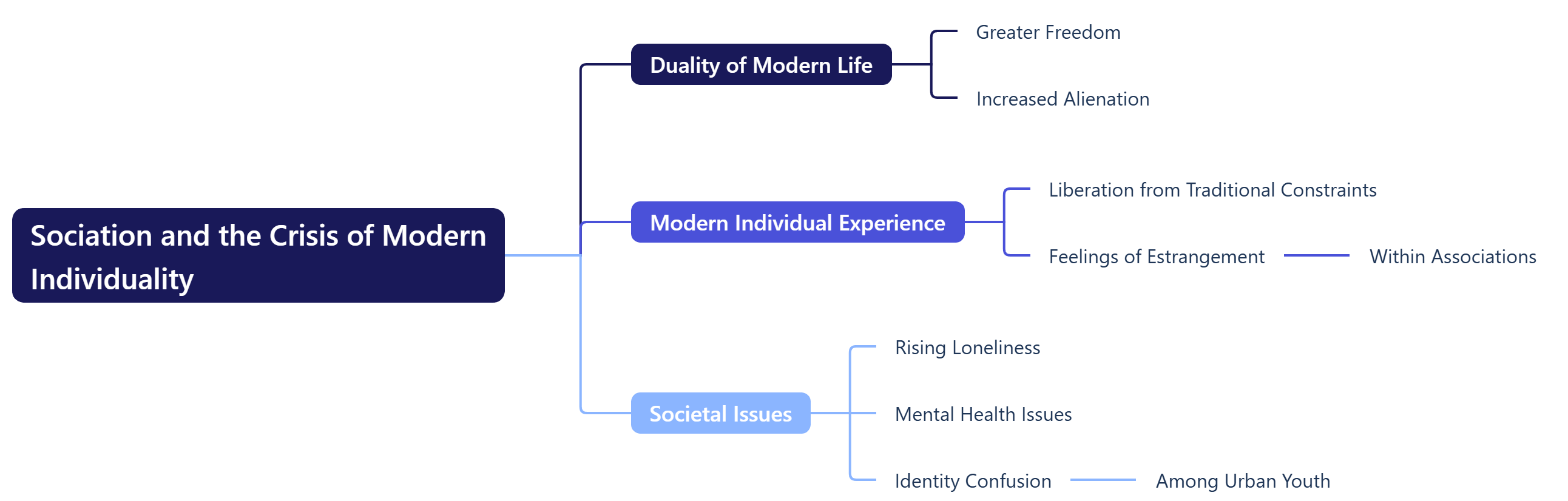
- Simmel warned of the duality of modern life—greater freedom, but also alienation.
- The modern individual, while liberated from traditional constraints, often feels like a stranger even within associations.This is evident in rising loneliness, mental health issues, and identity confusion among urban youth.
Conclusion:
Simmel’s concept of sociation offers a powerful tool to analyze how modern individuals form, dissolve, and re-form interactions in a rapidly transforming society. In a time of urban alienation, digital intimacy, and networked communities, sociation explains why society remains vibrant despite fragmentation.
PYQs
Paper 1
- Discuss the impact of digital communication on the nature of social interaction in modern society. (2024)
- What is the significance of social interaction in the formation of social groups? Illustrate with examples. (2023)
- Distinguish between society and sociation as understood by Georg Simmel. (2022)
- Discuss the significance of micro-sociology in understanding social reality with reference to Georg Simmel and Erving Goffman. (2021)
- Urbanism as a way of life leads to impersonality and detachment. Substantiate with sociological perspectives. (2020)
- How do formal and informal structures of organization influence individual behavior? Use sociological theories to explain. (2019)
- Explain Georg Simmel’s approach to the study of forms of interaction. How does it differ from other classical sociologists? (2018)
- How is the individual conceptualized in the theories of Durkheim, Weber, and Simmel? (2017)
- Differentiate between mechanical and organic solidarity. Explain their relevance in the context of contemporary Indian society. (2016)
- Examine the role of symbolic interactionism in the study of society. (2015)
Paper 2
- How do changes in work culture (gig economy, remote work) affect social integration and group identity in India? (2023)
- Do digital platforms enable new forms of social solidarity or do they reinforce social fragmentation in India? Explain with examples. (2023)
- Examine the impact of digital technology on social relationships and networks in contemporary India. (2022)
- Discuss how urban anonymity and changing lifestyles have redefined traditional social bonds in Indian cities. (2021)
- How has the nature of caste-based interaction changed in urban India? Comment with sociological insights. (2020)
- Analyze the impact of social media activism (e.g., #MeToo) in reshaping gender relations and collective consciousness in India. (2019)
- Explain the emergence of new youth subcultures in India with reference to digital spaces and virtual communities. (2018)
- How do urban spaces influence the pattern of interaction among different social groups in India? (2017)
- Discuss the relevance of traditional institutions like caste and kinship in forming new urban and digital associations in India. (2016)
|