Introduction
Despite the image of India as a land of farmers, recent decades have witnessed major occupational shifts in rural India. The question “Is rural India still agrarian?” becomes critical, not just for policymaking but also for sociological inquiry.
The decline in dependence on agriculture, growth of the rural non-farm sector, migration to urban spaces, and emergence of hybrid identities are reshaping the socio-economic and cultural fabric of the Indian countryside.
Current Trends: Occupational Diversification in Rural India
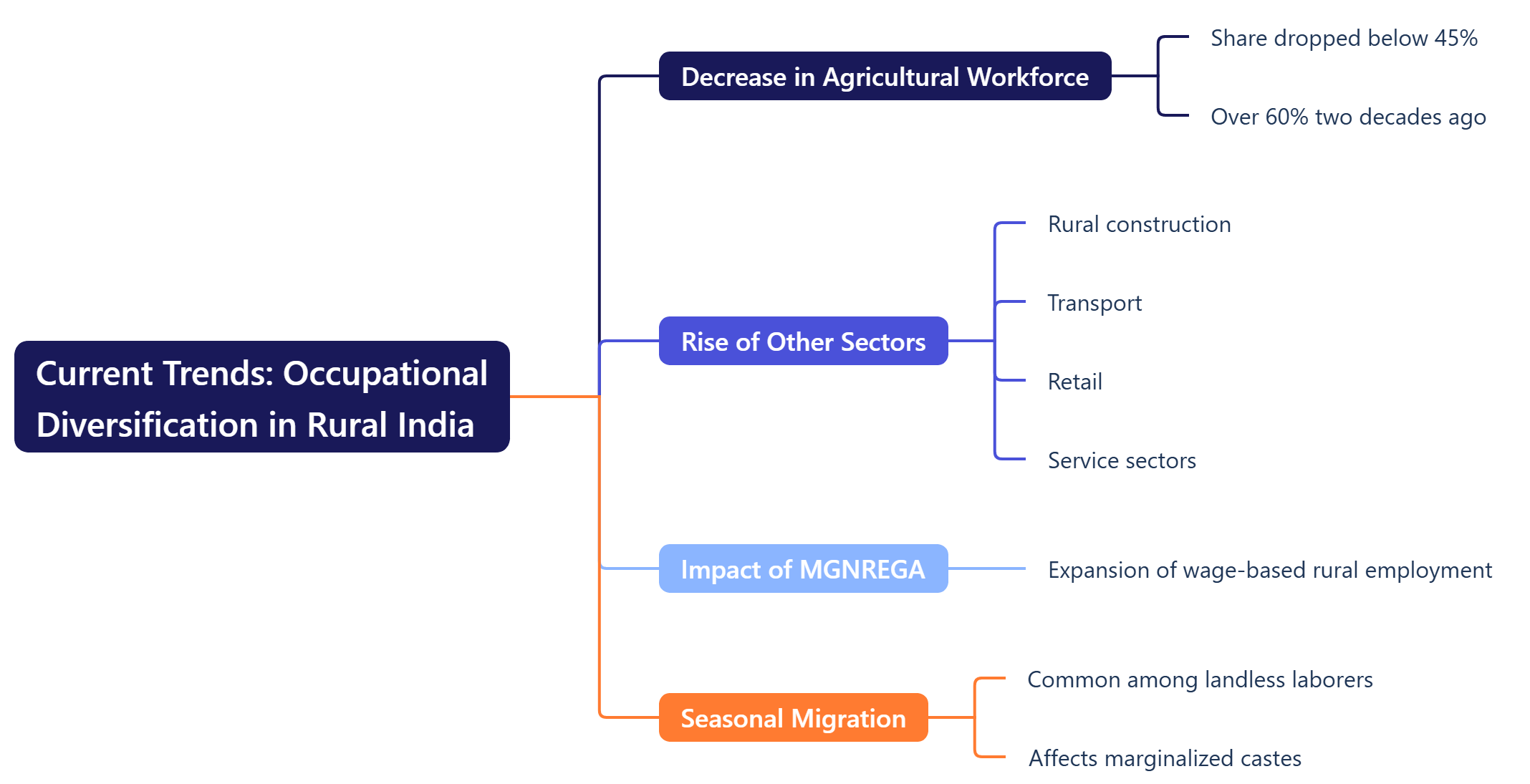
- According to the Periodic Labour Force Survey (PLFS) 2022-23, the share of agricultural workers in the rural workforce has dropped to below 45%, compared to over 60% two decades ago.
- There is a rise in rural construction, transport, retail, and service sectors.
- Mahatma Gandhi National Rural Employment Guarantee Act (MGNREGA) has expanded wage-based rural employment.
- Seasonal migration, especially among landless laborers and marginalized castes, has become common.
Sociological Analysis: Is Rural Still Agrarian?
- Marxist Perspective on Agrarian Structure: A.R. Desai viewed the Indian rural structure as semi-feudal and semi-capitalist. The decline of land-based occupations and proletarianization of the peasantry reflects the changing class structure in rural India. Many marginal farmers are now wage laborers or migrants—detached from traditional agrarian identities.
- M.N. Srinivas and the Concept of “Dominant Caste”: Srinivas’ idea of dominant caste based on land ownership and numerical strength is being challenged. New power structures are emerging in rural areas where income from construction, transport, and remittances now influences social status.
- Andre Béteille’s Agrarian Class Structure: Béteille’s differentiation between landowners, tenants, and laborers is blurred today as many landowners are absentee landlords while youth shift to non-farm occupations, diluting the traditional class boundaries.
- Identity and Rurality: Rural identity is no longer solely tied to agriculture. With access to smartphones, digital jobs, gig work, and urban consumption patterns, rural youth identify as entrepreneurs or skilled workers, not just as farmers or laborers.
- Field Studies of Jan Breman & Migration: Breman’s ethnographic studies on Gujarat highlight distress-driven migration and the creation of informal urban-rural linkages that blur the rural-agrarian binary.
Persistence of Agrarian Identity
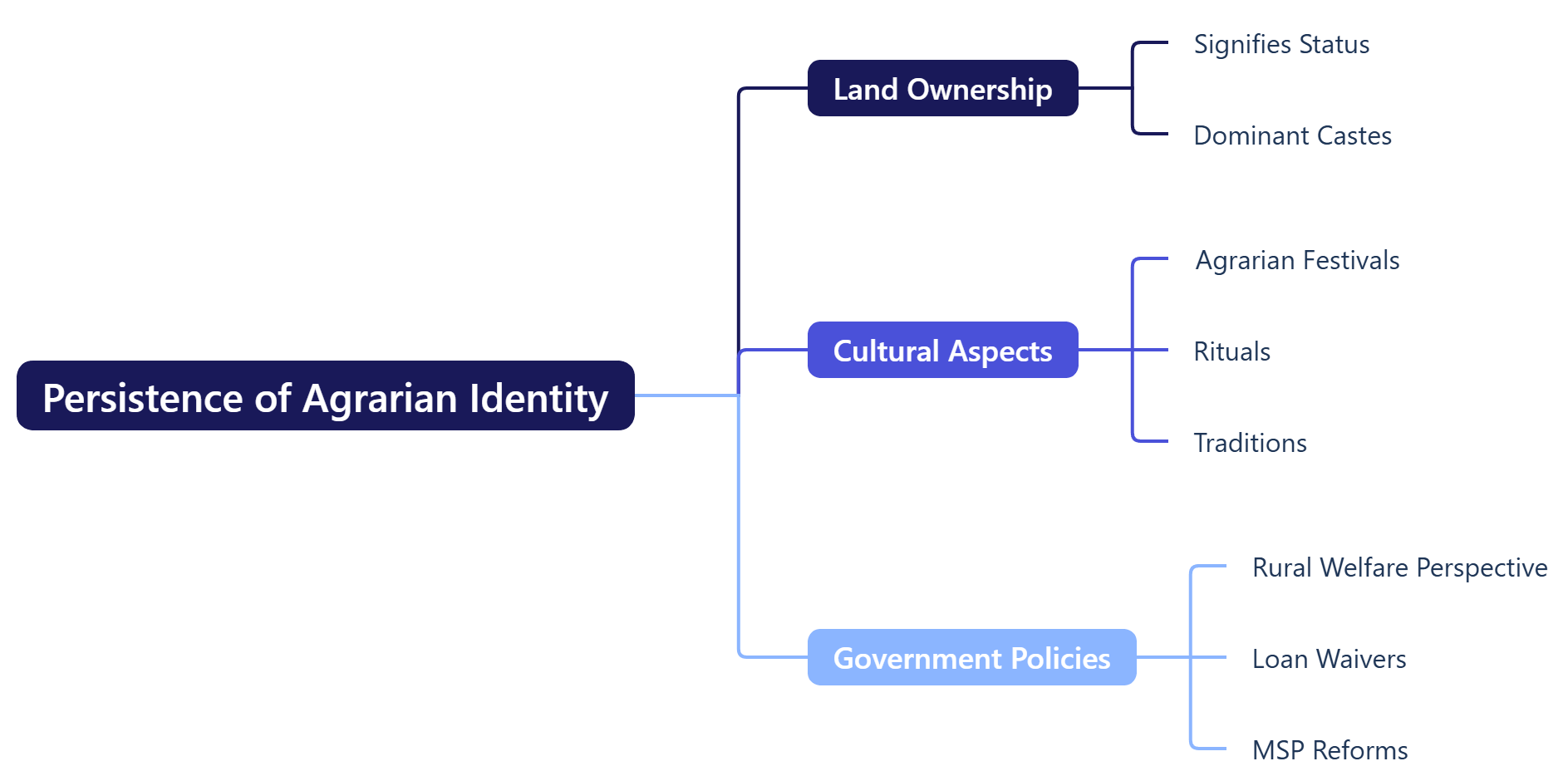
Despite occupational changes, agrarian identity remains symbolically significant:
- Land ownership still signifies status, especially among dominant castes.
- Agrarian festivals, rituals, and traditions continue to define rural life.
- Government policies still view rural India through an agrarian welfare lens, like loan waivers and MSP reforms.
Conclusion:
Rural India is undergoing a silent transformation. While agriculture is no longer the dominant occupation, it remains deeply embedded in social identity, culture, and politics.
A nuanced understanding of rural transformation requires moving beyond simplistic binaries like agrarian/non-agrarian and recognizing the hybrid, fluid nature of rural livelihoods and identities.
PYQs
Paper I
- Distinguish between agrarian and industrial societies. What are the features of agrarian society? (2013)
- What do you understand by the concept of ‘mode of production’? Discuss the impact of change in mode of production on agrarian structure. (2014)
- How is social mobility affected by the agrarian structure in developing societies? (2015)
- Discuss the relevance of Marxian theory of class in the context of rural agrarian society. (2016)
- Critically examine the concept of ‘alienation’ in the context of changing agrarian occupational patterns. (2018)
- How do caste and class intersect in rural occupational structures? Explain with reference to recent transformations. (2019)
Paper II
- Discuss the nature and problems of agrarian class structure in India. (2013)
- What are the main features of the agrarian unrest in India? Discuss recent farmers’ movements. (2015)
- Critically examine the impact of land reforms on rural social structure. (2016)
- How far is it correct to say that rural India is no longer agrarian? Substantiate your answer. (2017)
- Examine how occupational diversification has altered the social fabric of rural India. (2018)
- Explain how migration is reshaping rural social structure and identity in India. (2019)
- Discuss the impact of rural development programmes on rural transformation in India. (2020)
- Examine the changing nature of caste-class relations in rural India with the advent of non-farm employment. (2021)
- How has rural transformation influenced the gender division of labour in Indian villages? (2022)
- What are the consequences of urban influence on rural social structures in India? (2023)
|



One comment