
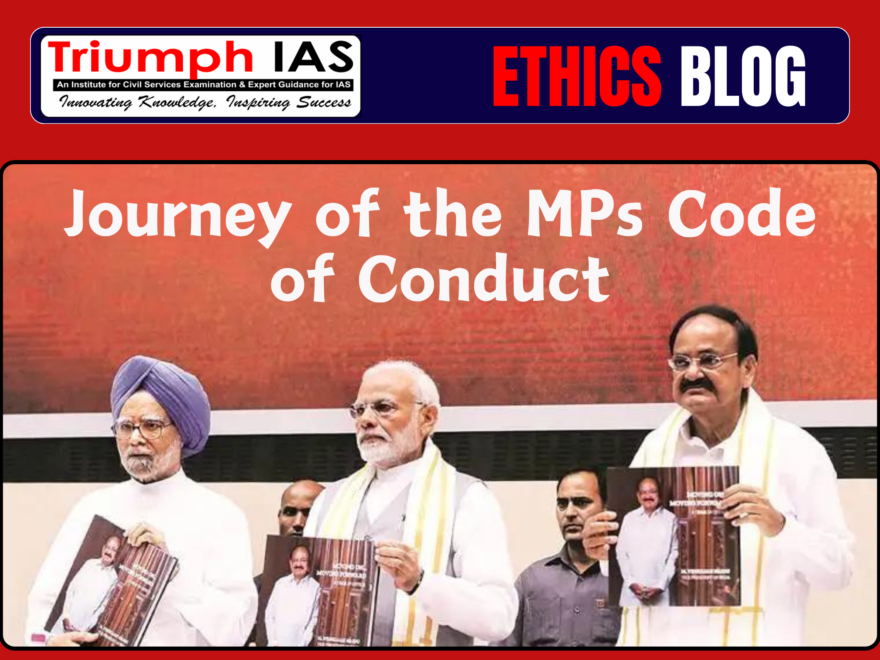

Journey of the MPs Code of Conduct
[Relevant for Public Ethics, Integrity and Aptitude]

Journey of the MPs Code of Conduct
India does not have any code of ethics in any of its wings of State including the selected executive i.e. bureaucracy. Even for elections we have Model Code of Conduct (MCC).
We have certain code of conduct for legislature and here we shall see its evolution and what is the present status of them.
The then Vice President M Venkaiah Naidu in 2018 had called on political parties to “evolve a consensus on a code of conduct for their members, both inside the legislature and out of it”, so that people do not lose faith in political processes and institutions.
A Code of Conduct for members of Rajya Sabha has been in force since 2005.
There is no such code for Lok Sabha. In Lok Sabha however parliamentary committee looks after the code of conduct of its MPs. The late Speaker, G M C Balayogi, constituted an ad hoc Ethics Committee in 2000, which became a permanent part of the House only in 2015.
The beginning
Codes of conduct for high constitutional functionaries and representatives of the people have been discussed for long. A code for Union ministers was adopted in 1964, and state governments were advised to adopt it as well. A conference of Chief Justices in 1999 resolved to adopt a code of conduct for judges of the Supreme Court and High Courts — this 15-point ‘Re-instatement of Values in Judicial Life’ recommended that serving judges should maintain an air of “aloofness” in their official and personal lives. Post that the Malimath Committee, formed in 2000 by the Indian Government, aimed to reform the criminal justice system. Chaired by Justice V.S. Malimath, it reviewed the investigation, trial procedures, and sentencing guidelines. It presented its recommendations in its report titled as the Report of the Committee on Reforms of the Criminal Justice System in 2003. While certain recommendations were implemented, others received criticism for perceived severity or potential infringement on fundamental rights. The committee’s report remains deliberated in India’s legal and policy circles.
In the case of MPs, the first step was the constitution of Parliamentary Standing Committees on Ethics in both Houses. The Committee in Rajya Sabha was inaugurated by Chairman K R Narayanan on May 30, 1997 “to oversee the moral and ethical conduct of the Members and to examine the cases referred to it with reference to ethical and other misconduct of Members”.
Code in Rajya Sabha
The First Report of the Ethics Committee was adopted on December 15, 1999, and its framework was reiterated in subsequent reports of the Committee. The Fourth Report was adopted by Rajya Sabha on April 20, 2005, and a 14-point Code of Conduct for members of the House has been in force since then. These include:
- “…If Members find that there is a conflict between their personal interests and the public trust which they hold, they should resolve such a conflict in a manner that their private interests are subordinated to the duty of their public office”;
- “Members should always see that their private financial interests and those of the members of their immediate family do not come in conflict with the public interest and if any such conflict ever arises, they should try to resolve such a conflict in a manner that the public interest is not jeopardised”; and
- “Members should never expect or accept any fee, remuneration or benefit for a vote given or not given by them on the floor of the House, for introducing a Bill, for moving a resolution or desisting from moving a resolution, putting a question or abstaining from asking a question or participating in the deliberations of the House or a Parliamentary Committee”.
Rule 293 of the Rules of Procedure and Conduct of Business in the Council of States states: “There shall be maintained a ‘Register of Member’s Interests’ in such form as may be determined by the Ethics Committee which shall be available to members for inspection on request.” This is accessible to ordinary citizens under the RTI Act.
Code in Lok Sabha – still not inked-in-law
The first Ethics Committee in Lok Sabha could be constituted only in May 2000, when GMC Balayogi was Speaker. The issue has been raised in every Lok Sabha since then, but has not been taken to its conclusion. The Report of the Ethics Committee — with regard to amendments to the Rules of Procedure and Conduct of Business in Lok Sabha — headed by L K Advani was presented to the Speaker on December 16, 2014, and laid on the table of the House in the winter session of 2014. Its recommendations were included in the report of the Rules Committee of Lok Sabha tabled in Lok Sabha in August 2015. It said that the Ethics Committee] shall “formulate a Code of Conduct for Members and suggest amendments or additions to the Code of Conduct from time to time”. The matter has since been pending with the Ethics Committee and since then the Ethics Committee have been functioning without any prescribed rules. In some cases, this has brought out the whims and fancies of the members of the Ethics Committee as has been witnessed in the most recent TMC MP Mahua Moitra.
While the Ethics Committee headed by Advani recommended that “Any person or member may make a complaint relating to unethical conduct”, the Rules Committee, headed by Speaker Sumitra Mahajan, added the provision that the “if a complaint is made by any person, it shall be forwarded by a member (and)… shall be countersigned by the member forwarding the complaint to the Speaker”.
This provision is different from that in Rajya Sabha, and is similar to the Ethics Committee rules of the US Congress, which says: “Information offered as a complaint by an individual not a Member of the House may be transmitted to the Committee, provided that a Member of the House certifies… that (he) believes the information is submitted in good faith and warrants the… consideration of the Committee.”
Elsewhere
In the UK, a code of conduct for MPs was “prepared pursuant to the Resolution of the House in 1995”.
The Canadian House of Commons has a Conflict of Interest and Ethics Commissioner with powers to examine violations of the Conflict-of-Interest Code at the request of another Member or by Resolution of the House or on his own initiative.
Germany has had a Code of Conduct for members of the Bundestag since 1972;
The US has had a Code since 1968.
Pakistan has a Code of Conduct for members of the Senate.
Code of Conduct for Higher Judiciary
India does not have any specific Codes for its higher judiciary. Whatever is mentioned is very generic and ethically normative based largely on the 1997 Restatement of Values of Judicial Life outlining ethical standards and principles for judges.
Some key points from the Restatement include:
Impartiality: Justice must not only be done but also be seen to be done. Judges’ behaviour should reaffirm people’s faith in the judiciary’s impartiality.
Avoiding Conflicts: Judges should avoid close associations with individual members of the Bar, refrain from hearing cases involving family members who are lawyers, and not enter public debates on political matters.
Financial Benefits: Judges should not seek financial benefits unless clearly available and should not speculate in shares or engage in trade or business.
Public Gaze: Judges must always be conscious that they are under public scrutiny, and their actions should benefit the high office they occupy.
Post-Retirement Assignments for Judges:
While the Indian Constitution doesn’t explicitly prohibit judges from taking up post-retirement assignments, there have been suggestions for implementing a cooling-off period to mitigate potential conflicts of interest.
Former CJI R M Lodha recommended a cooling-off period of at least 2 years.
#EthicsBlogoTerms
Related Blogs …
 |
 |
Follow us :
🔎 https://www.instagram.com/triumphias
🔎 https://www.youtube.com/c/TriumphIAS
🔎 https://t.me/VikashRanjanSociology
Find More Blogs…
| Compare and contrast Karl Marx’s and Max weber’s | Karl Marx- Historical Materialism |
| Position of Women In the Modern Indian Society | Sociology: Social system and pattern variables |
3 comments